|
#
|
Stage
(ESA)
|
Procedure
|
Time
|
Materials
|
Note
|
|
1
|
Organization
moment
|
Teacher:
Good
afternoon dear children! Glad to see you. Today we are going to speak about
environmental problems. We’ll practice our skills in speaking, reading and
listening. I wish you to be calm and to work well.
|
2
min
|
|
|
|
2
|
Engage
|
Look
at the screen, please. Let’s see the first slide - the topic of the lesson
and the second slide - the inscription and try to translate it: "People
will be lost from inability to use forces of the nature and from ignorance of
the true world"-the inscription on a pyramid of Cheops.
|
2
min
|
1-2
slides of the presentation
|
|
|
3
|
Study
|
And
now, let’s speak about nature and environmental problems. But at the
beginning look at the blackboard and read the words which help us understand
the information from the text (see Appendix to the lesson 1)
|
3
min
|
words
|
|
|
4
|
Activate
|
Reading
the text. Using the words. "The Earth’s atmosphere" - see
Attachment to the lesson
|
7
min
|
Text
"The Earth’s atmosphere. ”
|
|
|
5
|
Activate
|
Answer
the questions: What is the ozone layer? How
is it being damaged? What harm does the damage bring to the Earth?
|
5
min
|
|
|
|
6
|
Activate
|
Find
the words in the text: Озоновый
слой; ежедневное использование; рак кожи; ослаблять иммунную систему;
загрязнять слой; разрушать; ультрафиолетовые лучи; озоновая дыра; проникать;
разрушительный
|
3
min
|
|
|
|
7
|
Activate
|
And
now we’ll speak about other environmental problems. Look at the screen
(presentation) Land, air and water are important for the life on the Earth.
But what is happening now? Water is polluted Land is polluted Air is
polluted
|
10
min
|
Presentation
|
|
|
8
|
Activate
|
Now
let’s play a game. Imagine that your neighbor is the alien. An alien has
arrived on our planet, to learn how we live and asks us about our
environmental problems. We are working in groups. These cards will help you
to make the dialogue.
|
7
min
|
Flashcards
|
|
|
9
|
Activate
|
Let’s
make a KWL-chart
|
4
min
|
|
|
|
10
|
Summary
|
You
were great. I like your working today. You were very active. As for your
marks, they are… Stand up please. The lesson is over. Hometask: Monologue
about environmental problems
|
2
min
|
|
|
to the lesson 1
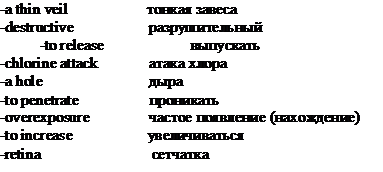
"The Earth’s atmosphere"
High above the Earth’s atmosphere there is
a thin veil called the ozone layer, which protects the earth from the sun’s
destructive ultraviolet (UV) rays.protective layer is being damaged by
chemicals, which are released into the atmosphere by the daily use of
industrial and household product such as refrigerators, air conditioners,
cleaning chemicals, food packing, and etc. the chlorine attacks the ozone
molecules, thinning or even making a "hole” in the ozone layer. This
"hole’ allows more UV rays to penetrate to the Earth.to UV rays can
increase the risk of skin cancer, weaken the immune system, and damage the
retina.only humans are at risk, so are animals, plants, and the environment in
general.
Analysis of the lesson 1
1. The topic of my lesson
was "Environmental problems”
I have set a goal to develop communicative
competence.objectives of the lesson were:dialogue skills,of listening skills
with a support on the read text,of ability to a logic statement of the text,of
speech habits on the situationof ecological thinking and conducting.
I have used visual aids:
presentation PowerPoint, flashcards and communicative techniques of KWL-chart,
dialogues, a game.
2. Type of the lesson -
skill-oriented.
Methods: question -
answer, individual and group - work.material about environmental problems.
3. Structure and procedure of lesson phases were
justified, the transition from one phase to another is carried out in
accordance with the logic.the lesson communicative and productive skills of
speaking were formed, a new vocabulary was introduced and consolidated.
.organizational moment successfully
"switch" for students to learning, the teacher talks to them in a
foreign language.lesson plan directs students to achieve practical and
educational purposes.
. Introducing of new material. Engaging includes
a new material in the form of communication. Visual aids were used in order to
motivate pupils and to introduce material effectively.
. In teaching communication I have used grammar
and vocabulary material. The technique of filling words were used.
. Language material (lexical) corresponded to the
age of students, their interests, level of education. To activate the
linguistic material in the speech of students I suggested a technique of
KWL-chart, a game in order to consolidate new lexical items.
. Lesson corresponds in its structure and
content. The aims and tasks of the lesson were realized.
Lesson 2
Topic: "Welcome to
Australia" Date: 12.10.2011
Aim: to develop communicative competence.
to develop intercultural
competence,develop the pupils speaking, listening, writing skills;revise the
knowledge of the theme "Australia";develop pupils’ motivation.
Equipment of the lesson: slides,
pictures, a map.
|
#
|
Stage
(ESA)
|
Procedure
|
Time
|
Materials
|
Note
|
|
1
|
Organization
moment.
|
Teacher:
Dear boys
and girls! I'm very glad to see you at our lesson today because we have an
unusual lesson - a competition. The class is divided into two teams. They
will show us their knowledge of Australia because our lesson is devoted to
this country. We'll speak about its landmarks, the capital of the country and
some interesting facts. We'll have several tasks at the lesson. I hope our
competition will be fun.
|
1
min
|
|
|
|
2
|
Engage
|
Phonetic
drill "I'm Australia" I'm a child of a dreamtime people,
Part of the land, like an old gum tree. I'm the river softly singing Chanting
our songs on the way to the sea. I awakened here when the earth was new,
There was emu, wombat, kangaroo. No other man of a different hue. I'm the
land and this land is me. I'm Australia!
|
3
min
|
poem
|
|
|
3
|
Activate
|
Teacher:
We'll also have the group of experts. They are English teachers. They will
assess your knowledge. Let's start our competition and introduce our teams to
each other. Students: The name of the first team is "The
Koala". The name of the second team is "The Kangaroo". Teacher:
The first task is the following: answer the questions ab6ut Australia. 1)
What is the capital of Australia? (Canberra) 2) What isapopular Australian
animal? (Koala, Kangaroo, Emu.) 3) Who discovered Australia? (Captain Cook)
4) Who are the Australian natives? (Aborigines) 5) What is the official
language in Australia? (English) 6) In which season do Australians celebrate
Christmas? (in summer) 3. Teacher: The second task is "Spot the
mistake". You will listen to a text about Australia. You know a lot of
facts about this wonderful continent. Now try to spot the mistakes made in
facts about Australia and correct them. Be attentive! The capital of
Australia is Sydney. Australia was discovered by Christopher Columbus.
Canberra is the home of Indian's government and embassies from around the
world. Australia is an Australian - speaking country. New Year is in the
middle of winter. Australia's national landmarks are located in Brisbane.
(The capital of Australia is Canberra. Australia was discovered by Captain
Cook. Canberra is the home of Australia's government and embassies from
around the world. Australia is an English - speaking country. New Year is in
the middle of summer. Australia's national landmarks are located in
Canberra.) rv. Jumbled letters. Write the correct sentences: 1)
million, Australia, eight, has, of, kilometers, an area, it, square, about.
(It has an area of about eight million square kilometers.) 2) birds, a land,
Australia, animals, is, of, other, of the, found, cannot, parts, world, be,
which, and, in. (Australia is a land of birds and animals which cannot be
found in other parts of the world.)
|
25
min
|
|
|
|
4
|
Engage
|
V.
Quiz: Have
you got acquainted with Australia? Teacher: This quiz has ten questions.
There are three answers to each question but only one of them is correct.
I'll give you 5 minutes to do it. 1. Australia is. a) a small country b) the
largest country in the world c) the sixth largest country in the world 2.
Which city is Australia's capital? a) Sydney b) Melbourne c) Canberra 3.
Australia's area is. a) 9.4 million sq. km. b) 8 million sq. km c) 268 700
sq. km 4. Australia's population is. a) 19 million people b) 58 million
people c) 3.5 million people 5. How many states are there in Australia? a) 50
b) 6 c) 10 6. The largest Australian state is. a) Tasmania b) Western
Australia c) New South Wales. 7. The longest Australia's river is. a) the
Murray b) the Darling c) the Murrumbidgee 8. The name of this animal is an
Aboriginal one for "no water" a) kangaroo b) koala c) kookaburra 9.
A domestic animal which outnumbers people in Australia. a) rabbit b) cow c)
sheep 10. When did Europeans settle in Australia? a) 1788 b) 1488 c) 1492 Key:
lc), 2c), 3b), 4a), 5b), 6b), 7b), 8b), 9c), 10a). VI. And
now you have the last task. You are to complete the crossword. 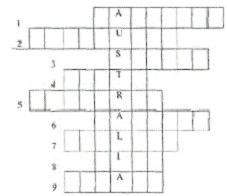 1) What is a popular Australian animal?
2) Which Australian city was its first capital? 3) Australia's oldest and
largest city. 4) Capital of Western Australia. 5) Capital of Australia. 6)
The longest Australia's river is. 7) Which is Australia's official language?
8) Australia is NOT a. 9) Capital of Australian island-state of Tasmania.
Key: /. Kangaroo.2. Melbourne.3. Sydney.4. Perth.5. Canberra.6. Darling.7.
English.8. city.9. Hobart. 1) What is a popular Australian animal?
2) Which Australian city was its first capital? 3) Australia's oldest and
largest city. 4) Capital of Western Australia. 5) Capital of Australia. 6)
The longest Australia's river is. 7) Which is Australia's official language?
8) Australia is NOT a. 9) Capital of Australian island-state of Tasmania.
Key: /. Kangaroo.2. Melbourne.3. Sydney.4. Perth.5. Canberra.6. Darling.7.
English.8. city.9. Hobart.
|
15
min
|
quiz
|
|
|
5
|
Summary
|
Our
lesson is over, Now the group of experts will announce the result of the
competition lesson. Home task.
|
1
min
|
|
|
Analysis of the lesson 2
1. The topic of my lesson
was lesson "Welcome to Australia”
I have set a goal to develop communicative
competence.objectives of the lesson were:
to develop intercultural
competence,develop the pupils speaking, listening, writing skills;revise the
knowledge of the theme "Australia";develop pupils’ motivation.have used
visual aids: slides, pictures, a map and communicative techniques of group work
(competition).
2. Type of the lesson -
mixed (skill and language-oriented). Methods: group work, competition, quiz, poem. Vocabulary
material: about Australia.
3. Structure and procedure of lesson phases were
justified, the transition from one phase to another is carried out in
accordance with the logic.the lesson communicative and productive skills of
speaking were formed, a new vocabulary was introduced and consolidated.
.organizational moment successfully
"switch" for students to learning, the teacher talks to them in a
foreign language. The lesson plan directs students to achieve practical and
educational purposes.
. Introducing of new material. Engaging includes
a poem, a map, a new material in the form of communication. Visual aids were
used in order to motivate pupils and to introduce material effectively.
. In teaching communication I have used grammar
and vocabulary material. The technique of quiz and competition were used.
. Language material (lexical) corresponded to the
age of students, their interests, level of education. To activate the
linguistic material in the speech of students I suggested a technique of quiz,
a competition, a crossword.
. Lesson corresponds in its structure and
content. The aims and tasks of the lesson were realized.
Lesson 3
Theme: Sights of
London Date: 13.11.2011
Aim: to develop
communicative competence.
Form of the lesson: the
excursion.
Objectives:
to develop
intercultural competence,
- to develop
pupils listening, speaking skills,
- to develop
critical thinking.
Equipment of the lesson: cards,
pictures, an album, booklet.
|
#
|
Stage
(ESA)
|
Procedure
|
Time
|
Materials
|
Note
|
|
|
1
|
Organization
moment.
|
-
Good morning, pupils! Who is on duty? Who is absent? Now, pupils, let's begin
our lesson. The theme of our lesson is "Sights of London"
|
1
min
|
|
|
|
2
|
Engage
|
Warm-up.
T: Close your eyes and think of your dream vacation: What kind of places will
you visit? Who will you take with you? Pupils will speak about their dreams:
where they want to go and what they want to see and with whom they want to
go.
|
5
min
|
|
|
|
3
|
Activate
|
Teacher:
There are many ways to get to London. One of them is to get to London by bus.
So, we have an excursion by bus. So, our first stop is Tower of London. P1:
There are many famous ancient buildings within the city. The most striking of
them is St. Paul's Cathedral, sir Christopher Wren's masterpiece. It was
built in 1675-1710 to replace the 13th century cathedral which had
been destroyed by the Great Fire. T: The next a beautiful Gothic building is
Westminster Abbey. P2: Westminster Abbey is a beautiful Gothic building.
Henry III wanted brighter and bigger building. The building of
Westminster Abbey went on until the 18th century. Almost all the
monarchs since William the conqueror have been crowned there. There are
memorials of many statesmen, scientists and writers in Westminster.
Westminster is not a cathedral. It is a royal property. It is dependent
directly on the monarch. T: We shall continue our excursion about London. Do
you want to know who rules the country in Britain? P3: Another place which
can strike you most is Buckingham Palace. It is the residence of the Queen.
It is rather difficult to understand the British way of ruling the country.
In Britain the Queen is the Head of the state, but in fact, she doesn't rule
the country as she has no power. The real power in the country belongs to the
British Parliament and to the British Government. The Queen is a symbol of
the country and its traditions. T: The next is Queen Elizabeth Gate - Hyde
Park. P4: London is also famous for its beautiful parks. Hyde Park is the
most democratic place in the world; because anyone can say anything he likes
there Regent Park is the home of the London zoo. T: Our journey has come to
the end.
|
15
min
|
|
|
|
4
|
Engage
|
T.
Then let’s think and say. III. Ginguaine (critical thinking) l. noun 1
word 2. verb 2 words 3. adjective 3 words 4.1 sentence, 4 words 5. Synonym.
For example: Keys: 1. sights 2. attracts people 3. Interesting, attractive,
beautiful. 4. Beautiful building in London. 5. Places of interest.
|
10
min
|
|
|
|
5
|
Activate
|
T.
Now let’s think about what is ideal country to live. Before beginning our
task I'll divide you into two groups. Each group will have the motto -
proverb. The first group's motto is "East or West Home is Best" The
second group's motto is "There is no place like home" Two groups
tell their monologues about ideal country for living. Then let’s make a test.
Test for two groups. British Customs. Test your knowledge on the
British way of life. Mark the following as true (T) or false (F) 1. Britain
is ruled by a queen. 2. British people don't like to queue. 3. If you say
"please" and "thank you", people will usually help you.
4. Britons like coffee more than tea. 5. Hours of work in offices are 08: 00
to 16: 00. 6. Most Britons speak more than one language. 7. Tennis is the
national sport. 8. British people often talk about the weather. 9. House
decorating and gardening are very popular things to do. 10. Few British
people drink lots of alcohol at weekends. 1 l. You should offer an old person
your seat on bus. 12. British pop music is well known in the world. 13. There
are a great number of cars on British roads. 14. Most working people take 2
hours for lunch.
|
13
min
|
test
|
|
|
6
|
Summary
|
Our
lesson is over. At home compose a test about customs, symbols, places of
interest in Kazakhstan.
|
1
min
|
|
|
|
|
|
|
|
|
|
|
Analysis of the lesson 3
1. The topic of my lesson
was lesson "Sights of London”
I have set a goal to develop communicative
competence.objectives of the lesson were:
- to develop
intercultural competence,
- to develop
pupils listening, speaking skills,
to develop
critical thinking.
I have used visual aids: cards, pictures, an
album, booklet
2. Type of the lesson -
mixed (skill and language-oriented).
Methods: group work,
excursion.material: about London.
3. Structure and procedure of lesson phases were
justified, the transition from one phase to another is carried out in
accordance with the logic.the lesson communicative and productive skills of
speaking were formed, a new vocabulary was introduced and consolidated.
.organizational moment successfully
"switch" for students to learning, the teacher talks to them in a
foreign language.lesson plan directs students to achieve practical and
educational purposes.
. Introducing of new material. Engaging includes
a critical thinking, new material in the form of excursion. Visual aids were
used in order to motivate pupils and to introduce material effectively.
. In teaching communication I have used grammar
and vocabulary material. The technique of testing was used.
. Language material (lexical) corresponded to the
age of students, their interests, level of education. To activate the
linguistic material in the speech of students I suggested a technique of
excursion, group work.
. Lesson corresponds in its structure and
content. The aims and tasks of the lesson were realized.
Lesson 4
Theme: Land of
English Date: 17.11.2011
Aim: to develop
communicative competence.
Form of the lesson: games,
drama, the competition.
Objectives:
to develop
intercultural competence,
- to develop
students' skills in dialogues, poems, acting in drama;
to develop the
students' speaking, listening and writing skills,
to evoke
interests in the English songs and fairy tales.
Equipment of the lesson: slides,
cards, pictures, decorations.
|
#
|
Stage
(ESA)
|
Procedure
|
Time
|
Materials
|
Note
|
|
1
|
Organization
moment.
|
-
Good morning, pupils! Who is on duty? Who is absent? Now, pupils, let's begin
our lesson. The theme of our lesson is "Land of English"
|
1
min
|
|
|
|
2
|
Engage
|
Warm-up.
I. Warming up: Teacher: Welcome to the land of English. Today we have
invited the guests. We hope you will enjoy the English songs, rhymes and
dramas we are going to present in our "Land of English". P1: My
name is. P2: My name is. And we shall assist you to go through the
land of English. I will ask you to solve puzzles and you will be able to say
what songs, rhymes or dramas are used in our Land of English. P1: I
am made up of trees and many animals live in me. ' What am I? PP: Is it
forest? P1: Yes, of course, you are right (children attach a picture
of a forest to the board). P2: And I have the following puzzle for
you: I am a small girl who lived in a mining town. I have got a splinter in
my foot. Who am I? PP: Clementine.
|
15
min
|
|
|
|
3
|
Activate
|
P2:
Of course
you are right, let's listen to the song "Clementine" performed by
one of the pupils. In a canyon in a cavern Excavating for a mine Dwelt a
miner forty niner And his daughter Clementine Oh, my darling, oh my darling
Clementine. Though art lost and gone forever Dreadful sorry, Clementine.
Light she was and like a fairy And her shoes were number nine Herring boxes
without topses Sandals were for Clementine. Drove she duckling to the water
Every morning just at nine Straight her foot against splinter Fell into the
foaming brine. P1: I am a large plant that has many
"fingers" called leaves. Birds make their homes on me. What am I?
PP: That is a tree. P1: Right you are, and here it is. (children
attach the trees around the forest). P2: So the following puzzle is connected
with animals. I am a large brown animal that lives in the forest and sleeps
all winter long. What am I? PP: Bear. P2: Of course it is a bear.
Let's listen to one of the pupils and her rhyme about little bears. Once two
little brown bears Found a pea-tree full of pears But they could not climb up
there For the trunk was smooth and bare. "If I only had a chair",
Said the elder brown bear, "I would get the biggest pear That is hanging
in the air". "If you do not soil my hair", Said the younger
little bear, "I will serve you as a chair And you can get the biggest
pear". P1: Thank you, I have only one more puzzle left. People
eat and sleep in me. They make me warm in the winter so they can keep warm.
What am I? PP: It's home. P1: All of us have homes and houses, (pupils attach
a house of a grandmother). P2: Let's guess what a very famous ship
sank in the 1900s. A famous movie was made about it. What is it? PP: The
Titanic. P2: You are right. Two girls will sing a song from the movie
"Titanic". "My heart will go on". P1: Thank you
very much.1 have one more puzzle and I want you to solve it. I am a beautiful
and delicate plant that comes out in the spring. What am 1? Pupils: Flower,
(children throw the flowers on the floor). P2: And I have one last
puzzle: It is a little girl, who has red clothes and she always helps her
mother and grandmother. Who is she? PP: It's Red Riding Hood! Isn't it
so? P2: Yes, you are right. Here you can see a scene from "Red Riding
Hood".
|
28
min
|
song
|
|
|
4
|
Summary
|
Our
lesson is over. We assisted you during our travel to the "Land of
English". Thank you and good bye! Conclusion. Giving awards. Home task.
|
1
min
|
|
|
Analysis of the lesson 4
1. The topic of my lesson
was lesson "Land of English”
I have set a goal to develop communicative
competence.objectives of the lesson were:
- to develop
intercultural competence,
- to develop
students' skills in dialogues, poems, acting in drama;
to develop the
students' speaking, listening and writing skills,
to evoke
interests in the English songs and fairy tales.
I have used visual aids: cards, pictures,
decorations.
2. Type of the lesson -
mixed (skill and language-oriented).
Methods: games, drama,
the competition.material: about London.
3. Structure and procedure of lesson phases were
justified, the transition from one phase to another is carried out in
accordance with the logic.the lesson communicative and productive skills of
speaking were formed, a new vocabulary was introduced and consolidated.
.organizational moment successfully
"switch" for students to learning, the teacher talks to them in a
foreign language.lesson plan directs students to achieve practical and
educational purposes.
. Introducing of new material. Engaging includes
a poem. Visual aids were used in order to motivate pupils and to introduce
material effectively.
. In teaching communication I have used grammar
and vocabulary material. The technique of dialogue was used.
. Language material (lexical) corresponded to the
age of students, their interests, level of education. To activate the
linguistic material in the speech of students I suggested a technique of
dramatization.
. Lesson corresponds in its structure and
content. The aims and tasks of the lesson were realized.
Lesson 5
Theme: It’s a
wonderful world of English
Aim: to develop
communicative competence.
Form of the lesson: brainstorm,
competition, contest.
Objectives:
to develop
intercultural competence,
- to enrich
students' knowledge about British and American history;
to develop
communicative skills;
Equipment of the lesson: slides,
cards, pictures, decorations.
|
#
|
Stage
(ESA)
|
Procedure
|
Time
|
Materials
|
Note
|
|
1
|
Organization
moment.
|
-
Good morning, students. I am glad to see you! Today we have an unusual
lesson. We shall have a competition. Two teams will take part in our
competition. At the lesson you will answer the questions, make up sentences
of the given words and find the rhyming twins. I hope the lesson will be
interesting for you and you will enjoy it. Let me introduce our teams and our
jury. There are two teams here today. Well, teams, you have some time to
choose the captain and decide how to present your team. The first team is
called. and its captain is. The second one is called., and its captain is.
The members of our jury are:. Now listen to the rules of our competition. Our
competition consists of six rounds.
|
2
min
|
|
|
|
2
|
Activate
|
Competition
The first round is "Brainstorming". We have questions to our
captains. Each captain is given six questions. Конкурс
капитанов. The task is to answer the
questions. Listen
carefully. Вопросы первому капитану: 1. Who discovered America?
(Columbus) 2. What is the national symbol of America? (The bald eagle) 3. Who
was the first man on the moon? (N. Armstrong) 4. Who lives in Buckingham
Palace? (The Queen) 5. Who can you see on the top of the column on Trafalgar
Square in London? (Admiral Nelson) 6. What country gave the Statue of Liberty
to the USA? (France) Вопросы второму капитану: 1. What is the capital of the U. S. A?
(Washington D. C.) 2. What money is used in the USA? (Dollar) 3. What's the
color of double-deckers in London? (Red) 4. What is the name of the Queen of
England? (Elizabeth II) 5. How do people call the flag of Great Britain?
(Union Jack) 6. What was the famous tradition of Native Americans? (Smoking
of a peace pipe)
|
10
min
|
|
|
|
3
|
Activate
|
The
second round Contest of proverbs The next round is to find the same Russian and Kazakh
proverbs. The teacher gives cards with English proverbs and idioms; you try
to find the equivalent in Russian in Kazakh. Better late than never, My home
is my castle, Live and learn, All's well that ends well, As hungry as a
hunter, A friend in need is a friend indeed, Business before pleasure делу, Tastes differ, There is no place like
home. The 3rd round is "The best erudite". Answer the
questions using your knowledge. Quiz: "Do you know Britain?"
1. What are the colours of the British flag? a) Blue, red and white b) blue
and red c) blue and white 2. How many pence are there in one pound? a) 100 b)
90 c) 10 3. What do the English often put in their tea? a) jam b) milk c)
lemon 4. Which holiday is on December 25? a) St. Valentine's Day b) Easter c)
Christmas 5. Where can you always see ravens in London? a) Near the Thames b)
near the Houses of Parliament с)
near the Tower of London 6. In what city were the famous "Beatles"
born? a) London b) Glasgow c) Liverpool Quiz "Do you know the
USA?" 1. How many states are there in the USA? a) 50 b) 52 c) 49 2. Who
was the first President of the USA? a) George Washington b) Abraham Lincoln
c) John Kennedy 3. What is the biggest state in the USA? a) Texas b) Alaska
c) California 4. What city is the Statue of Liberty in? a) Miami b)
Washington D. C. c) New York 5. What American holiday is on the fourth of
July? a) Halloween b) Independence Day c) Thanksgiving Day 6. What is a very
famous amusement park near Los Angeles? a) Marine World b) Malibu c)
Disneyland
|
15
min
|
|
|
|
|
The
4th round is to make compound words. The task is to make up one word out of
two. You have 30 seconds for thinking. Grand work Milk port Foot noon
Down side Sports son Sea stairs After ball Time table Home ground Air man
|
3
min
|
|
|
|
|
The
5th round is to find the rhyming twins. You have limited time for this task. Fast tree Peg bought Silk egg
Parrot foot Could fish Eat milk Thought meat Dish carrot Street last See
sweet
|
3
min
|
3
min
|
|
|
|
4
|
Summary
|
Conclusion.
That's all
for today. You were active. Thank you for your work. The lesson is over. I
hope you liked our lesson. Both teams were good. But the team. is the winner.
Let's congratulate them. Home task. Good-bye, everybody!
|
1
min
|
|
|
Lesson 6
Theme:
"Describing places and directions" Date: 25.11.2011
Aim: to develop
communicative competence.
Form of the lesson: game,
interactive.
Objectives:
to form
intercultural competence, to revise knowledge of the theme,
- to enrich the
pupils' knowledge of new words,
to improve
pronunciation,
to teach the
pupils to share their opinions.
Equipment of the lesson: pictures,
cards, computers.
|
#
|
Stage
(ESA)
|
Procedure
|
Time
|
Materials
|
Note
|
|
1
|
Organization
moment.
|
-
Good morning, pupils! Who is on duty? Who is absent? Now, pupils, let's begin
our lesson. The theme of our lesson is "Describing places and
directions"
|
1
min
|
|
|
|
2
|
Engage
|
Phonetic
drill. "Pussy-cat"
Pussy-cat, pussy-cat, where have you been? I've been to London to look at the
Queen. Pussy-cat, pussy-cat, what did you do there? I frightened a little
mouse under a chair.
|
5
min
|
|
|
|
3
|
Engage
|
Checking
- up the homework. To write the topic about "Places of interest". Pre-reading
task. Have you been to Astana? Have you been to Almaty? Have you been to
Korkyt-Ata monument? Have you seen Korkyt Ata monument's museum? And what do
you like?
|
7
min
|
|
|
|
4
|
Study
|
New
theme: Work
with electronic books. 1. Text (a) Astana The capital of Kazakhstan is
Astana City with the population of 290.000 persons. The area of Astana is
710.2 square kilometers. Places of interest: The monument "Astana -
Baiterek", "Duman" centre, circus, central mosque "Nur -
Astana", "Cinema city", "Arsenal" cinema, Palace of
Peace and Harmony. Astana is a young, modern, and beautiful city. Text (b) London
London is one of the largest cities in the world. About seven million people
live there. London is more than two thousand years old. London's most famous
sights are Tower Bridge, Big Ben and the Houses of Parliament, Trafalgar
Square and St. Paul's Cathedral. You can see all these places and much more
of London from a red double-decker.
|
12
min
|
|
|
|
5
|
Activate
|
Game:
"Goldfish". (There are 5 cards, 4 cards with questions and one
of them is a gold fish). a) 1. What can you say about the population of
London? 2. Find the places to relax. b) 1. What can you say about the
population of Astana? 2. Find the places to relax. 4.complete the sentences:
London's most famous sights are. (Towerbridge, Big Ben, Houses of Parliament,
Trafalgar square, St. Paul's Cathedral). Places of interest of Astana: (The
monument "Astana-Baiterek", "Duman" centre, circus central
mosque "Nur-Astana", "Cinema city", "Arsenal"
cinema, Palace of Peace and Harmony). 5. Vocabulary work Find the odd word in
the group a) book, crowded, beautiful b) ancient, castle, a carpet c)
country, museum, sofa. d) Fridge, city, region
|
10
min
|
|
|
|
6
|
Activate
|
Consolidation of the lesson.
a) What kind of adjectives do you know about describing places? Write 5
adjectives in your note-book. b) Talk to your partner about a good place for
a holiday. Example: I think a historic city is a good place for a holiday. с) Compare Astana and London.complete the
Venn diagram 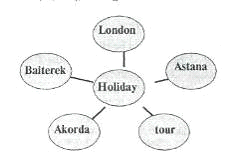
|
9
min
|
|
|
|
7
|
Summary
|
Conclusion.
That's all
for today. You were active. Thank you for your work. I hope you liked our
lesson. The lesson is over. Home task. Good-bye, everybody!
|
1
min
|
|
|
7
Theme: "Almaty
and its nature reserves" Date: 9.12.2011
Aim: to develop
communicative competence.
Form of the lesson: interactive,
test
Objectives:
to form
intercultural competence,
- tо make the students be
able to guess the riddle, to understand the text for listening,
to develop
communicative skills,
to encourage
students' interest to the history and geography of Kazakhstan.
Equipment of the lesson: Interactive
board, slides' presentation of Almaty sightseeing and nature reserves.
|
#
|
Stage
(ESA)
|
Procedure
|
Time
|
Materials
|
Note
|
|
1
|
Organization
moment.
|
-
Good morning, pupils! Who
is on duty? Who is absent? Now, pupils,
let's begin our lesson. The theme of our lesson is "Almaty and its
nature reserves"
|
1
min
|
|
|
|
2
|
Engage
|
Warm
up (is
held by PCV) A L M A T Y M is at the middle A is used twice L is between A
and M T is between the second A and Y Y is at the end. Brainstorming
activity. 1. Why is Almaty an unusual city? 2. What sights of Almaty do
you know? 3. What museums are located in Almaty? 4. The nature of Almaty is
very picturesque, isn't it? 5. What nature reserves do you know?
|
7
min
|
|
|
|
3
|
Engage
|
Teacher's
introductory words: The city Almaty has got a unique history. And I hope that some
facts about the history of the city enlarge your general scope and encourage
your interest's development to the history of your Motherland as well. That's
why I want you to listen to a brief story about it. But before listening to a
story pay attention to the helpful words. Presentation 1. Pre-Listening
activity (Vocabulary for help is given on the interactive board, PCV
introduces them) 1. Turkic and Mongolian nomads-тюркские и монгольские кочевники 2. fortify - военное укрепление 3. announce - объявлять 4. admit - принимать, допускать 5. wind round - обвивать 6. fortress - крепость
|
11
min
|
|
|
|
4
|
Study
|
Listening
activity. (PCVreads the text)"A brief story about the history of
Almaty" The first settlement of Turkic and Mongolian nomads was found in
1854 and called Almaty. A little later the fortify Zailiyskoye was founded in
that place. Then the fortress was renamed into Vernoye and existed from 1867
till 1921. In the middle of the 19! h century many Russian
settlers arrived to Verny. The fortress grew in its size and developed
quickly thanks to migration. The town Verny was announced to be the centre of
Seven Rivers region and the emblem was admitted on the 11th of
April in 1867. The town emblem represents a sword winded round with apple
branches. It is divided into 3 parts. The fortress is shown at the top, the
cross is on the left and the half-moon is on the right. In 1921 the town
Verny was renamed into Almaty.
|
15
min
|
|
|
|
5
|
Activate
|
Post
- Listening activity.comprehension Check. (The teacher asks questions) 1.
How was the first settlement called? 2. When did the fortress develop
quickly? 3. When did Verny become the centre of Seven Rivers region? 4. When
was Verny renamed in Almaty?
|
5
min
|
|
|
|
6
|
Engage
|
Slides'
Demonstration (The teacher invites the students to make an excursion over
Almaty and see its sightseeing and nature surrounding) Slides about Almaty
|
|
|
|
|
7
|
Activate
|
IV.
Independent Practice (PCV gives the students tests to summarize the students'
knowledge of the theme) Test about Almaty (The teacher shows the correct
answers on the interactive board, students exchange their papers, compare the
results with key and put the marks)
|
5
min
|
|
|
|
7
|
Summary
|
T:
Today we reviewed everything what you had learned before. So your home task
is to prepare a project or a poster of any Almaty sight and to prove that it
is the best place to visit. The lesson is over. Good-bye, everybody!
|
1
min
|
|
|
Lesson 8
Theme: "Great
Britain and Kazakhstan" 13.12.2011
Aim: to develop
communicative competence.
Form of the lesson: interactive,
consolidation
Objectives:
to form
intercultural competence,
- to master new
lexics and its use in speech,
to revise
already studied material on the theme "Geography",
to develop
students skills in monologue (dialogue) speech through asking (answering)
questions, making up of different conversations.
Equipment of the lesson: cards,
posters, pictures on the theme "Kazakhstan", "Great
Britain", interactive board.
|
#
|
Stage
(ESA)
|
Procedure
|
Time
|
Materials
|
Note
|
|
1
|
Organization
moment.
|
-
Good morning, pupils! Who is on duty? Who is absent? Now, pupils, let's begin
our lesson. The theme of our lesson is "Great Britain and
Kazakhstan"
|
1
min
|
|
|
|
2
|
Engage
|
Phonetic
and speech drill. New words and transcription Central Asia, Caspian Sea, Siberia,
Altai Mountains, situated, etc.
|
5
min
|
|
|
|
3
|
Engage
|
Reading.
Today we'll
work in groups. The first team is "Kazakhstan". The second team is
"the UK". Each group must read the text and give the translation,
do the tasks. 1st group: Kazakhstan 2nd group: Great Britain
|
8
min
|
|
|
|
4
|
Activate
|
Post-reading - true and false
questions. (see
Appendix 1 to the lesson)
|
5
min
|
|
|
|
5
|
Activate
|
Finish
sentences (see Appendix 2 to the lesson)
|
5
min
|
|
|
|
6
|
Activate
|
Complete
the sentence. 1.
The Republic of Kazakhstan is____in the Central Asia. 2. Its population
is_______. 3. Kazakh is the_______of the country. 4. The flora and
fauna_____on the climate of the area. 5. Rain usually______in spring and
autumn. 6. The area of the UK is some_______square kilometers. 7. The
population of Great Britain is over_______. 8. Coal and oil are the most
natural____of Great Britain. 9. The Gulf Stream____the English climate
greatly. 10. _____takes an important sector in the economy of the country. We'll
consolidate our lesson with a competitions between two teams. Questions for
team "The UK". 1. What's the foil name of the country of your
opponents? (The Republic of Kazakhstan). 2. What's the capital
of Kazakhstan? (Astana) 3. How many regions in are there in
Kazakhstan? (14regions) 4. What are countries are border Kazakhstan? (China,
Russia, Turkmenistan, Uzbekistan, Kirgizia) 5. Who is the head of
Kazakhstan? (Nazarbaev N. A) Questions for team
"Kazakhstan". 1. What's the foil name of the country of your
opponents? (The United Kingdom of Great Britain and Northern Ireland) 2.
What's the capital of the UK? (London) 3. Where is the UK situated? (in
Europe) 4. How many countries are there in in the UK? (4countries) 5. Who
is the formal head of the UK9 (Queen Elizabeth If)
|
20
min
|
|
|
|
7
|
Summary
|
Conclusion.
That's all
for today. You were active. Thank you for your work. I hope you liked our
lesson.
|
1
min
|
|
|
Appendix 1 to the lesson. Post-reading -
true and false questions.
|
Statements
|
T
|
F
|
|
1.
The UK is washed by the Atlantic Ocean. 2. Edinburgh - is the capital of
Wales. 3. The two main islands are Great Britain and Ireland. 4. The UK
consists of four parts. 5. There are some 5500 islands. 6. Great Britain is
rich in natural resources. 7. Kazakhstan is situated in the Central Asia. 8.
Its population is about 18 million. 9. The largest cities are Almaty,
Karaganda, Pavlodar and Astana.10. The climate of the country is mild. 11.
Astana is the capital of the Republic. 12. Kazakhstan borders China, Russia,
Turkmenistan, Uzbekistan and Kirgizia.
|
|
|
2 to the lessonfinish the
sentence.
Group 1
|
The
United Kingdom of Great Britain and Northern Ireland.
|
. it
is composed of some 5500 islands, large and small.
|
|
The
UK is one of the world's smaller countries.
|
. is
the official name of the state.
|
|
The
UK is an island state.
|
.
the English Channel and Strait of Dover.
|
|
The
United Kingdom of Great Britain and Northern Ireland.
|
. it
is twice smaller than France and Spain.
|
|
The
UK is separated from the European continent by.
|
. is
washed by the Atlantic Ocean.
|
|
Group
2
|
|
The
Republic of Kazakhstan is situated.
|
. national flag and anthem.
|
|
There
is a long border coast line.
|
. in the Central Asia.
|
|
Kazakhstan
has its own.
|
. of
water in the country.
|
|
The
four rivers are the main resources.
|
.
the Caspian sea in the Southwest.
|
|
Kazakhstan
borders.
|
China,
Russia, Turkmenistan, Uzbekistan and Kirgizia.
|
Lesson 9
Theme: "Life
in Great Britain and Kazakhstan" 17.12.2011
Aim: to develop
communicative competence.
Form of the lesson: role play,
consolidation
Objectives:
to develop
intercultural competence,
- to enrich
pupils' knowledge about life in Britain and in Kazakhstan,
to review the
new words
to develop
pupils' speaking, reading and writing skills,
to develop
pupils' abilities in reading for understanding,
to enlarge
pupils' interest in learning the foreign language.
Equipment of the lesson: interactive
board, a tape-recorder, a table.
|
#
|
Stage
(ESA)
|
Procedure
|
Time
|
Materials
|
Note
|
|
1
|
Organization
moment.
|
-
Good morning, pupils! Who is on duty? Who is absent? Now, pupils, let's begin
our lesson. The theme of our lesson is "Life in Great Britain and
Kazakhstan"
|
1
min
|
|
|
|
2
|
Engage
|
Warm-up:
T: What season is it now? P: It is winter now. T: Do you like winter? P: Yes,
I like winter. T: Please pay attention to the activeboard. It is winter. It
is so beautiful. It is white. The weather is so cold, but the air is clear
and fresh. Do you like it? Please describe this picture, (one of the
students) T: Look at the activeboard again. You see a poem. I will read it
and you must listen attentively. After me you will read as you can. Get to
know the laws of life, Let your soul be full of Ugh t. One of you could be a
poet, One will take a science road, You will serve for motherland Spreading
love for all. Айналайын
дарын бол, Сонбейтурын жалын бол. К, атардан ащан ак,ын бол,. Не болмаса
ралым бол, Халцыц уш'ш к^ызмет к,ыл, Тэмэм журтца мэл'ш бол.
|
7
min
|
|
|
|
3
|
Engage
|
Introduction
of the new material. T: I will divide you into 2 groups: group A and group B.
You will compete today in showing how well you know English. Good luck to
you! The theme of the lesson: "Life in Britain and in Kazakhstan".
T: At first let's review the new words. Pay attention to the active board.
One hour a day, three times a week, weekend, bowling, burger, restaurant,
cereal, every day, go cycling, go to the cinema, meal, orange juice, pasta,
quiz show, toast, vegetables, walk. T: Now let's review Present Simple
grammar material. Look at the activeboard. Here you see the verbs: Make -
makes Write - writes Take - takes Read - reads, etc
|
6
min
|
|
|
|
4
|
Activate
|
Listen
and answer the questions. My name is John and I'm from Britain. I watch TV
for an hour and a half every day. My favourite program is "Dancing with
the stars". I also like cartoons. I don't like sports programs. I don't
have a big breakfast. I just have orange juice and cereal. My favorite food
is spaghetti and vegetable soup. I don't like fish or hot dogs. My favourite
sport is volleyball and I also like running and swimming. I don't like
football, at the weekend I meet my friends and we go cycling or swimming. 1)
How long does John watch TV? (About an hour and a half.) 2) What is his favourite
program? ("Dancing with the stars".) 3) Does he like sports
programs? (No, he doesn't.) 4) What is his favourite food? (Spaghetti and
vegetable soup.) 5) What is his favourite sport? (Volleyball.) 6) What does
John do at the weekend? (He goes cycling or swimming with her friends.)
|
15
min
|
|
|
|
5
|
Activate
|
Speaking.
Ask and answer these questions. Write notes. Don't show them to your
classmate. 1) One hour a day. 2) My favorite TV program is music (cartoons,
etc.). 3) I have bread, tea and a cup of milk. 4) My favorite food is pizza,
hamburgers. 5) My favorite sport is football. 6) I play volleyball (I go
swimming, etc.). 7) I play computer games (I go to the cinema, etc.). 4.
Writing. a) Think about someone you know - your brother, sister, best friend,
etc. Make notes under these headings: (see Appendix to the lesson)
|
7
min
|
|
|
|
6
|
Activate
|
5. Look at the activeboard.
Here you see a text about Peter. What must you do? At first you will read,
then write your own sentences like this. But be careful! Here you must write
about your family, for example, your brother or sister, your friend. Peter watches
TV for 2 hours a day. His favorite TV program is Teen Titans. His favorite
food is pizza and his favorite sport is basketball. He goes swimming. At the
weekend he plays with his friends in the park and goes to the cinema. He
likes bowling but he doesn't like walking in the country. "Fun sport.
" T: Guess the sport. Match the sports to the pictures. 1 -
Skateboarding; 2 - Bowling; 3 - Volleyball; 4 - Swimming; 5 - Tennis; 6 -
Cycling; 7 - Football; 8 - Basketball; 9 - Running. 10 Homework.
|
8
min
|
|
|
|
7
|
Summary
|
Conclusion.
That's all
for today. You were active. Thank you for your work. I hope you liked our
lesson. The lesson is over. Home task…
|
1
min
|
|
|
Appendix to the lesson
|
Television
|
Food
|
Sport
|
At
the weekend
|
|
2
hours
|
pizza
|
basketball
|
Play
with the friend
|
|
comedy
|
beshbarmak
|
|
Go
to the cinema
|
Lesson 10
Theme:
"Christmas" and "New Year” 24.12.2011
Aim: to develop
communicative competence.
Form of the lesson: game,
holiday
Objectives:
to form
intercultural competence,
- to master new
lexics and its use in speech
Equipment of the lesson: cards with
songs, tape-recorder, pictures
|
#
|
Stage
(ESA)
|
Procedure
|
Time
|
Materials
|
Note
|
|
1
|
Organization
moment.
|
-
Good morning, pupils! Who is on duty? Who is absent? Now, pupils, let's begin
our lesson. The theme of our lesson is "Christmas" and "New
Year”
|
1
min
|
|
|
|
2
|
Engage
|
-
Hello, my dear friends! There are many holidays in our country and
English-speaking countries. But the holidays we like most of all are New
year's Day and Christmas Day. People prepare for these holidays beforehand:
they send greeting cards, buy presents, make fancy dresses and decorate their
houses. And when the holiday comes they congratulate each other singing songs
and reciting the poems. Now we can see what holidays about Christmas and New
Year you have learned.
|
3
min
|
|
|
|
3
|
Engage
|
Football
is a national British game. In Great Britain people who are fond of sport
like to play football on New Year's Day and Christmas Day. Now we shall play
football at our gymnasia. We have two teams today. I hope you are ready to
start. At first we shall sing a song "Jingle, Bells" and then we
shall start to play football.
|
8
min
|
|
|
|
4
|
Activate
|
There
are 11 players in a football team. So each team has 1 goal-keeper, 4 backs, 4
half-backs, and 2 forwards. Now the pupils will have their tasks and in 5 minutes
we shall start the game. Put the missed words in the text: Another,
presents, coloured, important, consists, called, breakfast, cheaply, snowy,
eat, a lot of, holiday. Text - see the Appendix to the lesson
|
10
min
|
|
|
|
5
|
Activate
|
Write
the end of the story. It was the 31st of December. The weather was fine.
Everybody was preparing for the New year's Day.
|
11
min
|
|
|
|
6
|
Activate
|
Write
as many words as you can on the topics "New Year's Day" and
"Christmas Day". Tree, Santa Claus, December, winter, presents, poems, socks,
fireplace, cards, games, snow, sweets, decorate, songs, church, Father Frost,
Music, holly, snowman, deer, turkey, bells, pudding. Draw a funny snowman
|
11
min
|
|
|
|
7
|
Summary
|
Conclusion.
The lesson is over. Home task… I wish you a merry Christmas and a happy New
Year! Let us sing a song "We Wish You a Merry Christmas".
|
1
min
|
|
|
Appendix to the lesson
Songs and poems about Christmas:
Father Frost or Santa
Claus, please, this way!Hare, with your paws come to play!are pretty
decorations in the hall.have sent the invitations to you all., please, your
mask or cloak with joy.'ll dance and sing, and joke to enjoy.Claus likes to be
present at the ball.gives his gifts and presents to us all.the time we are
having fun - there is no pause.here everyone and Santa Claus!, Merry Christmas
Is likely to come., Merry Christmas, You are welcome!in the window, Much
confetti.blue, red and yellow Lights on the tree.eyes and faces, Sweet music in
the hall.think someone places Happiness here for all., Merry Christmas Is
likely to come., Merry Christmas You are welcome!
Christmas DayDay is a
public (1). Families usually spend the day opening their (2). which are often
under the Christmas tree decorated with (3). toys. The most (4). meal is
Christmas dinner. The typical meal (5). of turkey with potatoes and other
vegetables. (6). traditional food in Britain is Christmas cake.make special
biscuits called Christmas cookies which they (7). over the Christmas season.Britain,
the day after Christmas is (8). Boxing Day and is also a public holiday. (9).
sports take place on Boxing Day. In the US there are many special sales, where
things can be bought (10)., on the day after Christmas.:
1 - holiday; 2 -
presents; 3 - coloured: 4 - important; 5 - consists; 6 - another; 7 - eat; 8 -
called; 9 - a lot of; 10 - cheaply.
Conclusion
The goal of the diploma work is reached, the
hypothesis is proved.
Communicative Language
Teaching is best considered an approach rather than a method. It has been
developed in the 1960s as a replacement to the earlier structural method,
called "Situational Language Teaching”.Language Teaching was no longer
felt to reflect a methodology appropriate for the seventies and beyond. CLT
appealed to those who sought a more humanistic approach to teaching, one in
which the interactive processes of communication received priority. The rapid
adoption and implementation of the communicative approach also resulted from
the fact that it received the sanction and support of leading British applied
linguists, language specialists, publishers, as well as institutions, such as
the British Council.features of CLT is the emphasis on learning to communicate
through interaction in the target language, the introduction of authentic texts
into the learning situation, etc.main aim of CLT is developing communicative
competence, which includes
linguistic, sociolinguistic, discourse and
strategic competence.research has shown that CLT methods techniques are as
follows: pair and group work, project work, debates, brainstorming, jigsaw,
games, role play, etc.has shown that all these methods and techniques promote
students’ learning and academic achievement, increase students’ retention,
enhance students’ satisfaction with their learning experience, help students
develop skills in oral communication, develop students' social skills, promote
student self-esteem, help to promote positive intercultural relations.these
techniques involve students in the learning process and are based on the
intercourse between objects of interaction.plays are modeling various
situations for the educational aims of developing speaking abilities. They
reflect a principle of problematical character at its certain organization and
allow solving problem situations of a various degree of complexity. Debates allow
forming the conscious attitude to consideration of problems, activity in its
discussion, speech culture, an orientation on revealing of the reasons of
arising problems and installation on their decision further. Here the principle
of formation of critical thinking is realized.educational games are highly
motivating and entertaining, they can give shy students more opportunity to
express their opinions and feelings. They also enable learners to acquire new
experiences within a foreign language which are not always possible during a
typical lesson. Project is a set of educational and cognitive modes which allow
solve the problem as a result of independent actions of pupils with obligatory
presentation of results. In a project work students are put in the centre of
the interaction, where they use the language and practice communicative speech.
Jigsaw is a cooperative technique that promotes better learning, improves
student motivation and interaction. Multimedia teaching is a modern teaching
method which is based on the interaction between pupils or pupils and a
computer. All these techniques may be combined.
References
1. Государственная
Программа развития образования Республики Казахстан на 2011-2020 годы. Принята
07.12.2010.
2. Стратегия
развития образования в Республике Казахстан (2010-2030). - Алматы, 2010.
. Концепция
иноязычного образования в РК до 2015 года.
. Кунанбаева
С.С. Современное иноязычное образование: методология и теория. - Алматы, 2005.
5. Littlewood W. T.communicative approach to language
teaching methodology. - Dublin: Dublin University, Trinity College, Centre for
Language and Communication Studies, 2005. - 265 p.
. Chomsky N. The Logical Structure of Linguistic Theory. -
New York: Prentice Hall, 1975. - 285 p.
7. Hymes, D. H. (1971). On communicative competence.
Philadelphia: University of Pennsylvania Press.
8. Ecroyd D. H. Speech in the Classroom. - New Jersey:
Prentice Hall, 2003. - 180 p.
. Krashen, S. & Terrell, T. D. (1983), The Natural
Approach, Pergamon
. Brown H. D. Principles of Language learning and teaching.
- New York: Prentice Hall, 2009. - 285 p.
. Malamah-Thomas A. Classroom Interaction. - Oxford: Oxford
University Press, 2003. - 310 p.
. Nunan D.communicative Language Teaching. - New York:
Longman, 2006. - 384 p.
. Dolle, D., & Willems, G. M. (1984). The communicative
approach to foreign language teaching: The teacher's case. "European
Journal of Teacher Education," 7 (2), 145-54.
. Gower R., Philips D., Walters S. Teaching Practice: A
handbook for teachers in training. - Oxford: Macmillan, 2010. - 215 p.
. Ur P. A Course in Language Teaching. Practice and theory.
- Cambridge: Cambridge University Press, 1996. - 375 p.
16. Hymes, D. H. (1966)"Two types of linguistic
relativity." In W. Bright (ed) Sociolinguistics pp.114-158. The
Hague: Mouton.
17. Lado R. Language teaching. A scientific approach. - New
York: McGraw-Hill, 1998. - 239 p.
. Doff A. Teach English. - Cambridge: Cambridge University
Press, 2005. - 286 p.
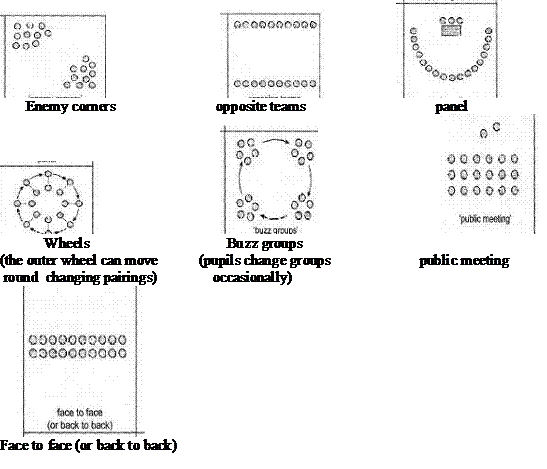
. #"807694.files/image005.gif">
Appendix
B
Pic.1
Seating possibilities in a standard classroom