Материал: Myth A Very Short Introduction by Robert A. Segal
Rudolf Bultmann and Hans Jonas
As philosophical as the approach to myth of especially earlier Cassirer is, he never contends that myth is philosophy. The theorists who do so are the German theologian Rudolf Bultmann (1884–1976) and the German-born philosopher Hans Jonas (1903–93), who eventually settled in the United States. The two not only take the meaning of myth from philosophy – from early, existentialist Martin Heidegger – but also confine themselves to the issue of meaning. Neither the origin nor the function of myth interests them. Myth is for them part of no activity. Like some armchair anthropologists, they treat myth as an autonomous text, but unlike Tylor, they do not even speculate from their armchairs about how myth arose or worked.
Undeniably, both Bultmann and Jonas translate myth into existentialist terms in order to make its meaning palatable to moderns, but they do not consider why myth is needed, especially when the message is the same as that conveyed by philosophy. They do not, for example, propose that myth, like literature for Aristotle, is a more accessible way of conveying abstract truths. Because
the mythologies they study – the New Testament for Bultmann, Gnosticism for Jonas – are nevertheless religious and not merely philosophical, their theories will be considered more fully in the next chapter, on myth and religion.
philosophy and Myth
Albert Camus
A more concrete example of the reduction of myth to philosophy is to be found in the celebrated interpretation of the Greek myth of Sisyphus by Albert Camus (1913–60), the French existentialist writer. Among the figures whom the hero Odysseus encounters in Tartarus, the part of Hades reserved for those who have offended Zeus, is Sisyphus, whose eternal punishment is to have to push a huge stone up a steep hill, only for it to roll back down every time just as he nears the top. As Odysseus describes the sight,
43
Myth
Also I saw Sisyphos. He was suffering strong pains,
and with both arms embracing the monstrous stone, struggling with hands and feet alike, he would try to push the stone upward to the crest of the hill, but when it was on the point of going over the top, the force of gravity turned it backward,
and the pitiless stone rolled back down to the level. He then tried once more to push it up, straining hard, and sweat ran all down his body, and over his head a cloud of dust rose.
(Homer, The Odyssey, lines 593–600)
Homer does not disclose what Sisyphus’ misdeed was, and ancient authorities differ. Still, for all ancients, Sisyphus was to be pitied. For Camus, he is to be admired. Rather than embodying the fate that awaits those few human beings who dare to defy the gods, Sisyphus symbolizes the fate of all humans who find themselves condemned to live in a world without gods. He is admirable because he accepts the absurdity of human existence, which is less unfair than pointless. Instead of giving up and committing suicide, he toils on, even while fully aware that his every attempt will prove futile. His is the only kind of heroism that a meaningless, because godless, world allows. Camus uses the myth of Sisyphus to dramatize the human condition.
The myth of Sisyphus was no less a part of a religion than the myths analysed by Bultmann and Jonas were – and for Bultmann still are. But Camus, just like Bultmann and Jonas, treats myth as an autonomous text, severed from any practising, institutionalized religion. For all three, myth is a philosophical tale, for after all, myth for them is philosophy.
44
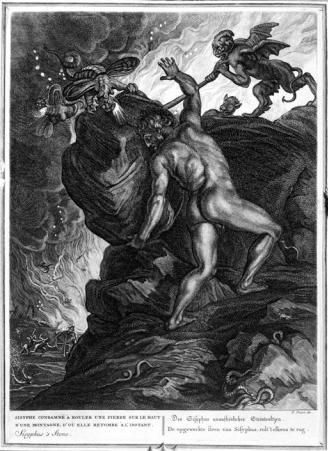
3. Sisyphus in Tartarus, 18th-century engraving by B. Picart
Chapter 3
Myth and religion
To approach myth from the field of religious studies is naturally to subsume myth under religion but is thereby to expose myth to the challenge to religion from science. Twentieth-century theories from religious studies have sought to reconcile myth with science by reconciling religion with science.
There have been two main strategies for reconciling the two. One tactic has been to re-characterize the subject matter of religion and therefore of myth. Religion, it has been argued, is not about the physical world, in which case religion is safe from any encroachment by science. The myths considered under this approach to religion are traditional myths, such as biblical and classical ones, but they are now read symbolically rather than literally. Myth, it is claimed, has been taken to be at odds with science because it has been misread. Tylor’s tirade against the moral allegorizers and the euhemerists for taking myth other than literally epitomizes this misreading of myth – by Tylor himself!
The other tactic has been to elevate seemingly secular phenomena to religious ones. As part of this elevation, myth is no longer confined to explicitly religious ancient tales. There are now overtly secular modern myths as well. For example, stories about heroes are at face value about mere human beings, but the humans are raised so high above ordinary mortals as to become virtual gods. At
46
the same time the actions of these ‘gods’ are not supernatural and are thus not incompatible with science. This approach retains a literal reading of myth but re-categorizes the literal status of the agents in myth.
There is a third tactic: replacing religious myths with secular ones. This strategy saves myth from the fate of religion by severing myth from religion. It is thus the opposite of the second tactic: turning secular myths into religious ones. In uncoupling myth from religion, this tactic conspicuously falls outside the present chapter.
Rudolf Bultmann
The grandest exponents of a symbolic rendition of traditional religious myths have been Rudolf Bultmann and Hans Jonas, both discussed briefly in the previous chapter. As noted, the two confine themselves to their specialities, Christianity
and Gnosticism, but nevertheless apply to them a theory of myth per se.
Taken literally, myth for Bultmann is exactly what it is for Tylor: a primitive explanation of the world, an explanation incompatible with a scientific one, and an explanation therefore unacceptable to moderns, who by definition accept science. Read literally, myth for Bultmann should be rejected as uncompromisingly as Tylor rejects it. But unlike
Tylor, Bultmann reads myth symbolically. In his celebrated, if excruciatingly confusing, phrase, he ‘demythologizes’ myth, which means not eliminating, or ‘demythicizing’, the mythology but instead extricating its true, symbolic meaning. To seek evidence of an actual worldwide flood, while dismissing the miraculous notion of an ark harbouring all species, would be to demythicize the Noah myth. To interpret the flood as a symbolic statement about the precariousness of human life would be to demythologize the myth.
religion and Myth
47