Материал: Myth A Very Short Introduction by Robert A. Segal
Myth
point of hanging herself to be free from her distress when she was saved by her old nurse, who pried loose the source of Myrrha’s despair and, as in Apollodorus, arranged for Myrrha to bed her father without discovery. But when, on the third night, he called for light to discover who it was who loved him so, he, as in Apollodorus, drew his sword and she fled. For nine months the pregnant Myrrha wandered. Also as in Apollodorus, the worn-out Myrrha prayed and was turned by the pitying gods into a tree – though here at the end, not the beginning, of her pregnancy. Yet Myrrha remained human enough to weep, and from her tears came the perfume myrrh. The baby, still alive in her, had to fight its way out of the tree to be born.
In Ovid, in contrast to Apollodorus, Venus (the Roman name for Aphrodite) encountered Adonis only as a young man but was likewise immediately smitten. There was no rivalry with other goddesses, so that Venus had him all to herself. They went hunting together. While Venus continually warned him to stick to small game, he heedlessly took on big game and, as in Apollodorus’ version, was gored to death by a boar, though not one sent by any rival for Venus’ love.
Where Apollodorus’ story ends with Adonis’ death, Ovid’s continues with Venus’ mourning for him. As a memorial, she sprinkled nectar over his blood, from which sprouted the flower anemone. Like Adonis, it is short-lived.
Where for Apollodorus the annual cycle of death and rebirth antedates Adonis’ ‘final’ death, for Ovid the annual cycle, in the form of the flower, follows Adonis’ death. The planting of the flower anticipates the ritual associated with the myth of Adonis – a connection absent from Apollodorus.
Where for Apollodorus the main spur to events is anger, for Ovid it is love. Where for Apollodorus Adonis is the innocent victim of warring parents and of rival deities, for Ovid the inconsolable Aphrodite is as much the victim as Adonis.
8
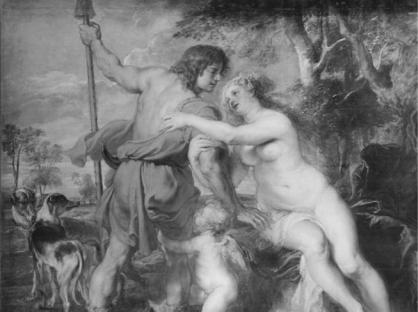
1. Venus and Adonis by Rubens
Where Apollodorus presents the story as true, Ovid presents it as fictional. Where Apollodorus tells it straight, Ovid twists it to fit larger themes – notably, that of transformation, as in Myrrha’s becoming a tree and Adonis’ becoming a flower. Where Apollodorus intends his story to be taken literally, Ovid intends his to be read metaphorically. Where Apollodorus is serious, Ovid is playful.
I propose using the myth of Adonis not only because it is extant in versions so disparate but also because it has proved so popular with modern theorists of myth. It has been analysed by J. G. Frazer, by the then-Lévi-Straussian Marcel Detienne, and by C. G. Jung and his followers.
Myth
Applying theories to myths
To analyse a myth is to analyse it from the viewpoint of some theory. Theorizing is inescapable. For example, handbooks of classical mythology that matter-of-factly connect Adonis’ annual trek to Persephone and return to Aphrodite with the course of vegetation presuppose a view of myth as the primitive counterpart to science. Being sceptical of the universality of any theory is one thing. Being able to sidestep theorizing altogether is another.
Theories need myths as much as myths need theories. If theories illuminate myths, myths confirm theories. True, the sheer applicability of a myth does not itself confirm the theory, the tenets of which must be established in their own right. For example, to show that Jung’s theory, when applied, elucidates the myth of Adonis would not itself establish the existence of a collective unconscious, which, on the contrary, would be presupposed. But one, albeit indirect, way of confirming a theory is to show how well it works when its tenets are assumed – this on the grounds that the theory must be either false or limited if it turns out not to work.
10
Chapter 1
Myth and science
In the West the challenge to myth goes back at least to Plato, who rejected Homeric myth on, especially, ethical grounds. It was above all the Stoics who defended myth against this charge by reinterpreting it allegorically. The chief modern challenge to myth has come not from ethics but from science. Here myth is assumed to explain how gods control the physical world rather than, as for Plato, how they behave among themselves. Where Plato bemoans myths for presenting the gods as practitioners of immoral behaviour, modern critics dismiss myth for explaining the world unscientifically.
Myth as true science
One form of the modern challenge to myth has been to the scientific credibility of myth. Did creation really occur in a mere six days, as the first of two creation stories in Genesis (1:1–2:4a) claims? Was there really a worldwide flood? Is the earth truly but six or seven thousand years old? Could the ten plagues on the Egyptians actually have happened? The most unrepentant defence against this challenge has been to claim that the biblical account is correct, for, after all, the Pentateuch was revealed to Moses by God. This position, known as ‘creationism’, assumes varying forms, ranging, for example, from taking the days of creation to mean exactly six days to taking them to mean ‘ages’. Creationism arose in reaction to
11
Myth
Darwin’s Origin of Species (1859), which contends that species gradually emerged out of one another rather than being created separately and virtually simultaneously. Surprisingly, creationism has become ever more, not ever less, uncompromisingly literalist in its rendition of the biblical account of creation.
At the same time creationists of all stripes vaunt their views as scientific as well as religious, not as religious rather than scientific. ‘Creationism’ is shorthand for ‘creation science’, which appropriates scientific evidence of any kind both to bolster its own claims and to refute those of secular rivals like evolution. Doubtless ‘creation scientists’ would object to the term ‘myth’ to characterize the view they defend, but only because the term has come to connote false belief. If the term is used neutrally for a staunchly held conviction, creationism is a myth that claims to be scientific. For creation scientists, it is evolution that is untenable scientifically. In any clash between the Bible and modern science, modern science must give way to biblical science, not vice versa.
Myth as modern science
A much tamer defence against the challenge of modern science has been to reconcile myth with that science. Here elements at odds with modern science are either removed or, more cleverly, reinterpreted as in fact modern and scientific. Myth is credible scientifically because it is science – modern science. There might not have been a Noah able singlehandedly to gather up all living species and to keep them alive in a wooden boat sturdy enough to withstand the strongest seas that ever arose, but a worldwide flood did occur. What thus remains in myth is true because scientific. This approach is the opposite of that called ‘demythologizing’, which separates myth from science. Demythologizing will be considered in the next chapter.
In their comment on the first plague, the turning of the waters of the Nile into blood (Exodus 7:14–24), the editors of the Oxford
12