Реферат: Participation in assets as a solution to the debt crises
Participation in assets as a solution to the debt crises
Participation
in assets as a solution to the debt crises
Najafov Salman
State University
Abstract
global financial crisis, as well as liquidity trap in Japan, the theory of debt deflation, the financial fragility hypothesis, the theory of balance sheet recession testifies imperfections of financial relations based on debt financing. It forces to reconsider principles of functioning of the financial system and search new approaches to solving debt crises. In article some theories of debt crises are shown, and it is argued that the participation in assets that provides coupling of debts with assets will allow solving of debt crises.
Key words: debt crisis, participation in asset, debt deflation, the financial fragility hypothesis, balance sheet recession
JEL classification. G01
1. Introduction
The Global financial and economic crisis in 2007 and a liquidity crisis of the world's leading banks force us to reconsider the debt relations. Credit boom accompanied by rising debt payments, could not continue persistently. Debt servicing was possible only with high incomes or assets value of the debtor, and as soon as the growth of income or assets stopped, the debtors have faced problems in servicing their debts: in spite of the decline in income and assets value of debt borrowers’ debt during the crisis did not reduce. As a result, the debtors faced decoupling of debts from assets.to Minsky decoupling between firms’ debt and assets, or the debt crisis caused by the cyclical nature of economic development: at the beginning of the boom phase firms finance their investment mostly at their own expense, and the role of loans is low. At this stage the companies’ incomes allow them to repay debts. With the growth of the economy firms are actively moving to external financing of capital investments. However, there comes a situation when income of many companies reduces, but their debts remain fixed. As a result, firms faced decoupling of debts from assets and their ability to service its debt decreases.to diminish financial instability has proposed to constrain the banking financing of capital assets and limitation on the liability structure of business.case of decoupling of debts from assets is liquidity trap in Japan. Richard Koo argues that deep recession in the Japanese economy is connected with balance sheet recessions - when bubble burst wealth of private sector declined but debts remained unchanged. As a result large number of private companies faced defaults leading to the credit crisis.crunch leads to decrease in deposit that reduces the interest rate on deposits to close to zero level.
Similar process occurs in the United States too, where the mortgage crisis and the decline in property prices causes a decrease in value of borrowers’ assets in comparison with debts. It leads to a decrease in lending activity which reduces interest rates.
The decoupling of firms’ debt from asset is also causes the
debt deflation. There are several channels debt crisis leads to deflation.
According to Fisher if over-indebtedness exists, this leads to debt
liquidation. But debt liquidation leads to contraction of deposit that slowing
down velocity of circulation causes deflation. Minsky argues that if as a
result of decline in income borrowers are faced difficulties in repay debts
they are forced to sell assets. Selling of assets reduces asset prices, and
losses from decline in asset values in comparison with debts reduce consumption
and investment through a wealth effect that leads to deflation. According to
Bernanke debt deflation is caused by credit squeeze that decreases aggregate
demand.article a new approach of solution to debt crises is argued, and to
avoid decoupling of the debts from asset the transition from financial relations
based on the debt to the model based on the participation in assets is
suggested.
2. Study of the debt crises
A significant contribution to the study of the debt crises is introduced by Minsky, who developed the hypothesis of financial fragility. Minsky debt crisis connects with the cyclical nature of economic development. So, at the beginning of the boom phase of the business cycle firms finance their investment projects mostly at their own expense, the role of loans is low. This is due to the fact that at this stage the growth of investment activity is still moderate, the credit risks are still high. The companies’ incomes allow them to repay the interest on the loan and principal. With the growth of the economy and favorable forecasts firms are beginning to step up investment, credit risk also reduce. As a result, firms are actively moving to external financing of capital investments. However, the income may not grow continuously. After a while there comes a situation when income of many companies reduces, but their debts remain fixed. As a result, firms' ability to service its debt decreases, number of defaults on loans starts to increase.avoid becoming a bankrupt firms to repay old debts are forced to take out new loans. That is, at this stage, the debts are not repaid by the incomes, and through new borrowing (Minsky this mechanism called Ponzi financing). But sooner or later the debtors applying this mode of financing debt, find themselves unable to get new loans due to higher credit risk (that reduce the desire of banks to lend). Thus, debtors are unable to repay debts, causing the debt crisis. Thus, decoupling between firms’ debt and assets, or the debt crisis caused by the cyclical nature of economic development: if business income and assets are cyclical and decreases in the phase of the economic downturn, the level of debt liabilities of debtors on the downward phase of the economy is not reduced, and even increase because of the interest rates. Thus, the cause of the debt crisis is the rigidity of the debt obligations to the downside.that asset securitization is also Ponzi-financing model, when the funds acquired structured securities with certain cash flows and issued under their security short-term commercial paper in several tranches, and whose income is formed as the difference between the interest rate on long-term assets and the interest rate on short-term borrowed funds. And when investment banks faced difficulty to attract new short-term obligations they were unable to pay debts.is worth noting that Minsky to diminish financial instability has proposed to constrain the banking financing of capital assets: "Banking, that is, the financing of capital asset ownership and investment, is the critical destabilizing phenomenon" (Minsky 1980, p. 520). He also proposed the limitation on the liability structure of business (Minsky 1980, p. 520).our view, constraint of the banking financing of capital assets and limitation on the liability structure of business is not enough. Decoupling between debts and assets are an integral part of the economy based on debt relations. So solution of financial instability in an economy based on the debt relation is not possible. Solution to these problems is the transition from debt financing to participation in assets. Participation in assets, firstly, preventing the decoupling of debt liabilities of companies from assets, will reduce the risk of their bankruptcy and make financial system more stable. Secondly, participation in assets will prevent Ponzi-financing or the practice of debt repayment by attracting new debt.should also be noted that, unlike the debt relations, where the debts are decoupled from corporate assets, participation in assets will provide more equal distribution of wealth, risks and losses and, thus, prevent the concentration of risk, making the financial system more stable.participation in assets will make borrowers more flexible and allow them better adapting to economic changes that will increase competitiveness of firms and economy in whole.transition to participation in assets is also advantageous for banks as deposits placed in banks will be no debt, but participation in assets that will prevent decoupling between bank's debt and its assets. To do this, deposits in banks should be divided into savings and participation in assets. So, if an individual wants just save the money for the future, he can make a non-interest saving, which is a debt obligation, if individual wants to multiply wealth and is ready to risk for it he can take advantage of participation in assets.of debts from assets is also connected with liquidity trap. This is well illustrated by the example of Japan, where, after asset bubbles burst in the 80s of the last century, a large number of companies found itself unprofitable and with large amount of non-performing loans.Koo deep recession in the Japanese economy (as well as the current global crisis) connects with balance sheet recessions - when bubble burst wealth of private sector declined but debts remained unchanged. A large number of private companies faced defaults leading to the credit crisis:
) Reduction of the firms’ assets, causing a decline in their creditworthiness, causes a reduction in lending activity
) companies to restore its balance sheet urgently begin to repay old debts and stop borrowing, further reducing the demand for loans.
) banks also reduce lending because banks fear to burden its balance with non-performing loans, and because banks’ liabilities do not decrease their balance sheet will deteriorate.and credit crunch causes a decrease in interest rates. However, despite the near-zero interest rates, companies are reluctant to take out loans. As a result, banks are not able to direct the attracted deposits to lending, funds are accumulated in bank reserves, or are withdrawn from the circulation (so-called liquidity trap). This withdrawal of money from the circulation causes a deflationary spiral, which only exacerbates the fall in asset prices and deteriorate the balance sheets even further., a credit crunch emerges not because banks are inability to lend but because the crisis of balance sheets of companies.crunch leads to decrease in deposit that reduces the interest rate on deposits to close to zero level, forcing the owners of time deposits to immediately withdraw funds and move them to risk-free current accounts.of the liquidity trap in Japan allows to point out the following phases of its development.first phasefirst phase is characterized by a decrease in assets of the borrowers and increase of non-performing loans:
· in the late 80's - late 90's of the last century in Japan Nikkei 225 fell from 38,900 to 13,000, land price in 1992-1998 decreased by more than 10% (figure 1)), in July 2013 the Nikkei 225 index was less than 15,000, which is lower than in 1989 by 2.5 times). Decrease in value of companies’ assets made difficult the payment of loans: in 1992-98 cumulative amount of non-performing loans in Japanese banks stood at about 60 trillion yen.
• The requirement of banks to replenish the devalued
collateral also negative impacted on the companies’ balance sheets.
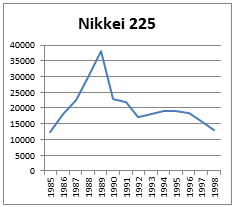
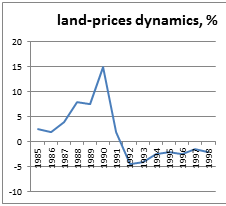 1. Nikkei index and the dynamics of land prices in Japan
second phasesecond phase is characterized by a deleveraging - companies and individuals stop borrowing and pay back loans:
• decrease in value of companies’ and individuals’ assets reduces their creditworthiness. As a result, they get fewer loans.
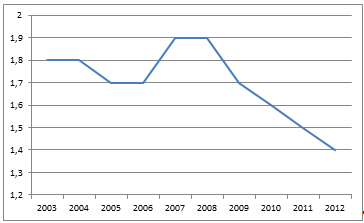
Figure 2. Lending interest rate in Japan, %
• banks also reduce the lending: increase of non-performing
loans (by 1995 74% of mortgage loans were non-performing (Akihiro Kanaya, David
Woo 2000, p. 24) deteriorates banks’ balance sheets, and banks with weak
balance sheets become more likely to forbear on loans.a result, despite the
lowest interest rates on loans claims of financial sector on other sectors of
the domestic economy in Japan in the period 2003-2012 decreased more than 15% (Figure
3).
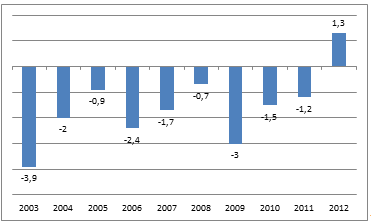
Figure 3. Claims of financial sector on other sectors of the
domestic economy in Japan, annual growth, %
The third phasecrunch forced banks to decrease the demand for
deposits. It leaded to the reduction of interest rates on deposits to a close-
to-zero level (Figure 4).is worth noting that not lower interest rates on
deposits reduce the amount of deposits, conversely, low demand for deposits by
banks reduces the interest rates on them.
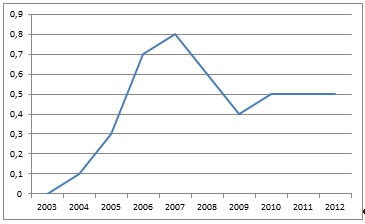 4. Interest rates on deposits in
Japan, %
4. Interest rates on deposits in
Japan, %
crunch, sharp decline of stock price of banks (the market price of many bank stocks fell to only 10% of their previous peak value (Benjamin M. Friedman, p. 50), drop in real estate prices, increase of non-performing loans caused deterioration of banks’ balances:
· as the result of failing of real estate price the quality of loans to the real estate companies deteriorated
· the drop in real estate prices eroded the value of collateral
· the decline of the stock prices of banks also negatively impacted on banks’ balances.fourth phase
Banks’ losses (in 1995 banks’ losses were 4.9 trillion yen. In 1996 losses were avoid due to reduction of provisioning from 23.3 trillion yen to 11.5 trillion yen that allowed banks to report a small profit of 236 bln. yen. But when banks increased their provisioning again, banks faced losses: 10.3 trillion yen in 1997 and 10 trillion yen in 1998 (Akihiro Kanaya, David Woo 2000, p. 41) forced Central Bank to carry out large-scale program of savings of banks: discount rate is lowered to 0.3%, the value of governmental support of banks in 1990-1998 was about 140 trillion yen.2001 the Central Bank adopted quantitative easing. To promote private lending Bank of Japan provided commercial banks with excess liquidity. The Bank of Japan accomplished this by buying government bonds, asset-backed securities, equities and commercial paper. The Bank of Japan increased the commercial bank current account balance from 5 trillion yen to 35 trillion yen (approximately US$300 billion) over a four-year period (Glen Allen 2010).
The fifth phaseliquidity into banks increases the risk of inflation in the economy. Although in the economy deflationary trend dominates (because of high levels of debt (debt deflation) and the growth of savings due to high uncertainty), at the stage of the recovering of business confidence and economic growth, lending and consumption growth will dramatically increase the risk of inflation. It should also be noted that in situation lending and private spending declines, government to prevent the decline in GDP has to increase their costs constantly. Since fiscal revenues during the crisis reduce, increase of government spending is accompanied by rising public debt. In particular, Japan's public debt exceeds 200% of GDP and about 50% of state budget revenue is generated by government bond issues, debt service is constitute 24% of the state budget, even assuming average interest cost on debt remains unchanged from today’s levels, Japan’s debt service will increase to 50% of the state budget by 2032 (Ron Rimkus 2012).high level of debt even a minor increase in interest rates will lead to the bankruptcy of the debtors and state.
· Increase of interest rates will reduce the value of assets that deteriorate borrowers’ balances and deepen debt crisis.
· Growth of interest rate will increase the interest expenditures of budget., the Japanese government should be very careful in trying to stimulate economic growth, as economic growth prompting interest rate rise will lead to decoupling of debts of private sector from their assets and cause a budget crisis.
It should be noted that similar process occurs in the United States, where the mortgage crisis and the decline in property prices (figure 5) observed since 2007 causes a decrease in value of borrowers’ assets in comparison with debts that leads to a decrease in lending activity.
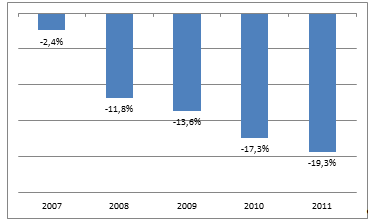
Figure 5. The price of apartments in the United States, 2006 = 100
a result, if before the crisis, the volume of bank loans and deposits in the United States were comparable, in the crisis years, volume of deposits began to exceed bank loans: in 2008-2012, while deposits rose by 30%, lending fell by 9%. So, in June 2013 the volume of deposits exceeds the volume of loans 2.1 trillion dollars (Figure 6) which means the withdrawal of funds from the circulation and their accumulation in the banking sector (liquidity trap occurs).
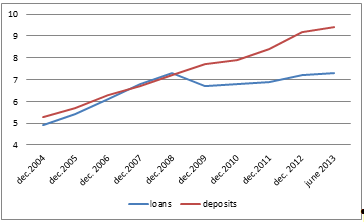
Figure 6. Loans and deposits in the U.S., end of period, trillion dollars
save banks the Federal Reserve started buying bank debt, mortgage-backed securities, and Treasury notes (Quantitative Easing programme). In September 2012 third round of QE was announced. During QE3 FRS purchases bond to the amount of $85 billion per month.
As a result of QE programmes, the amount of cash of commercial banks (vault cash, cash items in process of collection, balances due from depository institutions, and balances due from Federal Reserve Banks) in the United States increased from 296 billion dollars at the end of 2006 to 1,710 billion at the end of 2012, or from 3% of total assets of banks to 13.1% (Figure 7).
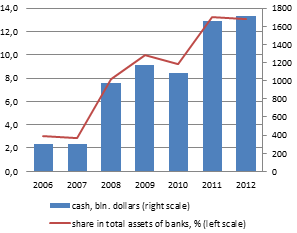
Figure 7. Cash (vault cash, cash items in process of collection, balances due from depository institutions, and balances due from Federal Reserve Banks) in commercial banks in the United States, end of periodcrunch forces banks to decrease the demand for deposits which leads to low interest rates. In December 2012 bank prime loan rate was 3.25%, certificate of deposits rate was 0.32% (Figure 8).
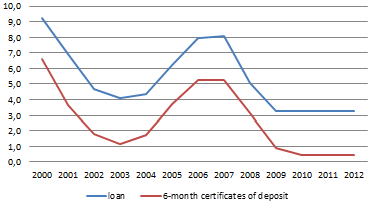
Figure 8. Interest rates in US, %
similar situation is also observed in the euro area, where in
recent years growth of deposits exceeds the growth of lending (Figure 9). So,
in 2009-2012 deposits in euro area increased by 14%, but lending increased by
less than 1%.
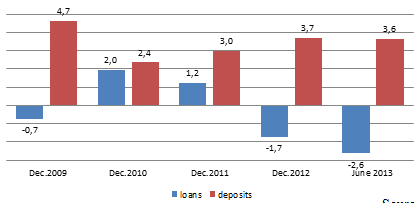
Figure 9. Annual growth rate of loans and deposits in the U.S., in %
with the placement of funds attracted by banks forced banks
to lower interest rates on both loans and on deposits (Table 1).
Table 1rates on loans and deposits, %
|
|
loans1 |
deposits2 |
1.85 |
0.87 |
|
France |
1.96 |
2.96 |
||
|
Finland |
2.02 |
1.4 |
||
|
The Netherlands |
2.18 |
2.47 |
||
|
Germany |
3.14 |
1.3 |
||
|
Italy |
4.72 |
2.74 |
1 loans to non-financial corporations up to 1 year
2 from households up to 2 years
, liquidity trap is caused with the reduction of value of assets of firms in comparison with their debt liabilities that leads to deleveraging of firms and close-to-zero interest rate. There is the only way to prevent decoupling of firm’ debts from their assets that is participation in assets, and participation in assets preventing decoupling of firm’ debts from their assets will allow avoiding deleveraging of borrowers that leads to close-to-zero interest rates and liquidity trap.decoupling of firms’ debt from asset is also causes the debt deflation. The term debt-deflation was coined by Irving Fisher in 1933. Debt deflation theory was later developed by Minsky and Bernanke and refers to the way attempts to repay debts leads to deflation.are several channels debt crisis leads to deflation:
• Minsky argues that if as a result of decline in income borrowers are faced difficulties in repay debts they are forced to sell assets. This leads to fall in asset prices, and losses from decline in asset values in comparison with debts reduce consumption and investment through a wealth effect that leads to deflation. "If payment commitments cannot be met from the normal sources, then a unit is forced either to borrow or to sell assets. Both borrowing on unfavorable terms and the forced sale of assets usually result in a capital loss for the affected unit. However, for any unit, capital losses and gains are not symmetrical: there is a ceiling to the capital losses a unit can take and still fulfill its commitments. Any loss beyond this limit is passed on to its creditors by way of default or refinancing of the contracts. Such induced capital losses result in a further contraction of consumption and investment beyond that due to the initiating decline in income. This can result in a recursive debt-deflation process." [Minsky 1963, p. 6-7]
• Bernanke says that debt deflation is caused by credit squeeze that decreases aggregate demand (Bernanke 1983, p. 257).the debt deflation is caused by decoupling of firms’ debts from their assets that make borrowers are disable to pay debts. There are the following ways to equal firms’ debts and their assets and so, solve a debt deflation:
) reflating the price level up to the level at which outstanding debts were contracted
) Expansionary fiscal policy that provides increase in profits and enable business to meet debt liabilities.
) Participation in asset, or coupling of debt with
asset at which when volume of assets of firms decrease their debts fall too.to
Fisher the solution to debt deflation is reflating the price level up to the
level at which outstanding debts were contracted by existing debtors. However,
as we can see in Japan and US, increase of inflation in case of reduction in
lending and aggregate demand is an elusive goal. So, in Japan and the United
States, where despite the massive infusion of money into the banking system the
threat of deflation remains.to escape debt deflation suggests stabilize profits
that will enable business to meet financial commitments. For this goal Minsky
suggests expansionary budget policy. Minsky wrote: "A cumulative debt
deflation process that depends on a fall of profits for its realization is
quickly halted when government is so big that the deficit explodes when income
falls" (Minsky 1982, p. 11); "Expansion can take place only as
expected profits are sufficient to induce increasing expenditures on
investments, and current profits provide the cash flows that enable business to
meet financial commitments" (Minsky 1982, p. 11).effective solution to
debt deflation is participation in assets: under the conditions of
participation in assets, when volume of assets of firms decrease they debt
liabilities fall too and so firms don’t face difficulties in repayment of debts
that allows avoiding debt deflation.
3. Conclusion
Debt deflation, liquidity trap, the theory of
debt deflation, the financial fragility hypothesis, the theory of balance sheet recession
have common reason and are connected with decoupling of borrowers’ debt from
their assets that makes difficulties for repaying debt. In article it is argued that solution to debt crises is transition from
debt relation to participation in assets which will allow providing coupling of
debts with assets that means that decrease in value of assets will be
accompanied with reduction of debt that will 1) make borrowers more
flexible and allow them better adapting to economic changes and so increase
competitiveness of firms and economy in whole and 2) provide
more equal distribution of wealth, risks and losses and, thus, prevent the
concentration of risk and make the financial system more stable
References
financial crisis debt fragility
Benjamin M. Friedman, "Japan Now and the United States Then: Lessons from the Parallels, Institute for International Economics", http://www.iie.com/publications/chapters_preview/319/3iie289X.pdfB. (1983), "Nonmonetary Effects of the Financial Crisis in Propagation of the Great Depression", American Economic Review, Vol. 73(3), JuneI (1933), "The debt-deflation theory of great depressions", Econometrica
Glen Allen (2010), Quantitative Easing - A lesson learned from Japan, http://www.oyetimes.com/business/44-markets/7045-quantitative-easingAkihiro, David Woo (2000), "The Japanese Banking Crisis of the 1990s: Sources and Lessons", IMFH. (1963), "Can "It" Happen Again?" in Carson, editor, Banking and Monetary StudiesH. (1982), "Can "It" Happen Again? A Reprise", Levy Economics Institute of Bard CollegeH (1980), "Capitalist Financial Processes and the Instability of Capitalism". Journal of Economic Issues. Vol. XIV, No 2Rimkus (2012), "The Japanese Debt Crisis (Part 1): Has Japan Passed the Point of No Return?", CFA Institute, http://blogs.cfainstitute.org/investor/2012/04/19/the-japanese-debt-crisis-has-japan-passed-the-point-of-no-return/