Материал: Topic_8_resp_syst
Ministry of Health of Ukraine
Kharkiv National Medical University
AUSCULTATION OF THE LUNGS: ADDITIONAL RESPIRATORY SOUNDS (RALES, CREPITATION, PLEURAL FRICTION SOUND). LABORATORY SPUTUM AND PLEURAL FLUID ANALYSIS. INSTRUMENTAL METHODS OF RESPIRATORY ORGANS EXAMINATION
Methodical instructions for students
Рекомендовано Ученым советом ХНМУ Протокол №__от_______2017 г.
Kharkiv
KhNMU
2017
Auscultation of the lungs: additional respiratory sounds (rales, crepitation, pleural friction sound). Laboratory sputum and pleural fluid analysis. Instrumental methods of respiratory organs examination: Меthod. instr. for students / Authors. Т.V. Ashcheulova, O.M. Kovalyova, G.V. Demydenko. – Kharkiv: KhNMU, 2017. – 28 p.
Authors: Т.V. Ashcheulova
O. M. Kovalyova
G.V. Demydenko
AUSCULTATION OF THE LUNGS
Adventitious (added) sounds
Three types of adventitious sounds can be heard in pulmonary pathology: rales, crepitation, and pleural friction
sound.
Rales are generated in bronchi and bronchioles. Dry and moist rales are distinguished.
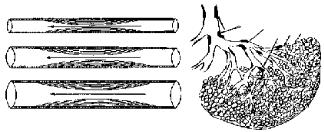
Dry rales can be caused by narrowing of airways, or by presence of viscous sputum in them (Fig. 1).
2

Fig. 1. Mechanism and site of dry rales generation
Dry rales are continuous musical sounds, persist throughout the respiratory cycle, and vary greatly in their character, pitch, and intensity. Depending on character and pitch, dry rales are divided into sibilant and sonorous rales.
Sibilant rales (wheezes) are relatively high pitched, whistling sounds (Fig. 2).
Fig. 2. Sibilant rales.
Sibilant rales signify obstruction in small bronchi in:
bronchial asthma (total bronchospasm during attack);
bronchitis (non-uniform swelling of the bronchial mucosa due to inflammation, or viscous sputum narrows the lumen of bronchi);
tuberculosis or tumor of bronchus (localized constriction of the bronchus. Limited dry rales over apex of the lung can suggest early symptom of tuberculosis).
Sonorous rales (rhonchi) are relatively low pitched, sonoring sounds (Fig. 3).
Fig. 3. Sonorous rales.
Sonorous rales are generated by vibration of the viscous secretions or in widespread obstruction of medium and large bronchus. The most common cause of sonorous rales is bronchitis. They may be also heard in bronchial asthma, tuberculosis, and bronchocarcinoma.
Intensity and transmission of the dry rales depends on the size and depth of the affected bronchi. In localized affection of medium and large bronchus insignificant amount of low pitched and soft rales is heard. Widespread bronchi inflammation or bronchospasm in asthma attack both sibilant and sonorous rales of different tone and intensity are heard. Such rales can be heard at a distance during expiration. If dry rales are caused by accumulation of the viscous secretions in the lumen of bronchi, they can be altered by coughing or deep inspiration to shift mucus.
Moist rales (clackles) are generated in bronchi and cavities in the lungs in the presence of liquid secretions (sputum, congestive fluid, blood).
Airflow in liquid-containing bronchi causes formation of air bubbles, which break to produce specific cracking sound. Similar sound can be heard when bubbling air through the water using small tube. Such sounds are called bubbling or moist rales.
Moist rales are discontininuous sounds, intermittent, nonmusical, and brief. Moist rales are heard throughout the respiratory cycle, but as speed of airflow in inspiration is higher, rales are somewhat louder during inspiration.
Moist rales are subdivided into fine, medium, and coarse bubbling rales depend on the caliber of bronchi where they are originated.
Fine bubbling rales ( . . . . . . . ) generate in small bronchi and bronchioles. These rales are soft, high-pitched, and
very brief. |
|
|
|
|
|
|
|
|
|
|
|
|
|
Medium bubbling rales ( |
|
|
|
|
|
|
|
) |
|
originate in bronchi of medium caliber. They are somewhat louder, and not |
|||
so brief. |
|
|
|
|
|
|
|
|
|
|
|
|
|
Coarse bubbling rales ( |
|
|
|
|
|
|
|
|
|
|
) |
produce in bronchi of large caliber, large bronchiectasis, and also in fluid- |
|
|
|
|
|
|
|
|
|
|
|
||||
containing lung cavity communicated with large bronchus (Fig. 4). Coarse bubbling rales are loud, low-pitched, and longer.
3
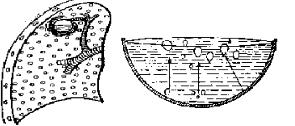
Fig. 4. Mechanism of the coarse bubbling rales generation over the cavity.
Moist rales are classified into consonating and non-consonating rales.
Consonating rales are heard when liquid-containing bronchi or cavity are surrounded by solid lung tissue. The cavity itself act as resonator to intensify loudness of rales.
Non-consonating rales are heard in bronchitis or acute pulmonary edema caused by left ventricular failure, when intensity of rales produced are dampened by air-containing lung tissue.
The most common causes of the moist rales include:
acute and chronic bronchitis (bilateral, symmetrical, of various caliber, non-consonating rales);
bronchopneumonia (consonating rales);
bronchiectasis (of various caliber, over limited area, non-consonating rales);
cavity in the lungs (coarse bubbling, over limited area, as rule over lung apices, consonating rales);
pulmonary edema due to the left ventricular failure (bilateral symmetrical, of different caliber, nonconsonating rales).
Crepitation is generated in alveoli, when they contain small amount of liquid secretion. During expiration alveoli stick together as a result of fluid presence. During inspiration alveolar walls separate with difficulty only at the end of inspiration to produce late inspiratory slight cracking sound (Fig. 5). Crepitation somewhat resembles sound produced by rubbing a lock of hair near the ear.
 Fig. 5. Mechanism of crepitation.
Temporary crepitation in first deep inspiration can be heard in the patients with grave cardiovascular and infectious diseases, in aged persons, especially so if the patient was in lying posture before auscultation.
Relatively constant crepitation can be due to:
acute lobar pneumonia at the initial and final stages (insignificant amount of exudates at the initial stage causes so-called indux crepitation – quit, remote sound. During next stage of disease alveoli are overfilled with inflammatory fluid and crepitation therefore disappears. At the final stage due to resolution of exudates, loud, as near the ear, crackling sound – redux crepitation is heard again);
pulmonary tuberculosis (in small amount of inflammatory fluid in alveoli);
lung infarction (in small amount of blood in alveoli);
4

congestive heart failure (in small amount of congestive fluid in alveoli);
compressive atelectasis (alveoli are compressed by pleural air or fluid, and separate therefore with difficulty).
Pleural friction sound (pleural rub, friction rub) is diagnostic added sound of pleurisy.
The smooth surfaces of visceral and parietal pleura lubricated by pleural fluid, allow pleura to move easily and noiseless during breathing.
Adventitious sound known as pleural friction sound, generates as a result of decreased amount of pleural fluid in dry pleurisy due to dehydrotation:
intestinal infections (cholera, dysentery);
profuse bleeding;
profuse diarrhea;
profuse vomiting;
or cicatrices, commissures, bands between pleural layers at the focus of inflammation, or when fibrin deposits on inflamed pleura to make it surface rough in:
pleuropneumonia;
rheumatic pleurisy;
pleural tuberculosis;
tumor;
effusive pleurisy at the period of rapid resorption of exudates.
Pleural friction rub is heard throughout inspiration and expiration, and is differentiated by intensity, location and duration.
A soft friction rub in early dry pleurisy may be mistaken for crepitation or fine bubbling rales but is not altered by coughing as rales; it can be louder by pressure with stethoscope. During rapid resorption of pleural effusion, pleural rub becomes louder, and more intense. Such sound is so rough that can be felt even during palpation.
Pleural friction sound is best heard at the lung bases due to better respiratory mobility, and rarely at the lung apices (tuberculosis with involvement of the pleura, for example).
Duration of the friction rub varies in different diseases. Periodic pleural friction sound is typical to rheumatic pleurisy. It is heard a few hours, temporary disappears, and then appears again. In dry pleurisy of tuberculosis etiology and pleurisy with effusion at resorption stage, pleural rub is heard for a week and over. Longstanding, for years after pleurisy, friction rub can be sometimes heard due to significant roughness of the pleural surfaces.
Characteristics of adventitious sounds are summarized in Tab. 1.
Tab. 1. Differential diagnosis of adventitious sounds.
|
|
|
|
Pleural |
Signs |
Dry rales |
Moist rales |
Crepitation |
friction sound |
Relation to |
Best heard |
Best heard |
Heard at the |
Heard |
the |
during |
during |
end of |
throughout |
respiratory |
expiration |
inspiration |
inspiration |
respiratory |
phases |
|
|
|
cycle |
Change |
Decrease or |
Decrease or |
Without |
Without |
during cough |
change |
disappears |
changes |
changes |
|
character |
|
|
|
Pressure with |
Without |
Without |
Without |
|
the |
changes |
changes |
changes |
Increase |
stethoscope |
|
|
|
|
Breathing |
|
|
|
|
movement |
|
|
|
Only this |
with close |
Absent |
Absent |
Absent |
sound is |
nose and |
|
|
|
heard |
mouth |
|
|
|
|
INSRUMENTAL AND LABORATORY METHODS
Diagnostic procedures for assessing the patients with suspected or known respiratory system disease include imagine studies, technique for obtaining biological specimens, and method used to characterize the functional changes developing as a result of disease.
Imagine studies
5