Материал: 2016_Kaplan_USMLE_Step_1_Lecture_Notes_Pharmacology

Chapter 7 λ Cardiac and Renal Drug List and Practice Questions
16.Answer: C. ACE inhibitors prevent the conversion of angiotensin I to angiotensin II and lower blood pressure by decreasing both the formation of aldosterone formation and the vasoconstrictive action of AII at AT-1 receptors. ACEIs also inhibit the metabolism of bradykinin, and this leads to additional hypotensive effects, because bradykinin is an endogenous vasodilator. Unfortunately, increases in bradykinin are associated with side effects, including cough and angioedema. Losartan, which blocks AT-1 receptors, does not increase bradykinin levels.
17.Answer: B. Supraventricular tachycardias (SVTs) are treated effectively by class II and class IV antiarrhythmics. In addition, adenosine is indicated for SVTs and nodal tachycardias but only acutely since it must be administered IV and has an extremely short duration. The primary actions of both beta blockers (esmolol) and CCBs (diltiazem) are at the AV node, but esmolol is too short-acting to be useful as prophylaxis. Lidocaine and mexilitene are both class Ib drugs that are used in ventricular arrhythmias.
18.Answer: A. ACEIs slow the progression of diabetic nephropathy and are indicated for management of HTN in such patients. Nitroprusside is used IV in severe HTN or hyper¬tensive crisis, not for management of mild-to- moderate HTN. Losartan, which blocks AT-1 receptors, is associated with teratogenic effects during fetal development, as are the ACEIs. Nonselective beta blockers are not ideal for patients who suffer from peripheral vascular disease, diabetes, or asthma. Milrinone, like most inotropes, is not useful long-term in CHF patients. The drug has been shown to increase mortality with chronic use, and thus is indicated for acute CHF. Digoxin is currently the only inotrope used chronically.
19.Answer: E. The sublingual administration of a drug avoids its absorption into the portal circulation and hence eliminates the possibility of first-pass metabolism, which can often have a major impact on oral bioavailability. Given sublingually, nitroglycerin is more effectively absorbed into the systemic circulation and has improved effectiveness in angina by this mode of administration. Effective absorption is unlikely to decrease reflex tachycardia or propensity toward methemoglobinemia. There is no bypass of the coronary circulation—nitrates actually decrease coronary vasospasm, which makes them effective in variant angina.
20.Answer: D. An increase in AV conduction is characteristic of quinidine, which exerts quite marked blocking actions on muscarinic receptors in the heart. Thus, an atrial rate, formerly transmitted to the ventricles in a 2:1 ratio, may be transmitted in a 1:1 ratio after quinidine. This effect of quinidine can be offset by the prior administration of an antiarrhythmic drug that decreases AV nodal conduction, such as digoxin or verapamil. All of the drugs listed (except quinidine) slow AV nodal conduction, but adenosine and esmolol (a beta blocker) are very short-acting agents used IV only.
129

SECTION IV
CNS Pharmacology
Sedative-Hypnotic-Anxiolytic Drugs |
1 |
Learning Objectives
Answer questions related to benzodiazepines and barbiturates
λDrugs: benzodiazepines (BZs), barbiturates, and alcohols
|
|
Barbiturates |
|
Coma |
|
|
Medullary depression |
Benzodiazepines |
Effects |
|
|
Anesthesia |
|
|
CNS |
|
|
|
|
|
|
Hypnosis |
|
|
Sedation, Anxiolysis |
Possible anticonvulsant |
|
& muscle-relaxing activity |
Paradoxical disinhibition
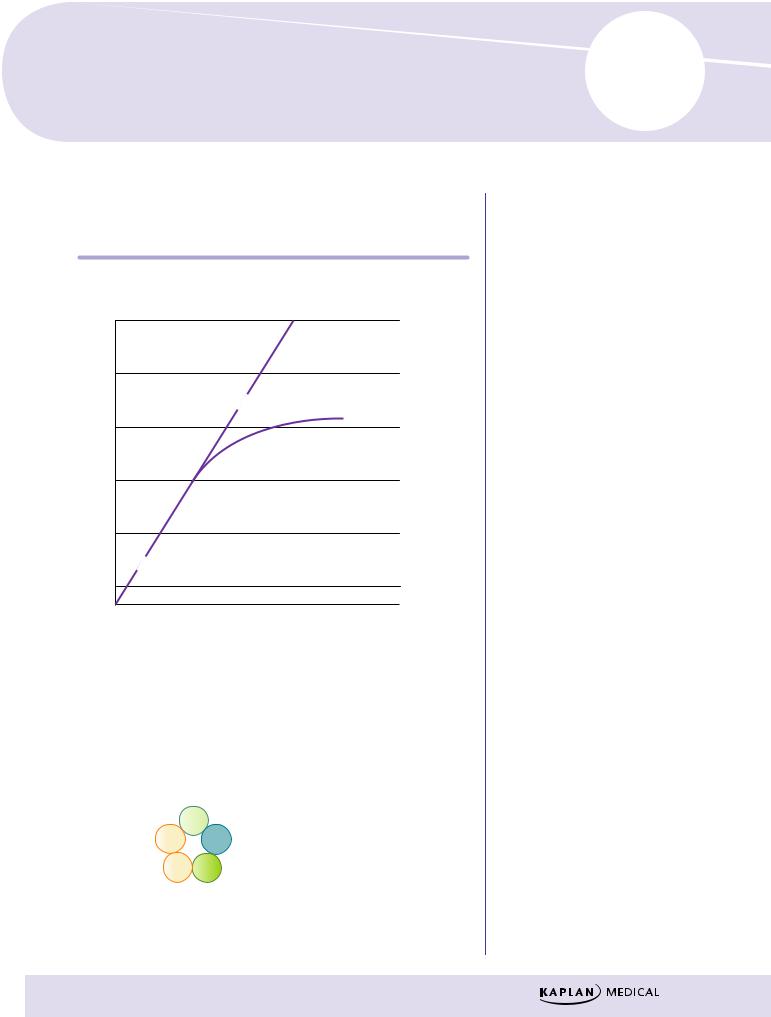
Increasing Sedative-Hypnotic Dose 
Figure IV-1-1. CNS Effects Associated with
Increasing Doses of Sedative-Hypnotic (S-H) Drugs
λ Cause dose-dependent CNS depression that extends from sedation to anesthesia to respiratory depression and death
λ BZs reach a plateau in CNS depression; barbiturates and alcohol do not λ Mechanisms:
α |
GABA binding site |
|
Cl– |
γ |
Benzodiazepine |
binding site |
||
β |
|
Barbiturate |
|
|
binding site |
5 Subunit types: α, β, γ, ρ, δ
Figure IV-1-2. Site of Action of Drugs on the GABAA Complex
133