Материал: 2016_Kaplan_USMLE_Step_1_Lecture_Notes_Pharmacology

SECTION VI
Drugs for Inflammatory and Related Disorders

Histamine and Antihistamines |
1 |
Learning Objectives
Answer questions about histamine
Use knowledge of H1 antagonists to describe their appropriate use
HISTAMINE
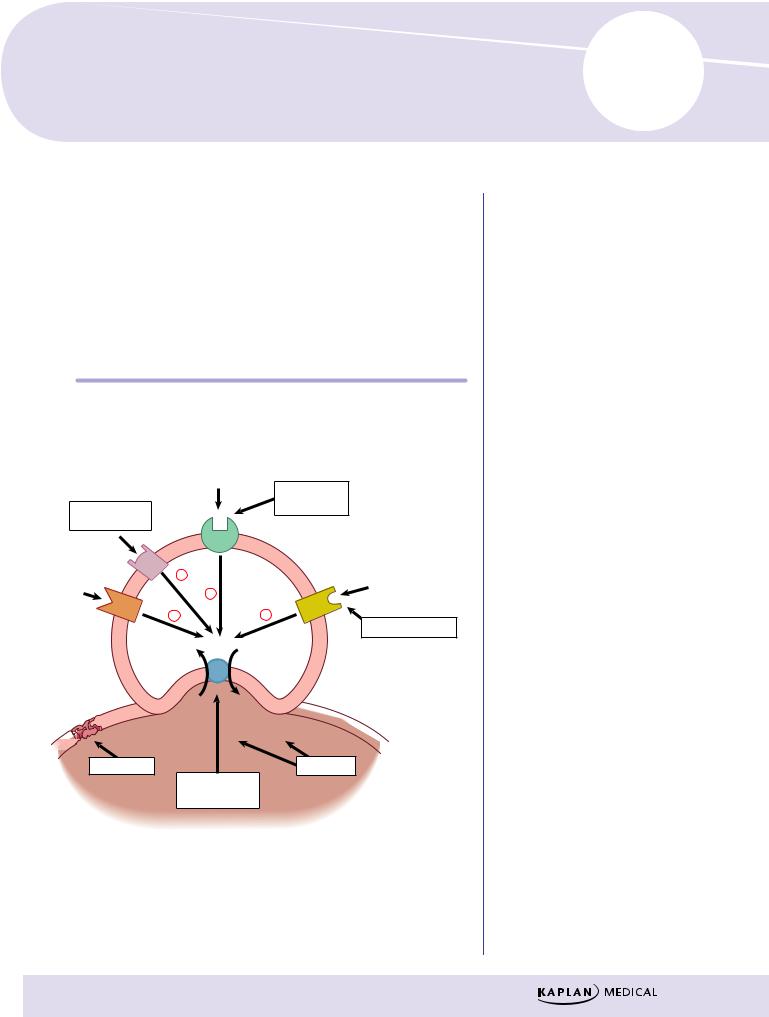
λHistamine is an autacoid present at high levels in the lungs, skin, and the gastrointestinal tract and is released from mast cells and basophils by type I hypersensitivity reactions, drugs, venoms, and trauma.
λHistamine receptors are of the serpentine family, with seven transmem- brane–spanning domains with G-protein–coupled second messenger effectors.
–H1 activation
º↑ capillary dilation (via NO) →↓ BP
º↑ capillary permeability →↑ edema
º↑ bronchiolar smooth muscle contraction (via IP3 and DAG release)
º↑ activation of peripheral nociceptive receptors →↑ pain and pruritus
º↓ AV nodal conduction
–H2 activation
º↑ gastric acid secretion →↑ gastrointestinal ulcers
º↑ SA nodal rate, positive inotropism, and automaticity
H1 ANTAGONISTS
λMechanism of action:
–H1 antagonists act as competitive antagonists of histamine and therefore may be ineffective at high levels of histamine.
–Vary in terms of both pharmacologic and kinetic properties, but all require hepatic metabolism and most cross the placental barrier.
221

Section VI λ Drugs for Inflammatory and Related Disorders
Table VI-1-1.Properties of Major Antihistamines
Drug |
|
M Block |
|
Sedation |
|
Antimotion |
|
Other |
|
|
|
|
|
|
|
|
Characteristics |
Diphenhydramine |
+++ |
+++ |
+++ |
|
Widely used OTC |
|||
|
|
|
|
|
|
|
|
drug |
Promethazine |
+++ |
+++ |
++ |
|
Some α block |
|||
|
|
|
|
|
|
|
|
and local anes- |
|
|
|
|
|
|
|
|
thetic action |
Chlorpheniramine |
++ |
++ |
++ |
|
Possible CNS |
|||
|
|
|
|
|
|
|
|
stimulation |
Meclizine |
++ |
++ |
++++ |
|
Highly effective in |
|||
|
|
|
|
|
|
|
|
motion sickness |
Cetirizine |
+/– |
+ |
0 |
|
|
|||
Loratadine |
+/– |
0 |
0 |
|
No CNS entry |
|||
Fexofenadine |
+/– |
0 |
0 |
|
No CNS entry |
|||
λUses:
–Allergic reactions: hay fever, rhinitis, urticaria
–Motion sickness, vertigo
–Nausea and vomiting with pregnancy
–Preoperative sedation
–OTC: sleep aids and cold medications
–Acute EPSs
λSide effects:
–Extensions of M block and sedation (additive with other CNS
Chapter Summary
λHistamine is an autacoid released from mast cells and basophils by type I hypersensitivity reactions or under the influence of drugs, venoms, or trauma. Histamine receptors are the G-protein–coupled, seven-transmembrane type.
Three different receptors are recognized: the well-characterized H1 and H2 types and an H3 variant.
λThe sequence of reactions leading to H1 and H2 activation is presented.
λH1 antagonists are competitive inhibitors with varying pharmacologic and kinetic properties. All require hepatic metabolism and cross the placental barrier.
λThe H1 antagonists are used to treat allergic reactions, motion sickness, vertigo, nausea and vomiting in pregnancy, and preoperative sedation, and are in over-the-counter sleeping pills.
λThe adverse effects are excess M block and sedation. Table VI-1-1 summarizes the properties of some of the major type 1 antihistamines.
222