Материал: Empower B1 pre_intermediate workbook



 3D
3D
 Skills for Writing


 We’ve successfully raised £500


1 READING
aRead David and Philip’s email and tick ( ) the correct answer.
David and Philip are writing to …
a 
 ask their colleagues for more money. b
 invite their colleagues to a party.
c 
 tell their colleagues about Cancer Research and how they have all helped.
d 
 ask their colleagues to swim a kilometre.
bRead David and Philip’s email again. Are the sentences true or false?
1In the last year they have given £2,500 to Cancer Research.
2In April, 30 people swam a kilometre to raise money.
3The party in June was very popular.
44,000 people with cancer get money from Cancer Research.
 Mail
Mail
Hello everyone,
We’d like to say a big ‘Thank you!’ to everyone who has helped us to raise money for Cancer Research over the past six months. We’ve
successfully raised £2,500!
We really hope you have enjoyed the various events that we have organised this year. First we had a ‘Swimathon’ in April. Thirty of us swam a kilometre and raised over £1,000. Then 200 people came to
our fantastic summer party in June. And don’t forget to come to our special quiz night in September. There are some amazing prizes!
Cancer Research will use the money to do important research. This includes the work of over 4,000 scientists, doctors and nurses who areghting cancer in this country. Cancer Research helps thousands of
people with cancer every year.
Would you like to help us raise more money for Cancer Research? Please look out for the next event. Thanks again for all your help.
David and Philip
|
WRITING SKILLS Paragraphing |
|
WRITING |
2 |
3 |
aRead the sentences. Put them in the correct order to make an email with four paragraphs. The paragraphs should be in the following order:
•Introduction
•How the team has raised / raises money
•Information about ActionAid
•Closing the email
Thanks again for all your help. Please look out for our next event.
ActionAid will use the money to help poor people around the world, to educate them and to protect them. In the past ten years, they have helped thousands of children start school.
We have successfully raised £750.
And, of course, next Friday there is the book and DVD sale at lunchtime.
1We’d like to thank everyone for helping to raise money for ActionAid over the past year.
Most of you came to the 1970s party in September. A lot of people also came to our karaoke night in November. 
So remember that a small amount of money can make a big difference. For example, only £4 per week gives a child in Africa clean water, education and medicine.
aRead the notes and write Sam’s email to his colleagues about the Save the Children charity.
Email to colleagues about Save the Children
Introduction:
Thank you – everyone who helped raise money – past 12 months. How much?
How the team has raised money and future events:
September: sports day
October: 1990s karaoke evening
Next week: quiz night + prizes!
Information about Save the Children:
Our money = save children’s lives + better future
Last year STC helped 10m children around world
Small amount of money = big di erence, e.g. £3 saves lives
of 8 children with stomach virus 


Closing the email
Help raise more money for STC? 


 Email me for info about future events


 Thanks again


19

UNIT 3
Reading and listening extension
1 READING
aRead the magazine article. Complete the sentences with the numbers in the box.
100 10 million 13 million 87 million
1 |
A company bought the website for £ 87 million . |
|
2 |
He started the website with £ |
. |
3 |
The website has more than |
regular users. |
4 |
Charities got £ |
from Martin after he sold the website. |
MARTIN LEWIS:
THE MONEY MAN
Martin Lewis is a British journalist,
TV presenter and writer. He knows a lot about money: how to spend it, where to use it, and, most of all, how to save it!
Martin was always interested in saving money and helping other people to save money. He gave tips to friends about it, he talked about it on television and he wrote about it in a national newspaper. In 2003, he decided to start a website,
moneysavingexpert.com. He paid a man in Uzbekistan £100 to design the site and soon thousands of people were using it. The website gave lots of useful information. It told people which times of the day supermarkets had the most special offers. It helped people get discounts on everything from clothes to holidays. It told people when shops had sales on. The website helped people to buy things that they couldn’t afford to buy before. And if you needed to borrow money to buy a new car or a house, it told you which banks were the best to lend
it to you. Lots of people started using moneysavingexpert.com and started telling their friends about it.
The website has been a huge success and Martin has done very well. Over 13 million people now use moneysavingexpert.com every month and in 2012, Martin Lewis sold the site to another company for £87 million. But Martin hasn’t stopped helping people. Since selling the website, he has given away over £10 million to charities that help people look after their money. He’s certainly made a lot of people smile. And it all started with £100.
bRead the magazine article again. Are the sentences true or false?
1Martin Lewis is an expert on how to spend less money.
2It took a long time before anyone used the website.
3People can save money by going to supermarkets at a particular time of the day.
4Martin Lewis still owns the website.
5Moneysavingexpert.com has made Martin a very rich man.
cComplete the summary of the magazine article with the correct forms of the verbs in the box.
borrow |
buy |
call |
cost |
get |
save |
spend |
work |
write |
|
Before 2003, Martin Lewis 1 |
worked as a |
|||
journalist and 2 |
|
|
about how to save |
|
money. In 2003, it 3 |
|
him £100 |
||
to start a website, which he 4 |
|
|||
moneysavingexpert.com. It was soon very popular. |
||||||
It has lots of information about how to |
|
|
||||
5 |
less money in shops, how to open |
|||||
|
|
|||||
a bank account, how to 6 |
|
|
a discount |
|||
on products and where to 7 |
|
|
money |
|||
from. The website has helped millions of people to money or get a loan since 2003.
the website in 2012
cWrite about something that you have borrowed from or lent to someone. Include answers to these questions:
•What was it?
•Who did you lend it to or borrow it from?
•How long for?
2 LISTENING
a  3.3 Listen to the conversation. Underline the correct people to complete the sentences.
1Anita / Gary / Mike gave a man something that he didn’t have.
2Anita / Gary / Mike is helping a friend who doesn’t have much money.
3Anita / Gary / Mike does something nice for other people every week.
4Anita / Gary / Mike asked other people to lend her things.
5Anita / Gary / Mike made friends with the person he helped.
20
b  3.3 Listen to the conversation again and tick ( ) the correct answers.
1 Why is Anita’s neighbour having a party?
aIt’s her daughter’s birthday.
b
 It’s her son’s birthday.
c
 It’s her husband’s birthday.
2Where is the birthday party going to be?
a 
 At the local beach. b
 In the back garden. c
 In the local park.
3What did the Greek man do?
a 
 He borrowed an umbrella from Gary. b
 He lent an umbrella to Gary.
c 
 He borrowed Gary’s coat.
4What happened when Gary saw the man again?
a 
 They had lunch.
b 
 They had a cup of tea.
c 
 They went on holiday together.
5What has Gary just bought?
a 
 A ticket to the theatre. b
 A ticket to Adelaide. c
 A ticket to Greece.
6How does Mike try and make people smile?
a 
 He gives them money.
b 
 He puts his arms around them. c
 He makes friends with them.
cWrite about the nicest thing that you’ve ever done. Remember to include:
•who you helped
•why you helped them
•what you did
•how they felt and how you felt afterwards.
 Review and extension
1 GRAMMAR
Correct the sentences.
1I never left a big tip in a restaurant.
I’ve never left a big tip in
 a restaurant.
2Did you ever give money to charity?
3I’ve been to China on business last year.
4I just bought a new mobile phone.
5I haven’t bought yet a birthday present for my brother.
6I already spent £200 this weekend.
2 VOCABULARY
Correct the sentences.
1I’ve just opened an account bank in the UK.
I’ve just opened a bank account in the UK.
2Can you borrow me 50 euros, please?
3Joe did a really funny joke, but nobody laughed.
4James is saving on for a new computer.
5Our taxi driver was very friendly, so we made him a big tip.
6I bought a new laptop in the sells – it was only £150!
7Have you ever made any volunteer work?
8Tony owes to me £50, but he hasn’t paid it back yet.
3 WORDPOWER just
Complete the sentences with the words in the box.
|
about spoken |
in time like coming |
|
||||||||||||||||
|
a beginner |
|
over |
under |
|
||||||||||||||
|
|
|
|
|
|
|
|
|
|
|
|
|
|
|
|
|
|
|
|
1 |
I’m just |
|
|
coming |
. I’ll be there in two minutes! |
|
|||||||||||||
2 |
There was a lot of traffi c but we got to the airport just |
|
|||||||||||||||||
|
|
|
|
|
|
|
|
for our fl ight. |
|
||||||||||
3 |
My watch cost just |
|
|
|
|
|
€100. Not cheap at all! |
||||||||||||
4 |
You’re just |
|
|
|
|
|
|
|
your mother – you have the |
||||||||||
|
same blue eyes! |
|
|
|
|
|
|
|
|
|
|
|
|||||||
5 |
Dinner is just |
|
|
|
|
|
|
|
ready. It’ll be fi ve minutes. |
||||||||||
6 |
The fi lm is 125 minutes long. It’s just |
|
|
two |
|||||||||||||||
|
hours. |
|
|
|
|
|
|
|
|
|
|
|
|
|
|
|
|||
7 |
I’ve just |
|
|
|
|
|
|
|
|
to him. He’ll meet us at 9.00. |
|
||||||||
8 |
No, she can’t give a presentation in English yet. She’s just |
||||||||||||||||||
|
|
|
|
|
|
. |
|
|
|
|
|
|
|
|
|
|
|
||

 REVIEW YOUR PROGRESS
Look again at Review your progress on p.36 of the Student’s Book. How well can you do these things now?
3 = very well 2 = well 1 = not so well
I CAN …
talk about experiences of generosity
talk about spending and saving money
talk to people in shops
write an update email.
21


 4A
4A
 I’m going
 to
to the hairdresser’s
 tomorrow


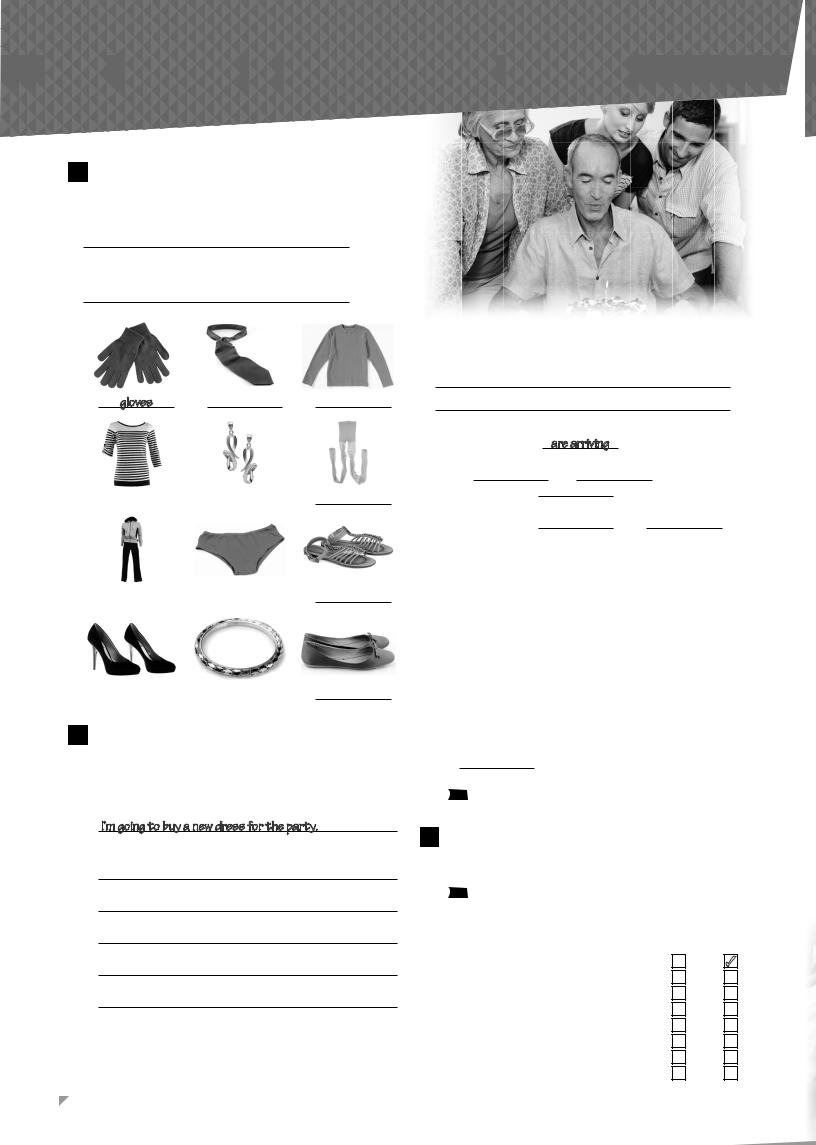
1 VOCABULARY
Clothes and appearance
a Match the pictures with the words in the box.
underwear tights sweatshirt tie high heels tracksuit gloves sandals earrings jumper flat shoes bracelet
1 |
gloves |
2 |
3 |
4 |
|
5 |
|
6 |
7 |
|
8 |
|
9 |
10 |
|
11 |
|
12 |
2 GRAMMAR
Present continuous and going to
a Put the words in the correct order to make sentences.
1buy / going / a new dress / I’m / the party / for / to .
I’m going to buy a new dress for the party.
2going / your wedding / you / are / invite / your / to / cousin / to ?
3aren’t / going / they / get married / to / this / year .
4going / are / do / after university / you / what / to ?
5visit / Spain next year / going / we’re / in / my relatives / to .
6to / you / are / wear / to / the party / what / going ?
bComplete the conversation with the present continuous forms of the verbs in the box. Use contractions where possible.
stay come bring |
not fly arrive take |
meet (x2) |
|
A So what have you arranged for this evening? |
|
||
B Well, my parents 1 |
are arriving |
at the station on the 6:30 |
|
train from Paris. |
|
|
|
A So, 2 |
you 3 |
them at the station? |
|
B Yes, we are. We 4 |
|
a taxi from our house at |
|
6:00. I booked it this morning. |
|
|
|
A Good. So where 5 |
|
they 6 |
? |
B At the Hilton Hotel. They’ve got a double room with a balcony.
AGreat. And what about the restaurant?
BI’ve reserved a table for eight at eight o’clock. Everyone
7 |
to the restaurant at 7:45 so we can all be |
|
|
|
|
there when they arrive. |
||
ABrilliant. Have you told the restaurant that it’s your father’s birthday?
BYes, they’ve made him a special cake with HAPPY 60TH on
|
it. They 8 |
|
|
it to our table at ten o’clock, together |
|
|
with the coffee. |
|
|
||
A |
And what about tomorrow? |
||||
B |
They 9 |
|
to Scotland until the afternoon, so |
||
|
there’s plenty of time. Their fl ight’s at 3:30. |
||||
A Great, so it’s all arranged. I have to go now because I
10 |
Sally for a coffee in ten minutes. See you later! |
|
c  4.1 Listen and check.
3 PRONUNCIATION
Sound and spelling: going to
a  4.2 Listen to going to in the sentences. Do you hear /g t/ (going to) or /g n/ (gonna)? Tick ( ) the correct box for each sentence.
|
/g t/ /g n/ |
|
1 |
Are you going to go out tonight? |
|
2 |
What are you going to do for your birthday? |
|
3 |
He isn’t going to have a holiday this year. |
|
4 |
We’re going to try to fi nd a taxi. |
|
5 |
I’m going to have a shower after breakfast. |
|
6 |
They aren’t going to do their homework. |
|
7 |
She’s going to phone her brother. |
|
8 |
I'm not going to go to Ibiza this year. |
|
22

 4B
4B
 Shall
Shall we
we go
go to
to the
the market?


1 GRAMMAR will / won’t / shall
a Match 1–8 with a–h to make sentences.
1c Let’s go on holiday to Greece next summer.
2 You know I don’t really like hot food.
3 Which fi lm shall we see with the kids?
4 Let’s invite your parents for lunch next Sunday.
5 Hello. I’m at the supermarket, but I can’t carry all the shopping on the bus.
6 Oh, no! We’ve just missed the last bus.
7 Hi, Dad. I’m afraid I’ve lost my mobile phone.
8 Oh, no. I haven’t got enough money to buy this tablet today.
aOK, shall I phone for a taxi, then?
bGood idea. I’ll call them this evening to see if they’re free.
cGood idea. I’ll go to the travel agent’s tomorrow.
dDon’t worry. I’ll buy you a new one for your birthday.
eOh, that’s a pity. Shall I lend you some money?
fDon’t worry. I’ll bring the car and meet you there in ten minutes.
gShall we go to the new Harry Potter fi lm?
hOK, so we won’t go to an Indian restaurant, then.
bUnderline the correct words to complete the sentences.
1A Will / Shall / Won’t we go to the cinema tonight? B Yes, OK. I ’ll / won’t / shall check which fi lms are
on and phone you back.
2A Hi, Dad. I’ve missed the last bus home!
B Don’t worry. I shall / won’t / ’ll bring the car into town and meet you by the cinema.
3What will / shall / won’t we do this weekend?
4Don’t worry. The station’s very near here, so you ’ll / shall / won’t miss your train.
5A Shall / Will / Won’t we try and get tickets for The Rolling Stones concert?
BGood idea. I won’t / shall / ’ll phone the ticket offi ce.
6Look, I know you’re a vegetarian, so I ’ll / won’t / shall cook steak for dinner.
7Will / Won’t / Shall I help you do the washing-up?
8A Let’s take Monica and Sara to that new Chinese
restaurant this evening.
BYes, that’s a great idea. I ’ll / won’t / shall call them and reserve a table for 7:30.
1
2 VOCABULARY Adjectives: places
a Complete the crossword puzzle.
2 |
3 |
|
4 A N C I E N T |
5 |
6 |
7 |
8 |
|
9 |
|
10 |
|
Across |
|
|
|
|
|
|
|
|
|
|
|
|
|
|
|
|||||
4 |
Stonehenge is an |
|
|
ancient |
|
monument in Wiltshire in |
|
||||||||||||||
|
England. It’s about 5,000 years old. |
|
|||||||||||||||||||
5 |
When the weather is really bad, we play on the i |
|
|
|
|
||||||||||||||||
|
tennis court at my local sports centre. |
|
|||||||||||||||||||
7 |
There are lots of h |
|
|
|
|
|
|
|
|
|
mountains in Switzerland. For |
|
|||||||||
|
example, the Matterhorn is about 4,500 metres above sea level. |
|
|||||||||||||||||||
8 |
I live in a very o |
|
|
|
|
|
|
town. Tourists never come here! |
|
||||||||||||
10 |
We live in a p |
|
|
|
|
|
village. There’s no traffi c at all! |
|
|||||||||||||
|
Down |
|
|
|
|
|
|
|
|
|
|
|
|
|
|
|
|||||
1 |
My school’s in a really m |
|
|
|
|
|
|
|
building. It’s only five years old. |
||||||||||||
2 |
This road is very n |
|
|
|
|
|
|
|
|
. It isn’t wide enough for a bus. |
|
||||||||||
3 |
The view from the top of the Empire State Building is m |
|
. |
||||||||||||||||||
6 |
It’s very n |
|
|
in this café, isn’t it? It’s diffi cult to hear you. |
|||||||||||||||||
9 |
The British Museum is h |
|
|
|
|
|
|
|
. There are nearly 600 rooms! |
||||||||||||
bChoose the opposites of the adjectives in bold. Use the words in the box.
modern high pretty outdoor quiet wide |
|
1 The streets in the old part of town are very narrow. |
wide |
2I think the new houses they’ve built are really ugly.
3There is a big indoor swimming pool in my town.
4That restaurant's always very crowded.
5This is one of the most ancient cities in Greece.
6The hills in the South of England are quite low.
3 PRONUNCIATION
Sound and spelling: want and won’t
a  4.3 Listen and underline the correct words to complete the sentences.
1We won’t / want to go swimming today.
2They want to / won’t take you to the old castle.
3I won’t / want to go to that restaurant again.
4You want to / won’t wait for the next train.
5I won’t / want to study English again next year.
6Tom and I want to / won’t invite him to our party.
23