Материал: Islamskaya_mysl
656 |
AB S T R A C T S |
|
|
V. I. Vovchenko
WITTGENSTEIN AND ISLAMIC ETHICS:
THE INTERPRETATION OF INTENTION
The article contains an analysis of the idea of intention in the philosophy of Ludwig Wittgenstein. It evaluates capabilities of his conception in the development of Ethics in the “Islamic context”. Author shows that Wittgenstein’s conception reveals a remarkable similarity to the fundamental assumption of Islamic Ethics, that is to direct connection (bind, cohesion, connectedness) between intention and action. It is shown that an adequate understanding of this connection requires consideration of the Wittgensteinian idea of internal relations. It is proved that intention is not a manifestation of a “soul substance”, “perception” or “feeling”. Interpretation of “intention” provides additional refinement while defining specific intention ad hoc. In conclusion author puts forward a hypothesis asserting utility of late Wittgenstein’s conception in the development of Islamic ethical theory.
H. Hanafi
OUR CIVILIZATIONAL POSITION
Hassan Hanafi (b. 1935) is a prominent contemporary Egyptian thinker and publicist and former dean of the Faculty of Philosophy at Cairo University (1988–1994). Hanafi’s dissertation “Exegesis of Phenomenology” (1977), which defended the applied value of intuitionism to the study and philosophical understanding of Muslim culture, brought him worldwide fame.
Hanafi’s following work, a paper delivered by the author at the First Arab Philosophical Congress in 1982 and published in Philosophical Studies in 1987, outlines the scholar’s cultural theory. According to the philosopher, contemporary Arab-Muslim culture is undergoing a severe crisis of self-determination. Hanafi is convinced that the revival of the classic heritage in the 19th and 20th centuries did the Ummah more harm than good: in each initiative of the traditionalists the inquisitive researcher discerns a replication of obsolete schemes of thought and behaviour that have lost their meaning throughout Islam’s centuries-long history. The position of Westerners, however, is no better: trying to join the cultural world of Europe, the latter, like conservatives, reduce cultural creativity to the sum of dead concepts that have no relation to the realities of today. Both traditionalists and advocates of Western rationalism, the professor notes, use the same herme-

AB S T R A C T S |
657 |
neutic strategies and do not even try to understand what and how exactly creates the unique face of culture. Only by defining the essence of the civilizational type and understanding its relation to its own heritage, to other cultures and to the actual sociocultural process, will the Muslim community be able to find a recipe for long-awaited reforms and genuine revival.
“Our Civilizational Position” is a manifesto, the result of many years of Hana- fi’s reflections on the fate of Eastern and Western civilizations. His four-volume work “Heritage and Renewal”, nine-volume work “From Imitation to Creativity”, and monumental “Muslim Studies” — these and many other books are devoted to the development of a qualitatively new methodology, allowing the humanities of the new generation to move from Oriental Studies to “Western Studies” and from the phenomenology of culture to systematic historiosophy. Considering the dialectical struggle between the Arab self and the Western Other, Hanafi is forced to admit the following fact: the contemporary Muslim world wanders in the maze of epigonism only because earlier, in the heat of medieval religious and political battles, the Islamic genius had lost sight of the freedom of speculation. Like the Iraqi existentialist al-Jubran (b. 1971), the Egyptian writer accuses the ideologues of “victorious theology” of political self-interest, which has hopelessly distorted not only the object of faith, but the very way of thinking of the heirs of the first Muslims. However, if the political process of the VIII–XI centuries ended with the decline of Arab thought, the political and cultural process of the XXI century should, according to the author’s plan, return the Ummah lost creativity, crystallizing in new theologemes and a new, balanced attitude to all three components of the autochthonous civilization position, the position that puts an end to both European expansion and the Arab fear of applied philosophy, “the philosophy of life”.
S. Yu. Boroday, D.V. Mukhetdinov
ISLAMIC THOUGHT: AN INVITATION TO THEMATIC READING
The article reviews the main topics of the yearbook “Islamic Thought: Tradition and Modernity” and has been prepared in connection with its fifth anniversary. Over the past five years the general concept of the Yearbook has remained unchanged: coverage of Arab-Muslim renewal thought, achievements of Russian religiousphilosophical school, and the most topical problems of contemporary Islamic studies. Over these years, a large number of works have been published, both authored and translated; translations from Arabic, English, French, Indonesian, and Tatar-Ot- toman have been made, all of which appeared in Russian for the first time, and both classical Muslim thinkers and contemporary thinkers and Islamic scholars are represented. In 2019 a new project grew out of the yearbook project — a series of

658 |
AB S T R A C T S |
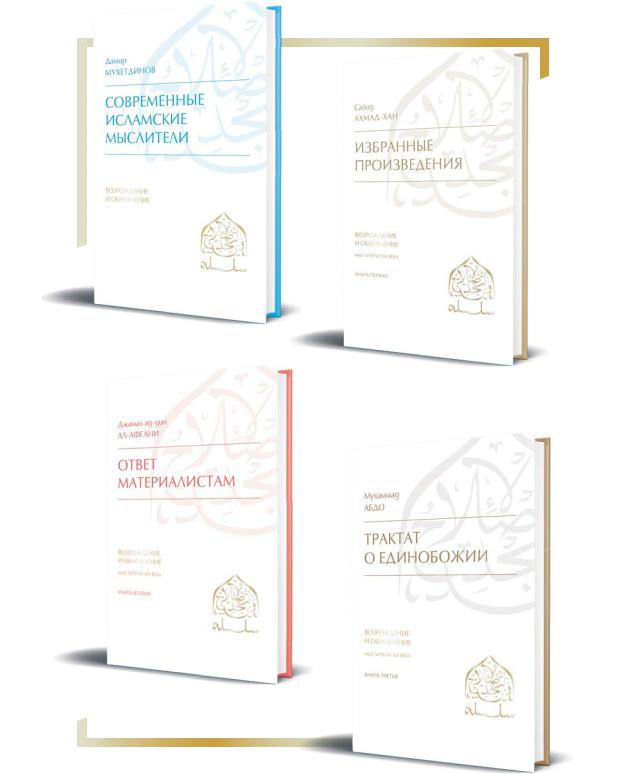
editions of “Revival and Renewal” (al-Islah wa-l-tа̄jdīd), within the framework of which the translation of 30 books and the preparation of three authors’ monographs are planned so far; the series concept involves the coverage of the works of the most prominent Muslim modernists and neomodernists of the XIX–XXI centuries. All editions have scientific prefaces and explanations, but despite this, the reader may be confused by this volume of literature, which is not surprising in light of the fact that most of the authors in question appear in Russian for the first time, and some are barely represented in other European languages as well.
In order to avoid such a situation, this article has been prepared. In it the author tries to show the thematic unity of the majority of the publications printed in the five volumes of the Yearbook, the unity which results from the focus of the project’s architects on the contemporary renewal movement (Neomodernism) and the problems associated with it. After a brief introduction, which sketches out in the most general and schematic way the context of the emergence of the Renewal movement, ten paragraphs are presented, dealing with the following topics: the general concept of Neomodernism and the approaches of individual thinkers; the critique of Islamic reason; the religious status of the Sunnah and Hadith; new ideas in Fiqh; religious pluralism and soteriology; comparative philosophy; Islamic feminism; Sufi hermeneutics of the Qur’an. The purpose of this article is to show the relationship between the works published in the five issues of the Yearbook and to give a brief overview of them, at the same time referring the reader to current Islamic literature on the topic. In the tenth paragraph, the article also presents a critical analysis of the phenomenon of the Renewal movement in its contemporary version — an analysis which can indicate the weaknesses of this movement and outline a possible overcoming of conceptual difficulties. This paragraph notes that Neomodernism is gradually transforming from a living thought into an ideological construct with its dogmas and non-reflexive provisions. Its weaknesses include: 1) insufficient attention to the peculiarities of the situation of modernity; 2) lack of comprehension of the relation between the ethical and the legal; 3) lack of a theory of the ethical; 4) insufficient attention to the procedure of thematization of values; 5) lack of an institutionalization strategy. The conclusion provides a productive critique of Neomodernism and paves the way for its further development.
Силсила «АЛ-ИСЛАХ ВА-Т-ТАДЖДИД»
МЫСЛИТЕЛИ XIX ВЕКА