Материал: Karl Marx_ A Biography ( PDFDrive )
126
K A R L M A R X : A B I O G R A P H Y
women as mere instruments of production; the present system was merely public and private prostitution.
It was also said that communists wished to abolish countries and nationality. But working men had no country. Modern industry was abolishing national differences and, with the disappearance of class antagonisms, hostility between nations would also end.
Sweeping value-laden condemnation of communism was not worthy, in Marx's view, of serious consideration. In a passage which minimised to the point of caricature the role of ideas in society Marx asked:
Does it require intuition to comprehend that man's ideas, views and conceptions, in one word, man's consciousness, changes with every change in the conditions of his material existence, in his social relations and in his social life?
What else does the history of ideas prove, than that intellectual production changes its character in proportion as material production is changed? The ruling ideas of each age have ever been the ideas of its ruling class.'56
Having dealt with these objections, Marx outlined the measures that would be taken by the proletariat once it had become the ruling class:
The proletariat will use its political supremacy to wrest, by degrees, all capital from the bourgeoisie, to centralise all instruments of production in the hands of the State, i.e. of the proletariat organised as the ruling class; and to increase the total of productive forces as rapidly as possible.157
In a section that was very largely inspired by Engels' draft, there followed a programme which included the abolition of landed property and inheritance, the imposition of income tax, the centralisation of credit and communications, state ownership of factories, and free education. He concluded:
When, in the course of development, class distinctions have disappeared and all production has been concentrated in the hands of a vast association of the whole nation, the public power will lose its political character. Political power, properly so called, is merely the organised power of one class for oppressing another. If the proletariat during its contest with the bourgeoisie is compelled, by the force of circumstances, to organise itself as a class, if, by means of a revolution, it makes itself the ruling class, and as such, sweeps away by force the old condition of production, then it will, along with these conditions, have swept away the conditions for the existence of class antagonisms and of classes generally, and will thereby have abolished its own supremacy as a class.
In place of the old bourgeois society, with its classes and class antag-
B R U S S E L S |
127 |
onisms, we shall have an association, in which the free development of each is the condition for the free development of all.'58
The third section of the Communist Manifesto contained criticism of three types of socialism - reactionary, bourgeois and Utopian. The first was a feudal socialism preached by the aristocracy to revenge themselves on the bourgeoisie who had supplanted them as the ruling class. Hand- in-hand with feudal socialism went Christian socialism which Marx simply dismissed as 'the holy water with which the priest consecrates the heartburnings of the aristocrat'.159 The second type - petty-bourgeois socialism - was chiefly represented by the French economist Sismondi. This school had well analysed the contradictions inherent in modern methods of production; but in its positive proposals it was reactionary, wishing to restore corporate guilds in manufacture and patriarchal relations in agriculture. The third party, labelled by Marx reactionary socialists, were the 'true' socialists. These were the German philosophers (mainly the followers of Feuerbach) who had emasculated French socialism by turning it into a metaphysical system. This was inevitable in an economically backward country like Germany where ideas tended not to reflect the struggle of one class with another. These philosophers thus claimed to represent ' . . . not true requirements, but the requirements of Truth; not the interests of the proletariat, but the interests of Human Nature, of Man in general, who belongs to no class, has no reality, who exists only in the misty realm of philosophical fantasy.'160
In the Manifesto's review of socialist and communist literature the second section - devoted to bourgeois socialism - was short. Proudhon was the main representative of this tendency and Marx had already devoted considerable space to examining his theories. Here he confined himself to observing that 'the Socialistic bourgeois want all the advantages of modern social conditions without the struggles and dangers necessarily resulting therefrom. They desire the existing state of society minus its revolutionary and distintegrating elements. They wish for a bourgeoisie without a proletariat.'161 Thus the reforms advocated by these socialists in no respect affected the relations between capital and labour, but they did at least lessen the cost and simplify the administrative work of bourgeois government.
The final school discussed was the 'critical-Utopian' school represented by such writers as Saint-Simon, Fourier and Owen. It originated during the early, inchoate period of the struggle between the bourgeoisie and the proletariat. These writers had perceived class antagonisms; but in their time the proletariat was still insufficiently developed to be a credible force for social change. Hence they wished to attain their ends by peaceful
126 |
K A R L M A R X : A B I O G R A P H Y |
|
|
|
|
|
|
|
|
|
|
|
|
|
|
|
|
|
|
|
|
|
|
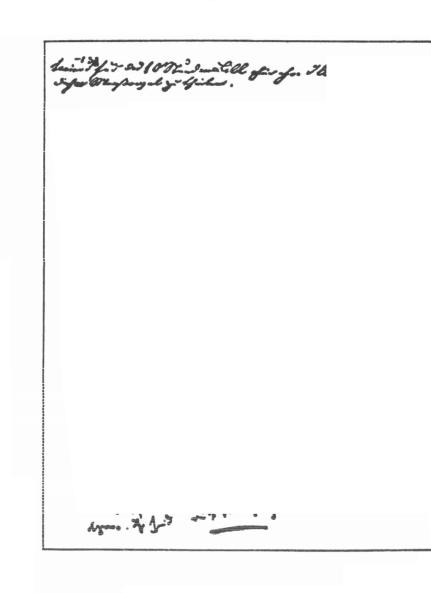
only surviving page from a draft of the Communist Manifesto. The two lin< \e top are in Jenny Marx's handwriting.
B R U S S E L S |
127 |
means and small-scale experiments, rejecting political - and in particular revolutionary - action. Their Utopias, envisaged at a time when the proletariat was still underdeveloped, 'correspond with the first instinctive yearnings of that class for a general reconstruction of society'.162 But at the same time these Utopian writings also contained critical elements: since they attacked every principle of existing society, they were full of insights valuable to the enlightenment of the working class. But as the modern class-struggle gathered strength, these Utopian solutions lost all practical value or theoretical justification. Thus 'although the originators of these systems were, in many respects, revolutionary, their disciples have, in every case, formed mere reactionary sects'.165
T h e fourth and concluding section of the Manifesto dealt with the attitude of communists to various opposition parties: in France they supported the social democrats, in Switzerland the radicals, in Poland the peasant revolutionaries, in Germany the bourgeoisie. Nevertheless in Germany they never ceased to instil into the working class the clearest possible recognition of the inherent antagonism between bourgeoisie and
proletariat. T h e communists |
directed their attention chiefly to Germany, |
which they believed to be |
on the eve of a bourgeois revolution. T h e |
Manifesto ended: |
|
The Communists disdain to conceal their views and aims. They openly declare that their ends can be attained only by the forcible overthrow of all existing social conditions. Let the ruling classes tremble at a communistic revolution. The Proletarians have nothing to lose but
their chains. They have a world to win. Working men of all countries, unite!164
In a sense, of course, virtually all the ideas contained in the Communist Manifesto had been enunciated before - particularly among French socialists in whose tradition the Manifesto is firmly situated.165 Babeufs ideas on revolution, Saint-Simon's periodisation of history and emphasis on
industry, Considerant's Manifeste, all inspired aspects of Marx's work. |
And |
lie himself was the first to admit that the concept he began with - |
that |
of class - was used long before by French bourgeois historians.166 But the powerful, all-embracing synthesis and the consistently materialist approach were quite new.
T h e Manifesto was a propaganda document hurriedly issued on the eve of a revolution. Marx and Engels considered in 1872 that 'the general principles expounded in the document are on the whole as correct today as ever' though they would doubtless have modified radically some of its ideas - particularly (in the light of the Paris Commune) those relating to the proletariat's taking over of the state apparatus and the rather simplistic
K A R L M A R X : A B I O G R A P H Y
statements on pauperisation and class polarisation.167 For all the clarity and force that later made it a classic, the publication of the Manifesto went virtually unnoticed. Before it was off the presses, the 1848 revolutions had already begun.
N O T E S
1.Jenny Marx to Marx, MEGA 1 v 449.
2.The date of her birth on the Highgate cemetery stone is mistaken. See H.
|
Monz, Karl Marx und Trier, p. 171. |
j . |
Engels to Marx, MEW XXVII 19. |
4. |
Cf. Jenny Marx, 'Short Sketch of an Eventful Life', in Reminiscences of Marx |
|
and Engels, p. 222. |
5.Weydemeyer to Luise Liining, Munchner Post, 30 April 1926.
6.Cf. MEW HI 537.
7.Engels to Marx, MEW XXVII 16.
8.Cf. MEW 11 519.
9.MEW xxi 212. Engels' 'History of the Communist League' is translated in
The Birth of the Communist Manifesto, ed. D. Struik (New York, 1971). 10. MESW 1 29.
11 . F. Engels, 'Ludwig Feuerbach und der Ausgang der klassischen Deutschen Philosophie', MEW xxi 264.
12. K. Marx, 'Preface to A Critique of Political Economy', MESW 1 364.
13.K. Marx and F. Engels, The German Ideology (Moscow, 1968) p. 659.
14.Ibid.
15.Ibid., p. 660.
16.Ibid.
17.Ibid., p. 662.
18. F. |
Engels, |
'History of the Communist League', MEW xxi 212, in Struik, |
op. |
cit., p. |
156. |
19.Cf. Marx to Leske, MEW xxvii 450.
20.Engels to Marx, MEW xxxn 510.
21. On Harney and the Fraternal Democrats see further: A. Schoyen, The Chartist Challenge (London, 1958) pp. 143 ff; J. Braunthal, History of the International
(London, 1967) 1 62 ff.
22.The landlord.
23.Jenny Marx to Marx, quoted in L. Dornemann, Jenny Marx, p. 81.
24.Marx to Leske, ME W XXXVII 448 f.
25.B. Bauer, 'Charakteristik Ludwig Feuerbachs', Wigandsvierteljahrschrift (1845) HI 138.