Материал: Myth A Very Short Introduction by Robert A. Segal

5. John F. Kennedy, Jr, on the front cover of Us Weekly, June 2000
Myth
President of the United States (by the Electoral College) in 1789, was then unanimously re-elected, and would have been re-elected anew had he been willing to serve. He was held in such awe that many revolutionaries feared that he or his supporters would establish a monarchy and thereby undo the republican goals for which the Revolution had been fought. His resistance to this temptation made him even more revered.
The reverence accorded Washington by Americans in his time and long afterwards bordered on deification, and the treatment of him constituted virtual worship. Even before he became the first President, let alone while and after he served, there were coins bearing his image, an unprecedented number of paintings and sculptures of him, songs and poems praising him, counties
and towns named after him, elaborate celebrations of his birthdays, and tumultous receptions for him wherever he went. For Eliade, a myth honours its subject’s establishing something
58
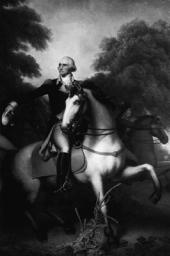
6. George Washington before Yorktown, 1824–5, by Rembrandt Peale
in the physical or social world that continues to this day – in the case of Founding Father Washington, America itself. A historian’s description of the birthday celebrations during Washington’s presidency captures the ‘cult’ of Washington:
By 1791, two years after he took office, the ‘monarchical’ and ‘idolatrous’ celebration of his birthday had become a national custom. There was hardly a town anywhere too small to have at least one ball or banquet on that day to honor Washington. . . . It was a national event, equaled only by July Fourth in enthusiasm and resplendence. The birth of the nation and the birth of Washington had become commemorative touchstones for the American people. . . . [T]he observance of Washington’s Birthday took on the character of a religious rite. . . . Washington’s Birthday was indeed a sacred day: a time for communion, a time when the sanctity of the nation, and the strength of the people’s attachment to it, could be reaffirmed.
(Schwartz, George Washington, pp. 77–9)
religion and Myth
59
Long after his death, the celebration of Washington’s birthday, which even today remains a national holiday, served not merely to commemorate his deeds but to bring them, and him, alive. Part of the celebration – the ritual – was the recitation of the highpoints of his biography – the myth. The bandied American line ‘George Washington slept here’ evinces the ultimate function of myth of Eliade: providing contact with a deity.
Of course, a sceptic can demur. Is a human hero, however revered, quite a divinity? Is celebration quite equivalent to worship? Does the celebration of a dead hero’s life really bring the hero back to life? Do celebrants really believe that they have travelled back in reality and not merely in their imagination? And in so far as the social sciences explain the lasting accomplishments of heroes, what is left for myth to explain? As affecting as Eliade’s effort to secure a firm place for myth in the modern, scientific world is, is it convincing?
Myth
60
Chapter 4
Myth and ritual
Myth is commonly taken to be words, often in the form of a story. A myth is read or heard. It says something. Yet there is an approach to myth that deems this view of myth artificial. According to the myth and ritual, or myth-ritualist, theory, myth does not stand by itself but is tied to ritual. Myth is not just a statement but an action. The least compromising form of the theory maintains that all myths have accompanying rituals and all rituals accompanying myths. In tamer versions some myths may flourish without rituals or some rituals without myths. Alternatively, myths and rituals may originally operate together but subsequently go their separate ways. Or myths and rituals may arise separately but subsequently coalesce. Whatever the tie between myth and ritual, the myth-ritualist theory differs from other theories of myth and
from other theories of ritual in focusing on the tie.
William Robertson Smith
The myth-ritualist theory was pioneered by the Scottish biblicist and Arabist William Robertson Smith (1846–94). In his Lectures on the Religion of the Semites Smith argues that belief is central to modern religion but not to ancient religion, in which ritual was central. Smith grants that ancients doubtless performed rituals only for some reason. But the reason was secondary and could even fluctuate. And rather than a formal declaration of belief, or a creed,
61
the reason was a story, or a myth, which simply described ‘the circumstances under which the rite first came to be established, by the command or by the direct example of the god’.
Myth itself was ‘secondary’. Where ritual was obligatory, myth was optional. Where ritual was set, any myth would do. And myth did not even arise until the original, nonmythic reason given for the ritual had somehow been forgotten:
Myth
the myth is merely the explanation of a religious usage; and ordinarily it is such an explanation as could not have arisen till the original sense of the usage had more or less fallen into oblivion.
(Smith, Lectures on the Religion of the Semites, p. 19)
While Smith was the first to argue that myths must be understood vis-à-vis rituals, the nexus by no means requires that myths and rituals be of equal importance. For Smith, there would never have been myth without ritual, whether or not without myth there would have ceased to be ritual.
Because Adonis was a Semitic god, Smith includes him in his Lectures. As part of his overall argument that ancient religion had no sense of sin, so that sacrifice – the main ritual – was not penance, he contrasts the amoral, mythic explanation for the ritualistic ‘wailing and lamentation’ over the dead Adonis to the later, ‘Christian idea that the death of the God-man is a death for the sins of the people’:
[I]f, as in the Adonis myth, an attempt is made to give some further account of the annual rite than is supplied by the story that the god had once been killed and rose again, the explanation offered is derived from the physical decay and regeneration of nature. The Canaanite Adonis or Tammuz . . . was regarded by his worshippers as the source of all natural growth and fertility. His death therefore meant a temporary suspension of the life of nature . . . And this death of the life of nature the worshippers lament out of natural
62