Материал: Myth A Very Short Introduction by Robert A. Segal
Myth
source of events in the physical world, so that Adonis becomes, at least on the literal level, the god of vegetation. As the god of vegetation, Adonis could, most simply, have been asked for crops. Or the request could have been reinforced by obedience to the god’s ritualistic and ethical dictates. Frazer himself writes that rites of mourning were performed for Adonis – not, as in the next stage, to undo his death but to seek his forgiveness for it. For Adonis has died not, as in the next stage, because he has descended to the Underworld but because in cutting, stamping, and grinding the corn – the specific part of vegetation he symbolizes – humans have killed him. Rather than ‘the natural decay of vegetation in general under the summer heat or the winter cold’, the death of Adonis is ‘the violent destruction of the corn by man’. Yet Adonis is somehow still sufficiently alive to be capable of punishing humans, something that the rituals of forgiveness are intended to avert. Since, however, Adonis dies because vegetation itself does, the god is here really, as in the first stage, only a metaphor for the element that he supposedly controls. Again, as vegetation goes, so goes Adonis.
In Frazer’s third, combined stage Adonis seems at last a god. If in stage two as vegetation goes, so goes Adonis, now as Adonis goes, so seemingly goes vegetation. Adonis’ death means his descent to the Underworld for his stay with Persephone. Frazer assumes that whether or not Adonis has willed his descent, he is too weak to ascend by himself. By acting out his rebirth, humans facilitate it. On the one hand the enactment employs the magical Law of Similarity. On the other hand the enactment does not, as in the first stage, compel but only bolsters Adonis, who, despite his present state of death, is yet hearty enough to revive himself, just not unassisted. In this stage gods still control the physical world, but their effect on it is automatic rather than deliberate. To enact the rebirth of Adonis is to spur his rebirth and, through it, the rebirth of vegetation.
Yet even in this stage the sole aspect of Adonis’ life considered by Frazer is that which parallels the annual course of vegetation: Adonis’ death and rebirth. Adonis’ otherwise unnatural life, beginning with
68
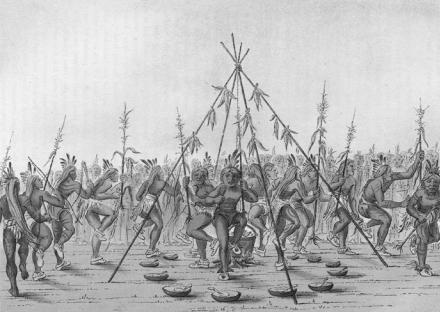
7. The Green Corn fertility dance of the Minatarees of North America, 19th-century illustration by George Catlin
his incestuous birth, is ignored. Ignored above all is Adonis’ final death, the unnatural cause – killing, even murder – aside. And so Frazer must do. For if Adonis’ life is to symbolize the course of vegetation, Adonis must continually die and be reborn. Yet he does not. By whatever means Adonis in Apollodorus’ version overcomes death annually, he does not do so indefinitely. In Ovid’s version Adonis has never before died and been reborn, and Venus is disconsolate exactly because he is gone once and for all. How, then, can his short, mortal life symbolize eternal rebirth, and how can he be a god? Frazer never says.
Finally, Frazer, once again oblivious to consistency, simultaneously declares Adonis’ life in even the combined stage to be but a symbol of the course of vegetation itself: the myth that Adonis spent a portion of the year in the Underworld
Myth
is explained most simply and naturally by supposing that he represented vegetation, especially the corn, which lies buried in the earth half the year and reappears above ground the other half.
(Frazer, The Golden Bough, p. 392)
Adonis now proves to be not the cause of the fate of vegetation but only a metaphor for that fate, so that in stage three as well as in stage two as vegetation goes, so goes Adonis, and not vice versa. How myth-ritualism is possible when there is no longer a god to be ritualistically revived and when there is only a description, not an explanation, of the course of vegetation is not easy to see. In now taking mythology as a symbolic description of natural processes, Frazer is like a group of largely German nineteenth-century theorists known appropriately as nature mythologists.
Jane Harrison and S. H. Hooke
The next stage in the myth-ritualist theory came with Jane Harrison (1850–1928) and S. H. Hooke (1874–1968), the English leaders of the initial main groups of myth-ritualists: classicists and biblicists.
70
Their positions are close. Both largely follow Frazer’s first mythritualist scheme, though Hooke, nearly as inconsistent as Frazer, sometimes follows the second scheme. Unlike Frazer, Hooke and Harrison postulate no distinct, prior stages of magic and of religion. Both begin instead with the equivalent of Frazer’s combined stage. Like Frazer, they deem myth-ritualism the ancient and primitive counterpart to modern science, which replaces not only myth-ritualism but myth and ritual per se. Harrison and Hooke follow Frazer most of all in their willingness to see heretofore elevated, superior religions – those of Hellenic Greece and of biblical Israel – as primitive. The conventional, pious view had been, and often continues to be, that Greece and Israel stood above the benighted magical endeavours of their neighbours.
Venturing beyond both Frazer and Hooke, Harrison adds to the ritual of the renewal of vegetation the ritual of initiation into society. She even argues that the original ritual, while still performed annually, was exclusively initiatory. There was no myth, so that for her, as for Smith, ritual precedes myth. God was only the projection of the euphoria produced by the ritual. Subsequently, god became the god of vegetation, the myth of the death and rebirth of that god arose, and the ritual of initiation became an agricultural ritual as well. Just as the initiates symbolically died and were reborn as fully fledged members of society, so the god of vegetation and in turn crops literally died and were reborn. In time, the initiatory side of the combined ritual faded, and only the Frazerian, agricultural ritual remained.
Against Smith, Harrison and Hooke alike deny vigorously that myth is an explanation of ritual: ‘The myth’, states Harrison, ‘is not an attempted explanation of either facts or rites.’ But she and Hooke really mean no more than Frazer. Myth is still an explanation of what is presently happening in the ritual, just not of how the ritual arose. Myth is like the sound in a film or the narration of a pantomime. Writes Hooke: ‘In general the spoken part of a ritual consists of a description of what is being done . . . This is the sense
ritual and Myth
71
in which the term ‘‘myth’’ is used in our discussion.’ Harrison puts it pithily: ‘The primary meaning of myth . . . is the spoken correlative of the acted rite, the thing done’.
Both Harrison and Hooke go further than Frazer. Where for him the power of myth is merely dramatic, for Harrison and Hooke it is outright magical. ‘The spoken word’, writes Hooke, ‘had the efficacy of an act’. ‘A myth’, writes Harrison, ‘becomes practically a story
of magical intent and potency.’ We have here word magic. Contemporary myth-ritualists like the American classicist Gregory Nagy appeal to the nature of oral, as opposed to written, literature to argue that myth was originally so closely tied to ritual, or performance, as to be ritualistic itself:
Myth
Once we view myth as performance, we can see that myth itself is a form of ritual: rather than think of myth and ritual separately and only contrastively, we can see them as a continuum in which myth is a verbal aspect of ritual while ritual is a notional aspect of myth.
(Gregory Nagy, ‘Can Myth Be Saved?’, p. 243)
How this position goes beyond that of Hooke and Harrison is far from clear.
Application of the theory
The classicists Gilbert Murray, F. M. Cornford, and A. B. Cook, all English or English-resident, applied Harrison’s theory to such ancient Greek phenomena as tragedy, comedy, the Olympic Games, science, and philosophy. These seemingly secular, even antireligious, phenomena are interpreted as latent expressions of the myth of the death and rebirth of the god of vegetation.
Among biblicists, the Swedish Ivan Engnell, the Welsh Aubrey Johnson, and the Norwegian Sigmund Mowinckel differed over the extent to which ancient Israel in particular adhered to the myth-ritualist pattern. Engnell sees an even stronger adherence
72