Материал: Myth A Very Short Introduction by Robert A. Segal
|
(1) |
The hero’s mother is a royal virgin; |
|
(2) |
His father is a king, and |
|
(3) |
Often a near relative of his mother, but |
|
(4) |
The circumstances of his conception are unusual, and |
|
(5) |
He is also reputed to be the son of a god. |
|
(6) |
At birth an attempt is made, usually by his father or his |
|
|
maternal grandfather, to kill him, but |
|
(7) |
He is spirited away, and |
|
(8) |
Reared by foster-parents in a far country. |
|
(9) |
We are told nothing of his childhood, but |
|
(10) |
On reaching manhood he returns or goes to his future |
|
|
kingdom. |
|
(11) |
After a victory over the king and/or a giant, dragon, or |
|
|
wild beast, |
Myth |
(12) |
He marries a princess, often the daughter of his pre- |
|
decessor, and |
|
|
|
|
|
(13) |
Becomes king. |
|
(14) |
For a time he reigns uneventfully, and |
|
(15) |
Prescribes laws, but |
|
(16) |
Later he loses favour with the gods and/or his subjects, |
|
|
and |
|
(17) |
Is driven from the throne and city, after which |
|
(18) |
He meets with a mysterious death, |
|
(19) |
Often at the top of a hill. |
|
(20) |
His children, if any, do not succeed him. |
|
(21) |
His body is not buried, but nevertheless |
|
(22) |
He has one or more holy sepulchres. |
|
|
|
Raglan’s hero myth pattern, from The Hero
88
of the god from one king to another. There is really no myth at all. Raglan, by making the heart of hero myths not the attainment of the throne but the loss of it, matches the myth of the hero with the Frazerian ritual of the removal of the king. The king in the myth who loses his throne and later his life parallels the king in the ritual who loses both at once. The myth that Raglan links to ritual is not that of a god but that of a hero – some legendary figure whose selflessness real kings are expected to emulate. Strictly, then, the myth is less the script for the ritual, as in Frazer’s first myth-ritualist scenario, than the inspiration for the ritual.
Unlike the patterns of Tylor, Propp, or, as we shall see, either Rank or Campbell, Raglan’s, like von Hahn’s, covers the whole of the hero’s life.
Raglan equates the hero of the myth with the god of the ritual. First, the king connects the hero to the god: heroes are kings, and kings are gods. Second, many of the events in the life of the hero are superhuman, especially points 5 and 11. True, the hero must die, but his death accomplishes a god-like feat: reviving vegetation. Third, in both the myth and the ritual the removal of the king ensures the survival of the community, which would otherwise starve. In both myth and ritual the king is a saviour.
Doubtless Raglan would never expect Adonis to fit his pattern. While points 1 through 4 seem to fit snugly, few of the others fit at all. For example, there is an attempt on the life of Adonis’ mother but no attempt on Adonis’ own life, at least at the outset (point 6). Perhaps Adonis can be said to have been raised by foster parents – Aphrodite and Persephone – and in a distant land (point 8), but not because he has been spirited away (point 7). Most important, Adonis never becomes king and so has no throne to lose. He does lose his life, but not while reigning as king, or even while living in a society. Of all of Raglan’s chosen examples, the one that fits best is Oedipus. A biblical hero who would fit almost as well is King Saul. Unlike Frazer, Raglan is too timid to mention the case of Jesus. A modern example
literature and Myth
89
Myth
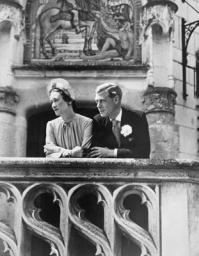
9. The Duke and Duchess of Windsor on their wedding day, June 1937, after Edward’s abdication
would be King Edward VIII of England, the heart of whose life was his abdication.
What matters in this chapter is the centrality of the plot to Raglan’s theory. Raglan appeals to the commonality of the plot to argue that the meaning of hero myths lies in that common plot, that the heart of the common plot is the loss of the throne, and that only an accompanying ritual of regicide makes sense of the common focus in the myth on the toppling of the king. Raglan’s myth-ritualism does not merely make the plot the scenario for the ritual but argues for the ritual from the plot.
90
Chapter 6
Myth and psychology
There are multiple theories in each discipline that have contributed to the study of myth. In psychology, two theories have almost monopolized the field: those of the Viennese physician Sigmund Freud (1856–1938) and of the Swiss psychiatrist C. G. Jung (1875–1961).
Sigmund Freud
While Freud analyses myths throughout his writings, his main discussion of his key myth, that of Oedipus, fittingly occurs in The Interpretation of Dreams, for he, and Jung as well, parallel myths to dreams:
If Oedipus Rex moves a modern audience no less than it did the contemporary Greek one, the explanation can only be that its effect does not lie in the contrast between destiny and human [free] will, but is to be looked for in the particular nature of the material on which that contrast is exemplified. There must be something [latent] which makes a voice within us ready to recognize the compelling force of destiny in the Oedipus. . . . His [Oedipus’] destiny moves us only because it might have been ours – because the oracle laid the same curse upon us before our birth as upon him. . . .
Our dreams convince us that that is so. King Oedipus, who slew his father Laı¨us and married his mother Jocasta, merely shows us the
91
Myth
fulfilment of our own childhood wishes. But, more fortunate than he, we have meanwhile succeeded, in so far as we have not become psychoneurotics, in detaching our sexual impulses from our mothers and in forgetting our jealousy of our fathers.
(Freud, Interpretation of Dreams, IV, pp. 262–3)
On the surface, or manifest, level, the story of Oedipus describes that figure’s vain effort to elude the fate that has been imposed on him. Latently, however, Oedipus most wants to do what manifestly he least wants to do. He wants to act out his ‘Oedipus Complex’. The manifest, or literal, level of the myth hides the latent, symbolic meaning. On the manifest level Oedipus is the innocent victim of Fate. On the latent level he is the culprit. Rightly understood, the myth depicts not Oedipus’ failure to circumvent his ineluctable destiny but his success in fulfilling his fondest desires.
Yet the latent meaning scarcely stops here. For the myth is not ultimately about Oedipus at all. Just as the manifest level, on which
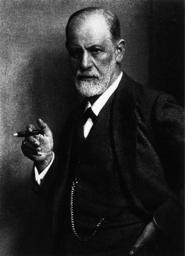
10. Sigmund Freud
92