Материал: Russian Journal of Building Construction and Architecture

Russian journal of building construction and architecture
fying different urban areas, it is necessary to analyze the intensity of their functional processes. An urban structure consists of three types of urban space: hub, surface, axis. An urban hub is characterized by an intense flow of functional processes and it concentrates population in one point.
Less intensive functional processes that localize population across the territory characterize an urban surface. Functional processes of urban axes are the processes that organize population expressed by a linear extent in space. Hubs, surfaces and axes in their unity and interconnection form the integral functional and spatial structure of the city, or its urban framework.
Moreover, studying of functional and spatial urban structure becomes one of the main tasks for specialists, as this is important for urban development management. "Planning structure is always illustrated in the scheme of urban transport communications and associated with the structure of public centers. To these axes and centers gravitate intensively developed urban areas. In combination, they form basis for territorial planning and urban organization –– creation of urban framework [17].
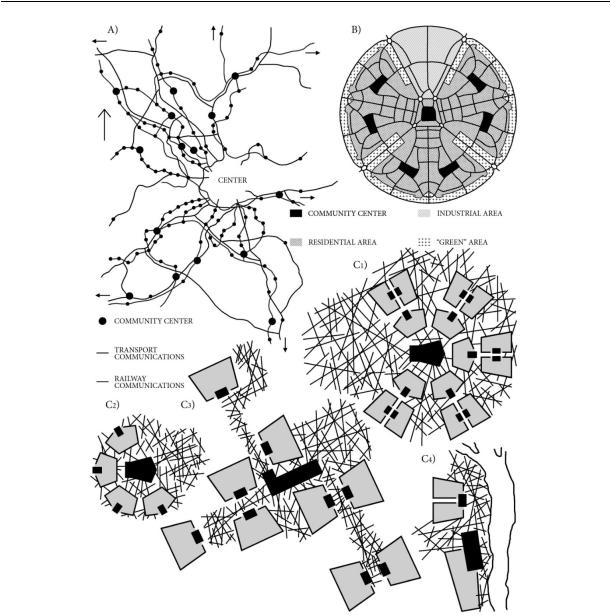
With the urban growth, city and its framework become more complicated because of the transformation of spatial and functional relations, their quantity etc. A city takes the form of a polycentric structure that is expressed in the structural formation of urban hubs. Nowadays historical city center is connected with different infrastructural subcenters. Studying the principles of urban spatial and functional formation is one of the most important tasks for urban planners (Fig. 2).
In modern urban development concept "center" no longer fits the ideas about the most intensively developed area of the historic core. It is more correct to speak about the system of centers, including urban hubs. The formation of the urban structural framework and the system of urban hubs will balance and harmonize urban functional and spatial organization, and thus sociology. In this approach, Central part of the city and its periphery do not contradict each other but create single functional and spatial structure of the urban environment. In this case historical center district is one of the elements of the system.
According to Pereni (scientist who studied polycentric tendencies in the 1970s), one of the fundamental tasks during agglomerations’ reconstruction is development of an urban center system which necessitates transformation of residential areas into their rational system. This does not mean complete transformation of agglomerations into a single "body", abandoning the idea of codependent residential areas" [22].
96
Issue № 1(33), 2017 |
ISSN 2542-0526 |
Fig. 2. Polycentric urban structures: a) Polycentric development of Stockholm (according to Master plan 2050) [26, p. 288]; b) New town structure[27, p. 9];c1––c4) Connections between community centers [23, p. 21]: c1) City; c2) Small town; c3) Conurbation; c4) City with natural or artificial water object
Formation of the urban hubs’ system in Voronezh city (Russia)
Following the Soviet Union period, Russian Federation lost its “second cities” such as Kiev, Minsk, Baku, etc. In this situation, country faced the problem of new megalopolises’ development [13, 28, 29, 31]. This is still necessary for the creation of the settlement’s framework as a part of the new geopolitical space. According to this condition, Voronezh city becomes one of the main urban centers such as Yekaterinburg, Kazan, and Nizhny Novgorod, etc.
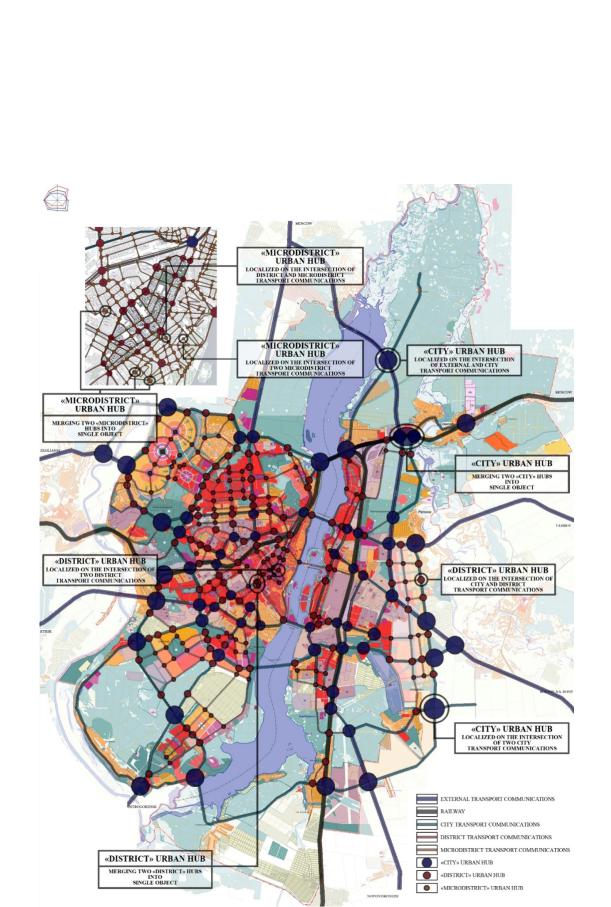
The concept of urban hub’s system (Fig. 3) is based on textual and illustrative materials of the city’s Master plan (stated in 2008 and in force until 2020).
97
Russian journal of building construction and architecture
One of the basic concepts in the process of system’s formation is dependence of an urban hub rank (the number of objects in its structure, its spatial development, etc.) on the rank of transport communications in the structure of which intersection it is localized. In other words, the concept of the city’s transport framework influences the concept of urban hubs’ system. The development of the latter is subordinated to any particular scenario of the transport framework and has numerous variants of the development.
Fig. 3. Urban hubs’ system. Voronezh city (Russian Federation)
98

Issue № 1(33), 2017 |
ISSN 2542-0526 |
Today experts often note the development of a multicomponent transport structure. It is difficult to imagine a modern city without inclusion of air-, railway-, public and individual transport networks [14, 28, 31]. According to this, formation of the urban hubs is one of the top-priority goals in the development of the city’s infrastructure. Such hubs serve as a transfer point of different types of external and internal transport including their structure, as a rule, stations of different transports and numerous of other infrastructural objects.
The structural framework of the system of Voronezh urban hubs is based on the simplified scheme of the city’s transport infrastructure. In initial materials, a more extensive typology of the main streets and roads is carried out: external transport networks, internal highways, internal transport networks with traffic lights, district transport networks and central transport network. For the sake of simplification of the initial typology of the main streets and roads, the following typology of transport communications is presented in the new scheme: external transport networks, city transport networks, district transport networks, microdistrict/quarter transport networks.
The structural framework of the urban hub system illustrates the location of different hubs, among them are hubs with the “City” rank, hubs with the “District” rank [15].
The total number of potential “City” hubs is 60, among them 20 are located in the territory without any buildings and 40 are part of the structure of existing urban environment.
In the first case, it is possible to design an urban hub “from a blank sheet” which certainly gives a designer more opportunities to create a multicomponent infrastructure. In the second case, it is necessary to consider existing objects. The principles of a system formation of urban objects are directed to the implementation of the step-by-step reconstruction and modernization of urban hubs due to systematic saturation of their structure by new elements, replacement and elimination of existing. Such an approach leads to the step-by-step “reorganization” of an urban environment.
The total number of “District” urban hubs is 212, the prevailing majority is localized in structure of existing urban environment. The principles of their formation is similar to those of the formation of the “District” urban hubs.
Analysis of the components of the structural framework showed a ratio of urban hubs. According to the principles of hierarchical structuring, the quantity of components of each level increases in the process of consideration from the highest to the lowest levels.
For the urban environment, both are important, i.e. existence of various profile objects of a city value (in the structure of the “City” hubs) as they meet the requirements of the entire
99

Russian journal of building construction and architecture
population and local infrastructural objects (in the structure of the“District” hubs). The number of “District” hubs has to be much higher according to the need of a five-minute availability of various services.
Conclusion
Experts regard the systematic approach, which focuses on studying various classes and types of systems, basic principles and regularities of their behavior and processes of their functioning and development, as the most effective method for solving various urban problems. In this case, urban environment is analyzed using three main defining characteristics: composition of the system (urban systems and their components that make up urban environment), structure (relationships of different parts as a whole), and environment in which all processes are organized (both external and internal ones). This of course leads to the consolidation of the basic idea, i.e. mapping the city with a complex object.
References
1.Avdotyin L. N., Lejava I. G., Smolyar I. M. Urban design. Moscow, Stroiizdat Publ., 1989. 432 p.
2.Afanas’ev V. Systematic and society. Moscow, Politizdat Publ., 1980.
3.Barkhin M. Masters of Soviet architecture about architecture. Moscow, Art. Publ., 1975, vol. 1.
4.Barkhin M. Masters of Soviet architecture about architecture. Moscow, Art. Publ., 1975, vol. 2.
5.Hall P. Cities of tomorrow: an intellectual history of urban planning and design in the twentieth century. Oxford, Blackwell Publishers Ltd, 1988. 502 p.
6.Haken H., Karlqvist A., Svedin U. The machine as metaphor and tool. Berlin, Springer-Verlag, 1993. 165 p.
7.Hauck T., Keller R., Kleinekort V. Infrastructural urbanism. Addressing the in-between. Berlin, DOM publishers, 2011. 335 p.
8.Hojer M., Gullberg A., Pettersson R., Ahlroth S. Images of the future city: time and space for sustainable development. Stockholm, Springer, 2011. 488 p.
9.Korotaev V. Formation of transport urban hubs as a main step of Moscow general plan’s realization. Urban planning, Moscow, 2014.
10.Kriken J. L., Enquist P., Rapaport R. City building. Nine planning principles for the twenty-first century. NY, Princeton Architectural Press, 2010. 260 p.
11.Landry C. The creative city: a toolkit for urban innovators. London, Earthscan Publications Ltd, 2000. 300 p.
12.Lavrik G. Methodological bases of regional planning. Introduction to demonology. Belgorod, BSTU. V. G. Shukhov. 2006.
13.Liventceva A., Yenin A. Analysis of modern tendencies in the field of the biggest cities reconstruction. Pershin publishing company. Tambov, 2014.
14.Liventceva A. Analysis of the transport structure. Implementation of the urban hub’s structural scheme on the example of Voronezh city. Architectural Researches. Voronezh, 2015.
15.Liventceva A. Principles of territorial-systematic and typological classification of the urban hubs. Scientific Herald of the Voronezh State University of Architecture and Civil Engineering, Voronezh.
100