Материал: Russian Journal of Building Construction and Architecture

BUILDING STRUCTURES,BUILDINGS AND CONSTRUCTIONS
UDC 624
V. I. Travush1, N. V. Fedorova2
SURVIVABILITY PARAMETER CALCULATION
FOR FRAMED STRUCTURAL SYSTEMS
Ltd. "Gorproekt"
Russia, Moscow, Akademika Tupoleva str., 15, building. 15, e-mail: travush@mail.ru 1Academician of RAACS, D. Sc. in Engineering, Prof.,
Southwest State University
Russia, Kursk, 50 Let Oktyabrya str., 94, r. 327, e-mail: klynavit@yandex.ru 2Councillor of RAACS, D. Sc. in Engineering, Prof.
Statement of the problem. A method for survivability parameter calculation for the framed structures of buildings and civil engineering works based on the static-dynamic analysis of structural changes of redundant systems, caused by abrupt failure of one of the bearing elements of the system is proposed.
Results. Application of a specific variant of the mixed-mode method allows one to obtain suitable for the computerized analysis matrices of coefficients for resolving equations and engineering predictability of the redistribution of loading in case of structural transformation of the system in the process of its local or progressive collapse.
Conclusions. Structural analysis of a reinforced concrete frame shows that the sequence of elements failures, values of survivability parameter (λ) and the dynamic loading coefficient of structural system elements depend on the continuity and location of structure elements and characteristics of static-dynamic deformation of system element sections.
Keywords: survivability parameter, structural system, static - dynamic diagram, structural non-linearity, dynamic loading.
Introduction
The solution to the problem of structural safety of buildings and facilities due to new types of impacts and increasing rate of man-induced, natural other design and so-called beyond design impacts necessitates extension of the range of methods of buildings and facilities protection
© Travush V. I., FedorovaN. V., 2017
6

Issue № 1(33), 2017 |
ISSN 2542-0526 |
against these impacts. In that regard, in scientific literature [1––5] and in recent regulations [6––8], issues of structural analysis both for limit and ultimate limit states caused by abovementioned impacts are being increasingly discussed. Occurrence of ultimate limit states is possible at any stage of structure operation after short-term or long-term actions of the factors decreasing strength characteristics and stress-strain properties of structure materials. Therefore, during structural safety assessment new tasks for structural system survivability analysis arise [2, 3].
Here, "survivability" is defined similarly to [2, 4] as the ability of structural system to redistribute loads between other bearing structural elements in case of an abrupt failure of one of the elements.
According to the research [4, 5], not only sudden cutoff of one of the structural elements causing redistribution of load, but also occurring during this, dynamic action effect on other bearing structural elements are hazardous. In this case, as the experimental research showed [9], partial (local) as well as progressive collapse of all the structural system is possible. In monographs [4, 5], for quantitative estimation of structural system failure, a method of determination of survivability characteristics by means of a combined parameter λ was presented. The value equal to the value of load at which in the structural system under consideration a process of structural transformation causing progressive change of its redundancy from the first tie failure and up to the stabilization of the process of system redundancy change (local failure) or to the transformation of the system into a changed system (progressive collapse) begins, is taken as a parameter value.
Survivability parameter calculation
The concept of the method of calculation of this parameter comes from the theory of multi-tie three-dimensional systems represented in [10] in the form of a specific mixed-mode method. According to [5] the task of survivability modeling of a structural system is reduced to searching for local initial failure of a tie in one of the most stressed element sections of a redundant structural system and a sequence of redistribution of this failure considering growing decrease of the extent of the system redundancy and considering dynamic action effect caused by the abrupt failure of the first tie.
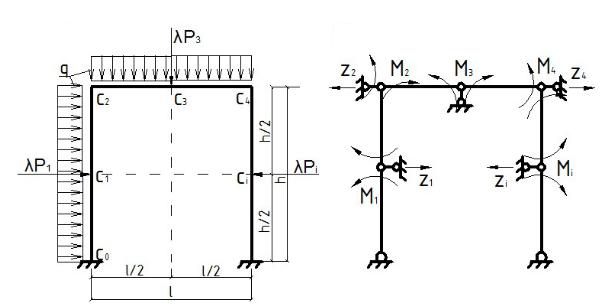
For the frame presented in Fig. 1, for the selected in accordance with recommendations [4, 5] basic system in terms of a specific mixed-mode method in the form of a pinned frame polygon with fictitious transverse bracing, there appears a possibility to calculate coefficients of resolving equations by recurrent formulae.
7
Russian journal of building construction and architecture
a) |
b) |
Fig. 1. For the calculation of survivability parameter (λ) of a redundant framed system: a, b –– specified and basic systems respectively
AM BZ |
P |
|
0 |
|
|
|||
|
|
|
p |
|
|
, |
(1) |
|
rp 0 |
|
|||||||
CM 0 |
RP |
|
|
|
||||
|
|
|
|
|
|
|
|
|
where A,B,AP, P,C, R,rp –– are the matrices of coefficients of unknown and absolute terms of a mixed-mode method.
The solution of the simultaneous equations (1) and determination of unknown moments |
M |
||||||||||||||||||||
and Z of the response in ties is written in the form respectively: |
|
|
|
|
|
||||||||||||||||
|
|
|
|
|
M |
|
|
|
M |
|
|
mp |
|
|
|
|
|
|
|
||
|
|
|
|
|
|
|
|
|
|
|
|
|
|
|
|
|
|||||
|
|
|
|
|
Z |
|
|
Z P |
|
zp |
, |
|
|
|
|
(2) |
|||||
|
|
|
|
|
|
|
|
|
|
|
P |
|
|
|
|
|
|
|
|
|
|
where |
|
|
|
|
|
|
|
|
|
|
|
|
|
|
|
|
|
|
|
|
|
|
MP |
|
A |
B |
1 |
|
|
P |
|
|
|
|
|
A B |
1 |
|
|
|
|
||
|
|
|
|
|
|
|
|
mP |
|
|
|
|
|
||||||||
|
Z |
|
BT 0 |
|
|
|
R |
|
|
; |
zP |
|
BT 0 |
|
|
rP |
. |
(3) |
|||
|
P |
|
|
|
|
|
|
|
|
P |
|
|
|
|
|
|
|
|
P |
|
|
The value of the forces in the i-th failed tie of the combined effect of the given and parametric loads (considering the dynamic effect) is found from the expression:
|
|
|
|
M j M jp |
mjp m(i 1,2,...,k), |
(4) |
||
where M |
jp |
and m |
jp |
are the j-th elements of |
M |
p |
and m columns matrices respectively. |
|
|
|
|
|
q |
|
|||
8
Issue № 1(33), 2017 |
ISSN 2542-0526 |
Dynamic loading calculation
The failure of the jth tie, e.g., a moment tie in the structural system will take place if the values of the forces in this tie reach their limit value. Then for all the forces in other failed ties of the structural system, inequations shall be satisfied
|
|
|
M |
j |
|
M |
jp |
m |
jp |
|
Md |
|
and (j = 1, 2, ..., k), |
(5) |
|
|
|
|
|
|
|
m |
jult |
|
|
||||
where |
Md |
is a limit value of the force in jth |
failed tie considering dynamic strength |
of the |
||||||||||
|
jult |
|
|
|
|
|
|
|
|
|
|
|
|
|
material.
According to (5), survivability parameter (λm) is determined by a minimum value of λ at which the limit value of force in the most loaded tie section is reached:
| λ m= min {[Mjultd± | Mjp|] / | mjp|}. |
|
(6) |
|
Plus the sign in dependence (6) is taken if moments Md |
and M |
jp |
signs are opposite and |
jult |
|
|
|
minus if moment signs coincide.
A calculated value of the coefficient of dynamic loading and correspondingly values of a survivability parameter in the failed jth tie are determined by the character of the specified diagram of static-dynamic deformation, time of failure of the preceding jth tie, and changing, in the process of ties failure, topology of a structurally non-linear system.
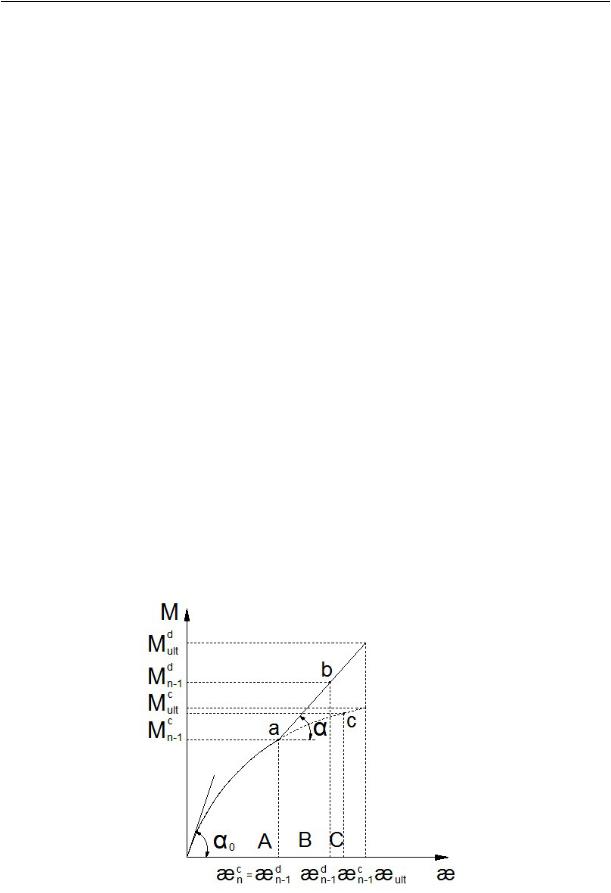
We assume that frame girder in Fig. 1 is made of reinforced concrete, loaded with distributed and concentrated loads, and deformation diagrams of the cross sections at the girder support at static loading are described bythe segment of the curve of the non-linear type (Fig. 2, Curve 1).
Fig. 2. "Moment –– curvature" diagram of static-dynamic deformation of the section of reinforced concrete element during analysis of structural system survivability
9
Russian journal of building construction and architecture
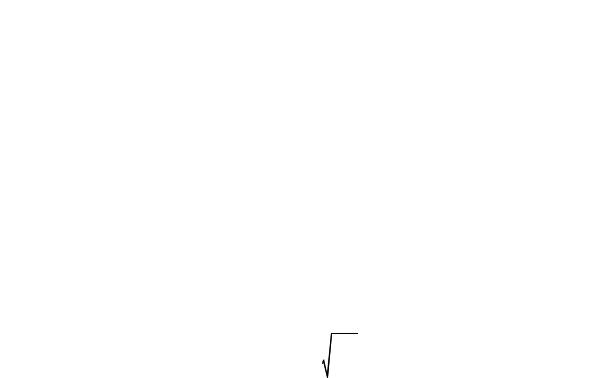
We also suppose that in order to protect the frame against progressive collapse in accordance with the recommendations [12], frame components are double reinforced, i.e. the girder section is over-reinforced and consequently, сan be brittly fractured due to the concrete deterioration of the compressed zone when reaching some limit value of load. Then as a result of sudden brittle failure of a moment tie, e.g., in section С3 (Fig. 1) dynamic loading of section C2 (point b on the diagram of the section deformation) will occur. We also note that the segment of the dynamic deformation of the section of the reinforced concrete element can be described by means of linear dependence and point b position in coordinate M depends on the time of dynamic loading of the system component under consideration. The value of the dynamic moment in system n-1 in the section under study after the failure of the moment tie can be calculated depending on the time of the dynamic loading calculated using the formula:
t |
|
|
T |
|
|
Уст |
|
, |
(7) |
d |
|
|
g |
||||||
|
4 |
2 |
|
|
|
|
|||
where Уст is the deflection of the girder caused by the static load action; |
Т is the time of one |
||||||||
full wave (period); g is the acceleration due to gravity. |
|
|
|
||||||
Having calculated the time of the dynamic action, it is possible to determine the angle of slope (α) of the segment of dynamic deformation a––b on diagram M – æ (Fig. 2).
Having calculated the specified parameters of static-dynamic diagram of deformation of the section, the value of the dynamic moment in the section of the reinforced element of the structural system can be determined on the energy base taking into consideration stationary condition of the total specific potential energy regarding the point of equilibrium of statics on the relevant curve of deformation: Мс (æ) is segment а- с and Мd(x) is segment a––b:
|
æd |
|
d |
|
æc |
|
c |
|
|
|
n 1 |
M |
(x)dx |
n 1 |
M |
(x)dx |
(8) |
||
c |
|
c |
|
||||||
æn |
|
|
æn |
|
|
|
|
||
The conditions (8) for static-dynamic diagrams 1 and 2 yield the following relations:
æ − æ < æ − æ . |
(9) |
Integrating the expression (8), the simplest dependence "moment –– curvature" can be used, for example, [12]: for Mc(æ) (curve 1) parabolic curve
Mc(æ) = 2Mcult(æc / æult)[1 – (æc / 2 æult)]; |
(10) |
for Мd(x): linear dependence: |
|
Мd(x) = Mn + æ tgα. |
(11) |
10