Материал: Обучение чтению литературы на английском языке по специальности «Радиоэлектронные системы и устройства» (120
LESSON 2
Memorize the following basic vocabulary and terminology to text 2A:
tuned circuit — резонансный контур
PMR (proton magnetic resonance) — протонный магнитный резонанс
inductance n — индуктивность capacitance n — электрическая емкость reactance n — реактивное сопротивление
UHF (ultrahigh frequency) — ультравысокая частота FM (frequency modulator) — частотный модулятор
Read text 2A and answer the questions after the text.
Text 2A
Antenna resonance and bandwidth
Two major factors associated with radio antenna design are the antenna resonant point or center operating frequency and the antenna bandwidth or the frequency range over which the antenna design can operate. These two factors are naturally very important features of any antenna design and as such they are mentioned in specifications for particular RF antennas. Whether the RF antenna is used for broadcasting, WLAN, cellular telecommunications, PMR or any other application, the performance of the RF antenna is paramount, and the antenna resonant frequency and the antenna bandwidth are of great importance.
16
Antenna resonance
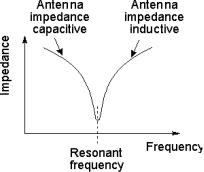
An RF antenna is a form of tuned circuit consisting of inductance and capacitance, and as a result it has a resonant frequency. This is the frequency where the capacitive and inductive reactances cancel each other out. At this point the RF antenna appears purely resistive, the resistance being a combination of the loss resistance and the radiation resistance (Fig. 3).
Fig. 3. Impedance of an RF antenna with frequency
The capacitance and inductance of an RF antenna are determined by its physical properties and the environment where it is located. The major feature of the RF antenna design is its dimensions. It is found that the larger the antenna or more strictly the antenna elements, the lower the resonant frequency. For example, antennas for UHF terrestrial television have relatively small elements, while those for VHF broadcast sound FM have larger elements indicating a lower frequency. Antennas for short wave applications are larger still.
(1351)
Answer the following questions.
1. What are the two main features of antenna design? 2. What are the applications of RF antenna? 3. What is the idea of antenna
17
resonance? 4. What do the capacitance and inductance of RF antenna depend on? 5. Why are the dimensions of antenna design so important?
Task 1. Prove the importance of antenna resonance in designing RF antenna.
Task 2. Explain the dependence of the capacitance and inductance of RF antenna on its physical properties and the environment where it is located.
Memorize the following basic vocabulary and terminology to text 2B:
impair v — ослаблять, уменьшать
SWR (standing wave ratio) — коэффициент стоячей волны folded dipole — петлевой симметричный вибратор antenna lobe — лепестокдиаграммынаправленностиантенны gain n — коэффициент усиления
Read text 2B and answer the questions after the text.
Text 2B
Antenna bandwidth
Most RF antenna designs are operated around the resonant point. This means that there is only a limited bandwidth over which an RF antenna design can operate efficiently. Outside this the levels of reactance rise to levels that may be too high for satisfactory operation. Other characteristics of the antenna may also be impaired away from the center operating frequency.
The antenna bandwidth is particularly important where radio transmitters are concerned as damage may occur to the transmitter if the antenna is operated outside its operating range and the radio transmitter is not adequately protected. In addition to this the signal radiated by the RF antenna may be less for a number of reasons.
18
For receiving purposes the performance of the antenna is less critical in some respects. It can be operated outside its normal bandwidth without any fear of damage to the set. Even a random length of wire will pick up signals, and it may be possible to receive several distant stations. However, for the best reception it is necessary to ensure that the performance of the RF antenna design is optimum.
Impedance bandwidth
One major feature of an RF antenna that does change with frequency is its impedance. This in turn can cause the amount of reflected power to increase. If the antenna is used for transmitting it may be that beyond a given level of reflected power damage may be caused to either the transmitter or the feeder, and this is quite likely to be a factor which limits the operating bandwidth of an antenna. Today most transmitters have some form of SWR protection circuit that prevents damage by reducing the output power to an acceptable level as the levels of reflected power increase. This in turn means that the efficiency of the station is reduced outside a given bandwidth. As far as receiving is concerned the impedance changes of the antenna are not as critical as they will mean that the signal transfer from the antenna itself to the feeder is reduced and in turn the efficiency will fall. For amateur operation the frequencies below which a maximum SWR figure of 1.5 : 1 is produced is often taken as the acceptable bandwidth.
In order to increase the bandwidth of an antenna there are a number of measures that can be taken. One is the use of thicker conductors. Another is the actual type of antenna used. For example, a folded dipole has a wider bandwidth than a non-folded one.
Radiation pattern
Another feature of an antenna that changes with frequency is its radiation pattern. In the case of a beam it is particularly noticeable. In particular the front to back ratio will fall off rapidly
19
outside a given bandwidth, and so will the gain. In an antenna such as a Yagi this is caused by a reduction in the currents in the parasitic elements as the frequency of operation is moved away from resonance. For beam antennas such as the Yagi the radiation pattern bandwidth is defined as the frequency range over which the gain of the main lobe is within 1 dB of its maximum.
For many beam antennas, especially high gain ones it will be found that the impedance bandwidth is wider than the radiation pattern bandwidth, although the two parameters are inter-related in many respects.
(2790)
Answer the following questions.
1.What is the role of the resonant point in RF antenna design?
2.Why is antenna bandwidth important in radio transmitters performance? 3. What can cause damage for transmitting function of RF antenna? 4. How is it possible to prevent the damage? 5. When are impedance changes of antenna more
crucial? 6. What are the ways of increasing the bandwidth? 7. What are the main parameters of RF antennas?
Task 1. Speak about the functions of antenna bandwidth in RF antenna design.
Task 2. Explain the importance of impedance bandwidth and radiation pattern in antennas that change with frequency.
Task 3. Tell about the impact of RF antenna resonance and bandwidth on radio communications systems.
Grammar exercise № 2
Point out Complex Subject Infinitive constructions in the following sentences and translate them.
1. Cognitive radio is reported to be a smart wireless communications technology that will be able to find and connect with any nearby open radio frequency.
20