Материал: Руководство+к+тренажеру+_завязывание+узлов_
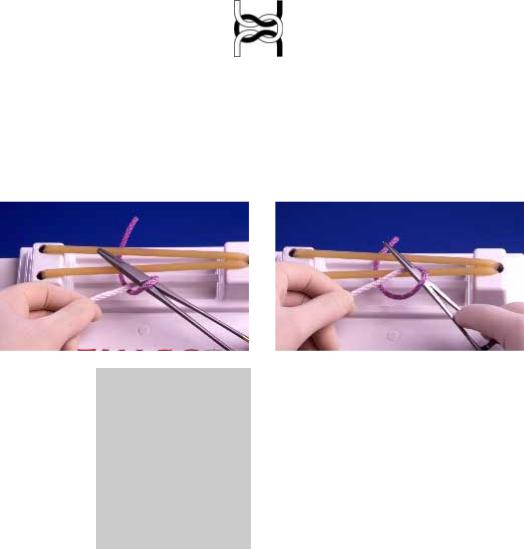
Instrument Tie
Instrument Tie
Page 1 of 2
The instrument tie is useful when one or both ends of the suture material are short. For best results, exercise caution when using a needleholder with PANACRYL* braided synthetic
absorbable suture or any monofilament suture, as repeated bending may cause these sutures to break.
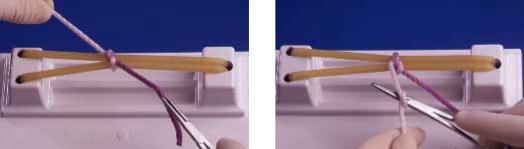
1Short purple strand lies freely. Long white end of strand held between thumb and index finger of left hand. Loop formed by placing needleholder on side of strand away from the operator.
Needleholder in right |
2 |
|
|
hand grasps short |
|
purple end of strand. |
|
|
|
3 |
First half hitch |
|
White strand is |
4 |
|
completed by |
|
drawn toward |
|
|
pulling |
|
operator with left |
|
|
needleholder |
|
hand and looped |
|
|
toward operator |
|
around |
|
|
with right hand and |
|
needleholder held |
|
|
drawing white |
|
in right hand. Loop |
|
|
strand away from |
|
is formed by |
|
|
operator. |
|
placing |
|
|
Needleholder is |
|
needleholder on |
|
|
released from |
|
side of strand |
|
|
purple strand. |
|
toward the |
|
|
|
|
operator. |
|
|
|
|
|
|
Instrument Tie
Page 2 of 2
5 |
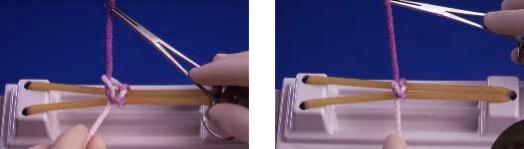
With end of the |
|
Square knot |
6 |
|
strand grasped by |
|
completed by |
|
|
the needleholder, |
|
horizontal tension |
|
|
purple strand is |
|
applied with left |
|
|
drawn through loop |
|
hand holding white |
|
|
in the white strand |
|
strand toward |
|
|
away from the |
|
operator and |
|
|
operator. |
|
purple strand in |
|
|
|
|
needleholder away |
|
|
|
|
from operator. |
|
|
|
|
Final tension |
|
|
|
|
should be as nearly |
|
|
|
|
horizontal as |
|
|
|
|
possible. |
|
|
|
|
|
|
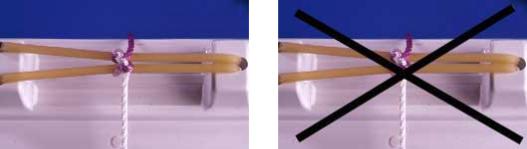
Granny Knot
A granny knot is not recommended. However, it may be inadvertently tied by incorrectly crossing the strands of a square knot. It is shown
only to warn against its use. It has the tendency to slip when subjected to increasing pressure.
Suture Materials
The requirement for wound support varies in different tissues from a few days for muscle, subcutaneous tissue, and skin; weeks or months for fascia and tendon; to long-term stability, as for a vascular prosthesis. The surgeon must be aware of these differences in the healing rates of various tissues and organs. In addition, factors present in the individual patient, such as infection, debility, respiratory problems, obesity, etc., can influence the postoperative course and the rate of healing.
Suture selection should be based on the knowledge of the physical and biologic characteristics of the material in relationship to the healing process. The surgeon wants to ensure that a suture will retain its strength until the tissue regains enough strength to keep the wound edges together on its own. In some tissue that might never regain preoperative strength, the surgeon will want suture material that retains strength for a long time. If a suture is going to be placed in tissue that heals rapidly, the surgeon may prefer to select a suture that will lose its tensile strength at about the same rate as the tissue gains strength and that will be absorbed by the tissue so that no foreign material remains in the wound once the tissue has healed. With all sutures, acceptable surgical practice must be followed with respect to drainage and closure of infected wounds. The amount of tissue reaction caused by the suture encourages or retards the healing process.
When all these factors are taken into account, the surgeon has several choices of suture materials available. Selection can then be made on the basis of familiarity with the material, its ease of handling, and other subjective preferences.
Sutures can conveniently be divided into two broad groups: absorbable and nonabsorbable. Regardless of its composition, suture material is a foreign body to the human tissues in which it is implanted and to a greater or lesser degree will elicit a foreign body reaction.
Two major mechanisms of absorption result in the degradation of absorbable sutures. Sutures of biological origin such as surgical gut are gradually digested by tissue enzymes. Sutures manufactured from synthetic polymers are principally broken down by hydrolysis in tissue fluids.
Nonabsorbable sutures made from a variety of nonbio-degradable materials are ultimately encapsulated or walled off by the body?s fibroblasts. Nonabsorbable sutures ordinarily remain where they