Материал: 2016_Kaplan_USMLE_Step_1_Lecture_Notes_Pharmacology

Chapter 5 λ Autonomic Drug List and Practice Questions
effects of NE on the heart. However, reflex bradycardia is not possible following pretreatment with an M blocker. Thus, HR increases because of the direct activation of cardiac β1 receptors by NE.
17.Answer: A. This question is to remind you that indirect-acting sympathomimetics require innervation of the effector organ to exert effects. In this case, amphetamine would not be effective because the transplanted heart lacks sympathetic innervation; thus, there is no “mobile pool” of NE capable of being
released by a drug. However, transplanted hearts retain receptors, including
those (β1) responsive to direct-acting sympathomimetics. Heart transplants are not responsive to AChE inhibitors because they, too, are indirect acting and require vagal innervation to exert effects on the heart.
18.Answer: B. Edrophonium is a very short-acting (reversible) AChE inhibitor that has been used in the diagnosis of myasthenia gravis. The drug is useful for distinguishing between muscle weakness attributable to excessive cholinergic receptor stimulation (usually due to overdose of a AChE inhibitor) and the symptoms of myasthenia (reflecting inadequate treatment). If symptoms improve with a single dose of edrophonium, then an increase in the dose of neostigmine or pyridostigmine is indicated. If symptoms worsen, then the dose of neostigmine should be reduced.
19.Answer: D. The effectiveness of carvedilol in the management of hypertension
and in congestive heart failure appears to be due to a combination of antago-
nistic actions at both alpha and beta adrenoceptors. Carvedilol is not a β1 selective blocking agent (unlike atenolol and metoprolol), and (unlike pindolol and acebutolol) it lacks intrinsic sympathomimetic activity.
20.Answer: E. As an inhibitor of AChE, neostigmine exerts effects to enhance the actions of ACh at all innervated effector sites where ACh is a neurotransmitter. These include all ANS ganglia, PANS postganglionic neuroeffector junctions, and SANS innervation of thermoregulatory sweat glands. Pilocarpine activates M receptors and has no effects at conventional dose levels on nicotinic receptors such as those in ANS ganglia and the skeletal NMJ.
21.Answer: B
22.Answer: D
23.Answer: C
Agonist 1 increases HR, presumably through direct activation of cardiac β1 receptors because the effect is blocked by propranolol but is not influenced by the alpha blocker (prazosin), the ganglion blocker (mecamylamine), or blockade of M receptors (atropine). Only two of the listed drugs directly activate cardiac receptors: epinephrine and norepinephrine. For NE, any direct cardiac stimulation is
counteracted by reflex bradycardia resulting from the increase in mean BP via its
activation of α1 receptors in blood vessels (it has no effects on β2 vascular receptors). Therefore, agonist 1 is identified as epinephrine which activates both β1 and β2 receptors directly at low doses.
To identify agonists 2 and 3, recognize that although the alpha blocker prazosin
simply neutralizes the effect of agonist 2 on HR, it reverses the effect of agonist
3. This could occur only if agonist 3 was capable of β1 receptor activation in the heart. Direct cardiac stimulation could occur with norepinephrine (agonist 3) but not with phenylephrine (agonist 2), which is a selective alpha-1 agonist.
79

Section II λ Autonomic Pharmacology
Explanations to Figures II-4-2 through II-4-11: Drug Identification from
Effects on Heart Rate and Blood Pressure.
Figure II-4-2: The effects of Drug R are changed by treatment with either an alpha or betablocker, so Drug R must have activity at both receptors (choices C, D, and E are ruled out). A pressor dose of epinephrine would be “reversed” by an alphablocker, not just decreased! Drug R is norepinephrine.
Figure II-4-3: The effects of Drug U are changed by treatment with the alphablocker, but not by the beta-blocker. Drug U must be an alpha-activator with no beta actions—the only choice is phenylephrine.
Figure II-4-4: The effects of Drug S are changed by treatment with the beta-blocker, but not by the alpha blocker (choices A, B, and C are ruled out). Terbutaline is β2 selective and would not increase heart rate directly. Drug S is isoproterenol. Note that option A would have been a possibility but one would have to assume a low-dose of epinephrine.
Figure II-4-5: The effects of Drug H are changed by treatment with either an alphaor betablocker, so Drug H must have activity at both receptors (choices C, D, and E are ruled out). “Reversal” of a pressor effect can only occur if the drug has β2 activity (choice B is ruled out). Drug H is epinephrine.
Figure II-4-6: Mecamylamine blocked reflexed tachycardia induced by Drug X, which dropped blood pressure by vasodilation. Propranolol prevented all responses. Drug X is a β2 agonist (terbutaline).
Figure II-4-7: Drug X decreases TPR and BP, eliciting a reflex sympathetic discharge (note delay in response), resulting in increased CO. There is no direct effect on CO (choices A, B, C, and E are ruled out). Drugs X and Y are terbutaline and phenylephrine. Note that the alpha agonist does not antagonize the decrease in respiratory resistance (a β2 response).
Figure II-4-8: ACh (used as a drug) decreases blood pressure and heart rate, but the latter effect is overcome and reversed by a sympathetic reflex. Because Drug X abolishes only the reflex tachycardia, it must be the ganglion blocker hexamethonium (choice A). Remember, AChE inhibitors do not vasodilate because there is no parasympathetic innervation of the vasculature!
Figure II-4-9: No autonomic reflexes are possible in isolated preparations! Arterial contraction due to the alpha agonist (choice E) is reversed by the alpha-blocker (choice C). Arteriolar relaxation and tachycardia due to epinephrine (choice B) is reversed by the beta-blocker (choice D). Bethanechol (choice A) causes both arteriolar relaxation and bradycardia.
Figure II-4-10: Classic example showing that denervated tissues do not respond to indirect-acting agonists. In this case, amphetamine fails to cause mydriasis in the left eye, but this eye is more responsive than the right eye to phenylephrine (denervation supersensitivity).
Figure II-4-11: Block of tachycardia due to Drug P by hexamethonium is indicative of a sympathetic reflex that follows a decrease in BP due to a vasodilator (choice B). “Reversal” of bradycardia due to Drug Q by hexamethonium indicates a vagal reflex elicited by vasoconstriction (e.g., alpha activation) masking cardiac stimulation (e.g., beta activation) typical of norepinephrine (choice C). Tachycardia due to Drug R is unaffected by any antagonist, indicative of a beta activator (choice D). “Reversal” of tachycardia due to Drug S by hexamethonium indicates a sympathetic reflex masking a vagotomimetic action typical of a muscarinic activator (choice A); this is confirmed by the effect of atropine.
80

SECTION III
Cardiac and Renal
Pharmacology
Diuretics 1
Learning Objectives
Answer questions about osmotic diuretics, carbonic anhydrase inhibitors, loop diuretics, thiazides, and K+-sparing agents
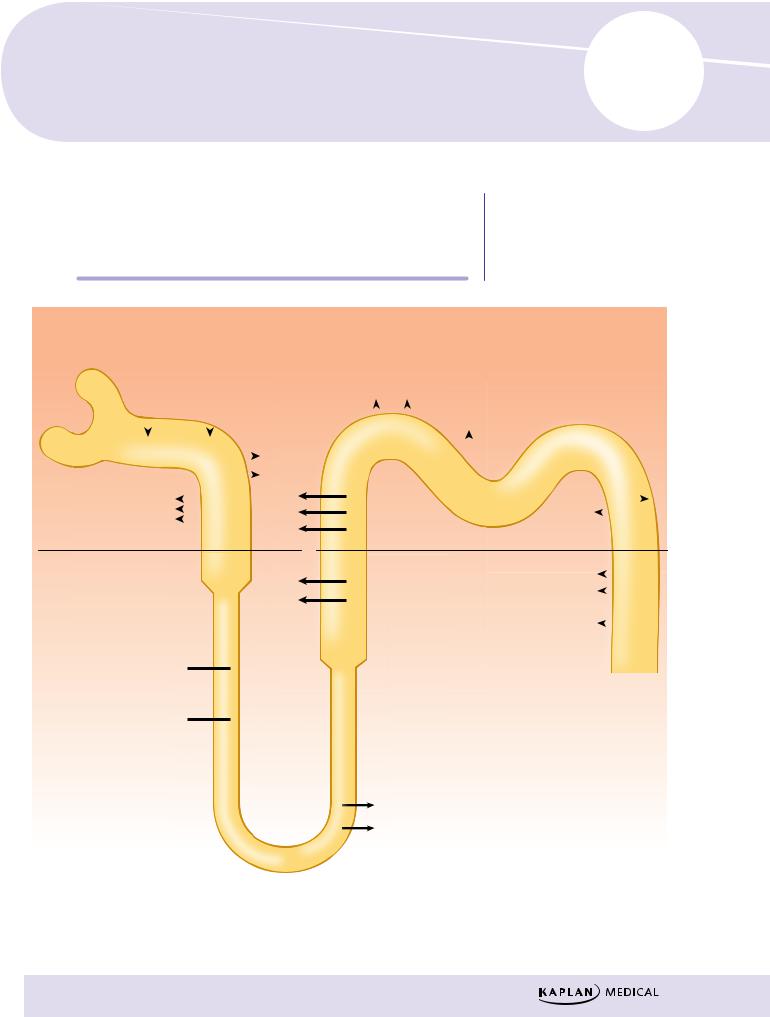
Proximal convoluted tubule (PCT)
Glomerulus |
|
|
|
|
|
|
|
|
|
|
acids |
|
bases |
|
|||||
|
|
active |
|
|
|
– |
(>95%) |
||
|
|
secretion |
|
|
HCO3 |
||||
|
|
|
|
|
|
|
(reabsorption) |
||
120 ml/min |
|
Lumen |
|
|
|
|
Na+ (60%) |
||
|
|
|
|
|
|
|
|
||
|
|
|
|
|
|
|
|
||
|
|
|
|
|
|
|
|
|
Cl– (45%) |
|
|
|
|
|
|
|
|
|
|
|
|
|
|
|
|
|
|
|
K+ |
|
|
H O |
|
|
|
|
|
|
Ca2+2+ |
|
|
|
|
|
|
|
|
||
|
|
|
|
|
|
|
|
||
Cortex |
2 |
|
|
|
|
|
Mg |
||
Medulla |
Cl– |
|
|
|
Na+ |
|
(25%) |
H2O
H2O
Thin descending loop
Loop of
Henle
|
|
Distal convoluted |
|||||||||
|
|
tubule (DCT) |
|||||||||
Na+ Cl– |
|
|
|
|
|
|
|
|
|
||
(10%) |
|
PTH sensitive |
(Aldosterone) |
||||||||
|
|
|
|||||||||
|
|
|
Ca2+ |
||||||||
|
|
|
|
|
K+, H+ |
|
|
|
|||
|
|
|
|
|
|||||||
|
|
|
|
|
|
|
|
|
|
|
|
|
|
|
|
|
|
|
|
|
|
|
|
|
|
|
|
|
|
|
|
||||
|
|
|
|
|
Na+ |
|
|
|
|
|
|
|
|
|
|
|
|
|
|
||||
|
|
|
|
|
(<5%) |
|
|
|
|
|
|
|
|
|
|
|
(ADH) |
|
|
|
|||
|
|
|
|
|
|
|
|||||
|
|
|
|
|
H2O |
|
|
|
|||
|
|
|
|
|
|
|
|||||
|
Thick ascending |
Urea |
|
|
|||||||
|
|
||||||||||
loop (TAL)
Collecting duct
1 ml/min
Thin ascending loop
 H2O
H2O
 Na+
Na+
Type |
Site of Action |
CA inhibitors |
Proximal tubule |
Osmotic |
Entire tubule |
Loops |
Ascending limb |
Thiazides |
Early distal |
K+ sparing |
Early collecting |
Aldosterone |
Early collecting duct |
antagonists |
|
Figure III-1-1. Actions of Diuretics at the Various Renal Tubular Segments
83