Материал: 2016_Kaplan_USMLE_Step_1_Lecture_Notes_Pharmacology
Chapter 4 λ Autonomic Drugs: Glaucoma Treatment and ANS Practice Problems
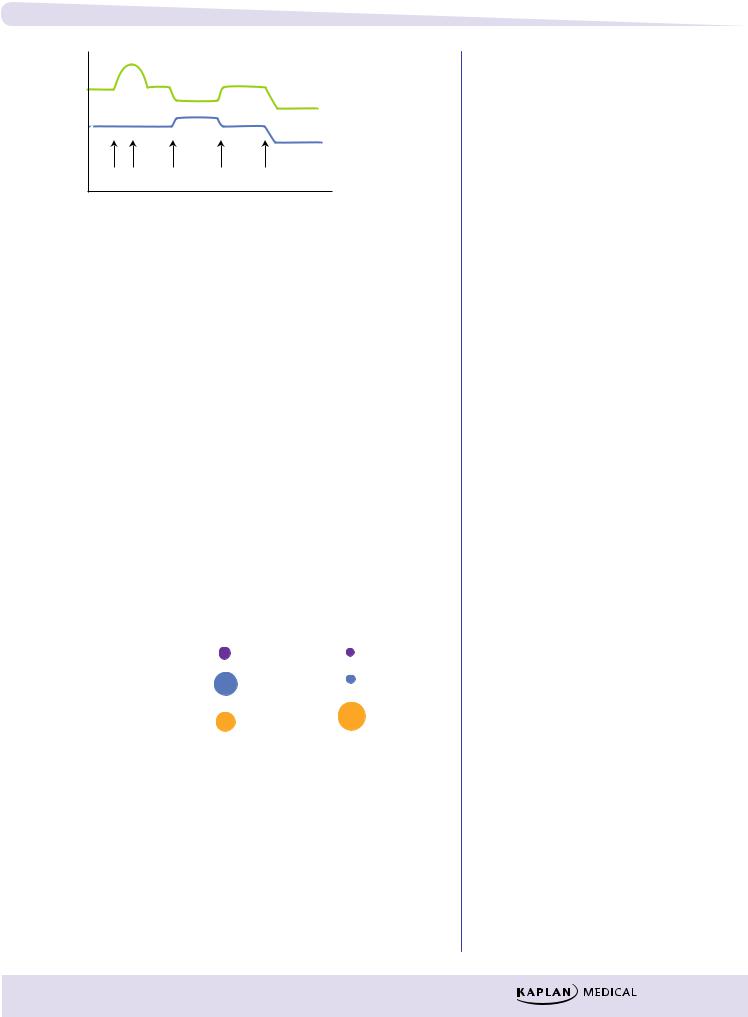
Arterial contraction
Heart rate
1 |
2 |
3 |
4 |
5 |
Time
Given the following information:
•Contractile force is measured in an isolated arterial preparation, and heart rate is measured in an isolated heart preparation.
•One drug is added at each specified time.
•No washout between drugs
A.Bethanechol
B.Epinephrine
C.Phenoxybenzamine
D.Pindolol
E.Phenylephrine
Time 1:
Time 2:
Time 3:
Time 4:
Time 5:
Figure II-4-9
RIGHT EYE |
LEFT EYE |
Without treatment
With amphetamine
With phenylephrine
The circles above represent the size of the pupils of a patient’s eyes, without treatment and with two different treatments. The responses are compatible with the conclusion that the left eye had:
A.been pretreated with atropine.
B.been pretreated with prazosin.
C.been pretreated with propranolol.
D.been pretreated with physostigmine.
E.denervation of the radial muscle.
Figure II-4-10
69
Section II λ Autonomic Pharmacology
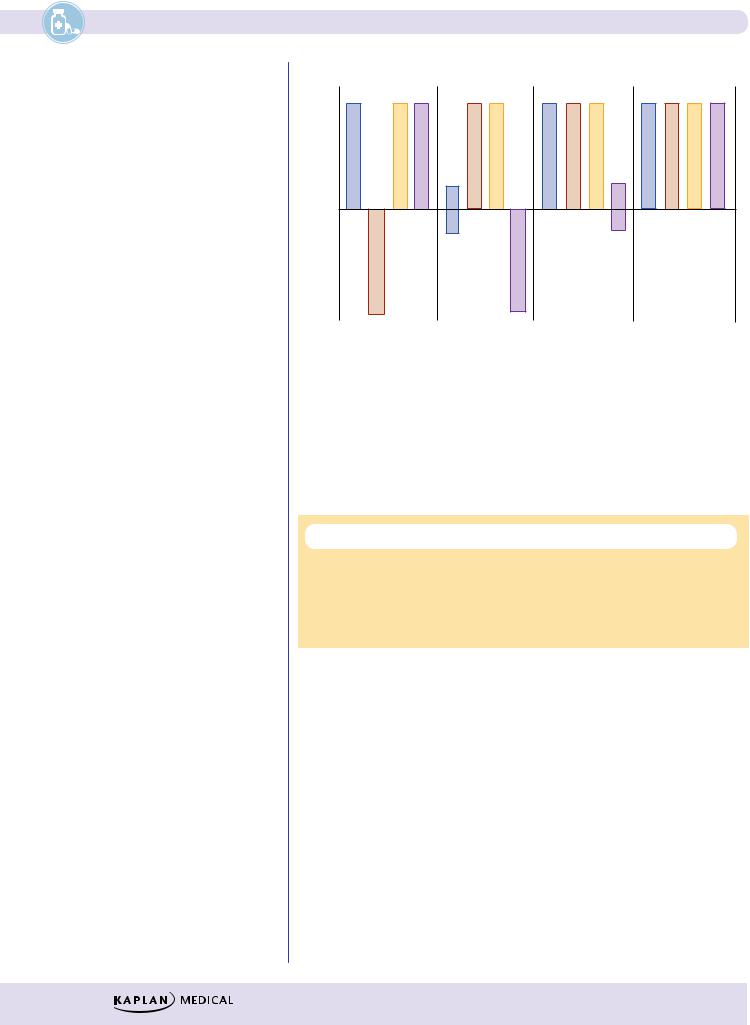
Control Hexamethonium Atropine Phenoxybenzamine
|
P |
R |
S |
Q |
R |
changes |
|
|
|
P |
|
|
Q |
|
|
S |
|
Heart rate |
0 |
|
|
||
|
|
|
|
||
|
|
|
|
|
P |
Q |
R |
P |
Q |
R |
S |
|
|
|
S |
|
|
|
A. Acetylcholine |
P is |
B. Hydralazine |
|
C. Norepinephrine |
Q is |
D. Isoproterenol |
R is |
E. Edrophonium |
S is |
Figure II-4-11
Chapter Summary
λThe drugs used to treat open-angle glaucoma and their modes of action are summarized in Table II-4-1.
λThe effects of autonomic drugs affecting the cardiovascular system are summarized visually in Figures II-4-2 through II-4-11.
70

Autonomic Drug List and
Practice Questions
Cholinergic Receptor Activators
Direct activators: bethanechol (M), methacholine (M and N), nicotine (N), pilocarpine (M), cevimeline (M)
AChE inhibitors: reversible—edrophonium, physostigmine, neostigmine, pyridostigmine, donepezil, rivastigmine
AChE inhibitors: irreversible—malathion, parathion
Cholinergic Receptor Antagonists
Muscarinic blockers: atropine, benztropine, ipratropium, scopolamine
Ganglionic blockers: hexamethonium, mecamylamine
Adrenergic Receptor Activators
α1 agonists: phenylephrine
α2 agonists: clonidine, methyldopa
β agonists: isoproterenol, (β1 = β2), dobutamine (β1 > β2) β2 agonists: albuterol, terbutaline, salmeterol
Mixed: dopamine (D1, β1, α1), epinephrine (α1, α2, β1, β2), norepinephrine (α1, α2, β1)
Indirect-acting: amphetamine, cocaine, ephedrine, tyramine
Adrenergic Receptor Antagonists
α1 antagonists: doxazosin, prazosin, terazosin
α2 antagonists: mirtazapine
Mixed α antagonists: phenoxybenzamine, phentolamine
β1 (cardioselective) antagonists: acebutolol, atenolol, metoprolol β1, β2 (nonselective): pindolol, propranolol, timolol
α1 and β antagonists: carvedilol, labetalol
Chapter Summary
λDrugs acting as cholinergic receptor activators or antagonists and those acting as adrenergic receptor activators or antagonists are listed.
5
71

Section II λ Autonomic Pharmacology
1.Alpha-1 agonists cause reflex bradycardia, which can be blocked by
A.atenolol
B.atropine
C.mirtazepine
D.phenylephrine
E.propranolol
2.Which one of the following effects is caused by the ingestion of mushrooms that contain pilocarpine?
A.Tachycardia
B.Bronchodilation
C.Diarrhea
D.Hypertension
E.Hyperthermia
3.Increasing the concentration of norepinephrine in adrenergic synapses leads to
A.activation of dopa decarboxylase
B.increased release of norepinephrine
C.activation of presynaptic Gi coupled receptors
D.stimulation of MAO
E.activation of tyrosine hydroxylase
4.Urination in the human subject is decreased by
A.muscarinic agonists
B.muscarinic antagonists
C.AChase inhibitors
D.Nicotinic agonists
E.Spider venom
5.A 5-year-old child becomes ill while visiting relatives who have a farm in Arkansas. His symptoms include severe abdominal cramps with vomiting and diarrhea and profuse lacrimation and salivation. Pupillary constriction is marked. The most likely cause is exposure to
A.herbicides
B.antifreeze
C.lead-based paint
D.insecticides
E.rat poison
72

Chapter 5 λ Autonomic Drug List and Practice Questions
6.The activation of muscarinic receptors in bronchiolar smooth muscle is associated with
A.activation of adenylyl cyclase
B.decrease in cAMP formation mediated by G-proteins
C.increase in IP3 and DAG
D.inhibition of protein kinase C
E.opening of Na+/K+ cation channels
7.Ganglion blocking agents are of little clinical value today but they are important drugs to know for solving cardiovascular drug problems because they can block
A.all muscarinic receptors
B.all nicotinic receptors
C.all autonomic reflexes
D.the direct actions of drugs on blood vessels
E.the direct actions of drugs on the heart
8.An 11-year-old boy was brought to the ER by some of his friends because he “started going crazy” after eating seeds from a plant while “trying to get high.” The boy was incoherent; his skin was hot and dry. His pupils were dilated and unresponsive to light. Blood pressure was 180/105, pulse 150, and rectal temp 40°C. The presumptive diagnosis was drug toxicity due to the ingestion of a compound similar to
A.cannabis
B.digoxin
C.mescaline
D.phencyclidine
E.scopolamine
9.Reflex tachycardia caused by the systemic administration of albuterol can be blocked by what drug?
A.dobutamine
B.prazosin
C.phenylephrine
D.metoprolol
E.low-dose epinephrine
73