Материал: 2016_Kaplan_USMLE_Step_1_Lecture_Notes_Pharmacology
Chapter 1 l Pharmacokinetics
Redistribution
In addition to crossing the blood–brain barrier (BBB), lipid-soluble drugs redistribute into fat tissues prior to elimination.
In the case of CNS drugs, the duration of action of an initial dose may depend more on the redistribution rate than on the half-life. With a second dose, the blood/fat ratio is less; therefore, the rate of redistribution is less and the second dose has a longer duration of action.
|
CNS |
|
Blood |
Fat |
|
|
3 |
4 |
|
D |
1 |
Rapid |
Drug (D) |
D |
|
2 |
Slow |
||
|
Active |
Blood–brain barrier |
|
Inactive |
|
|
|
||
|
|
|
Figure I-1-7. Redistribution |
|
BIOTRANSFORMATION
●The general principle of biotransformation is the metabolic conversion of drug molecules to more water-soluble metabolites that are more readily excreted.
●In many cases, metabolism of a drug results in its conversion to compounds that have little or no pharmacologic activity.
●In other cases, biotransformation of an active compound may lead to the formation of metabolites that also have pharmacologic actions.
●A few compounds (prodrugs) have no activity until they undergo metabolic activation.
Drug  Inactive metabolite(s)
Drug  Active metabolite(s)
Prodrug  Drug
Drug
Figure I-1-8. Biotransformation of Drugs
Clinical Correlate
Active Metabolites
Biotransformation of the benzodiazepine diazepam results in formation of nordiazepam, a metabolite with sedative-hypnotic activity and a long duration of action.
9
Section I l General Principles
Biotransformation Classification
Clinical Correlate
Grapefruit Juice
Active components in grapefruit juice include furanocoumarins capable
of inhibiting the metabolism of many drugs, including alprazolam, midazolam, atorvastatin, and cyclosporine. Such compounds may also enhance oral bioavailability
decreasing first-pass metabolism and by inhibiting drug transporters in the
GI tract responsible for intestinal efflux of drugs.
There are two broad types of biotransformation, called phase I and phase II.
Phase I
●Definition: modification of the drug molecule via oxidation, reduction, or hydrolysis.
–Microsomal metabolism
Cytochrome P450 isozymes
ºThese are major enzyme systems involved in phase I reactions. Localized in the smooth endoplastic reticulum (microsomal fraction) of cells (especially liver, but including GI tract, lungs, and kidney).
ºP450s have an absolute requirement for molecular oxygen and NADPH.
ºOxidations include hydroxylations and dealkylations.
ºMultiple CYP families differing by amino acid (AA) composition, by substrate specificity, and by sensitivity to inhibitors and to inducing agents.
Table I-1-2. Cytochrome P450 Isozymes
CYP450 |
|
|
Substrate |
|
|
Inducers |
|
|
Inhibitors |
|
|
Genetic |
|
|
|
Example |
|
|
|
|
|
|
|
|
Polymorphisms |
1A2 |
Theophylline |
Aromatic |
|
Quinolones |
|
No |
||||||
|
|
Acetaminophen |
|
hydrocarbons |
|
Macrolides |
|
|
||||
|
|
|
|
|
|
(smoke) |
|
|
|
|||
|
|
|
|
|
|
|
|
|
|
|
||
|
|
|
|
|
Cruciferous |
|
|
|
|
|
||
|
|
|
|
|
|
vegetables |
|
|
|
|
|
|
2C9 |
Phenytoin |
General inducers* |
|
— |
|
Yes |
||||||
|
|
Warfarin |
|
|
|
|
|
|
|
|
||
2D6 |
Many cardiovascular |
None known |
|
Haloperidol |
|
Yes |
||||||
|
|
and CNS drugs |
|
|
|
|
Quinidine |
|
|
|||
|
|
|
|
|
|
|
|
|
|
|
||
3A4 |
60% of drugs in PDR |
General inducers* |
|
General inhibitors† |
|
No |
||||||
|
|
|
|
|
|
|
|
|
Grapefruit juice |
|
|
|
|
|
|
|
|
|
|
|
|
|
|
|
|
*General inducers: anticonvulsants (barbiturates, phenytoin, carbamazepine), antibiotics (rifampin), chronic alcohol, St. John’s Wort.
†General inhibitors: antiulcer medications (cimetidine, omeprazole), antimicrobials (chloramphenicol, macrolides, ritonavir, ketoconazole), acute alcohol.
10
Chapter 1 l Pharmacokinetics
−Nonmicrosomal metabolism
Hydrolysis
ºPhase I reaction involving addition of a water molecule with subsequent bond breakage
ºIncludes esterases and amidases
ºGenetic polymorphism exists with pseudocholinesterases
ºExample: local anesthetics and succinylcholine
Monoamine oxidases
ºMetabolism of endogenous amine neurotransmitters (dopamine, norepinephrine, and serotonin)
ºMetabolism of exogenous compounds (tyramine)
Alcohol metabolism
ºAlcohols are metabolized to aldehydes and then to acids by dehydrogenases (see CNS Pharmacology, section IV)
ºGenetic polymorphisms exist
Phase II
●Definition: Conjugation with endogenous compounds via the activity of transferases
●May follow phase I or occur directly
●Types of conjugation:
Glucuronidation
–Inducible
–May undergo enterohepatic cycling (Drug: Glucuronide → intestinal bacterial glucuronidases → free drug)
–Reduced activity in neonates
–Examples: morphine and chloramphenicol
Acetylation
ºGenotypic variations (fast and slow metabolizers)
ºDrug-induced SLE by slow acetylators with hydralazine > procainamide > isoniazid (INH)
Glutathione (GSH) conjugation
ºDepletion of GSH in the liver is associated with acetaminophen hepatotoxicity
11
Section I l General Principles
Clinical Correlate
The elimination of a drug from the body does not always end the therapeutic effect. Irreversible inhibitors, e.g. aspirin, PPIs, MAOIs, will have a therapeutic effect long after the drug is eliminated.
ELIMINATION
Concerns the processes involved in the elimination of drugs from the body (and/ or plasma) and their kinetic characteristics. The major modes of drug elimination are:
●Biotransformation to inactive metabolites
●Excretion via the kidney
●Excretion via other modes, including the bile duct, lungs, and sweat
●Definition: Time to eliminate 50% of a given amount (or to decrease plasma level to 50% of a former level) is called the elimination half-life (t1/2).
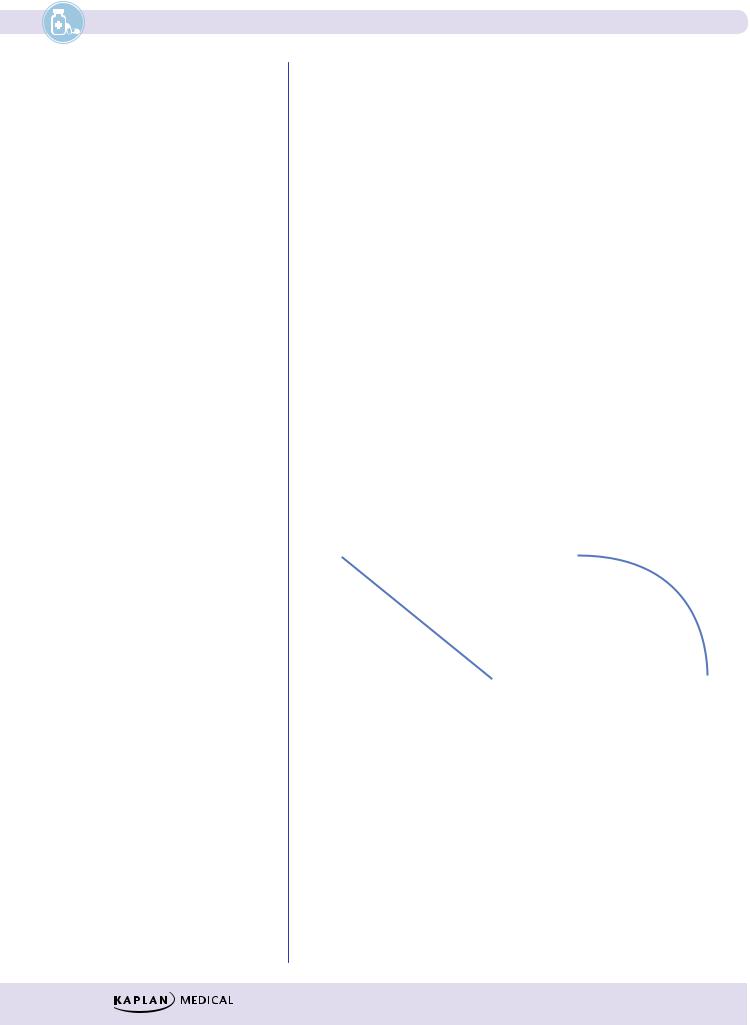
Zero-Order Elimination Rate
●A constant amount of drug is eliminated per unit time; for example, if 80 mg is administered and 10 mg is eliminated every 4 h, the time course of drug elimination is:
4 h |
4 h |
4 h |
4 h |
80 mg → 70 mg |
→ 60 mg |
→ |
50 mg → 40 mg |
●Rate of elimination is independent of plasma concentration (or amount in the body).
●Drugs with zero-order elimination have no fixed half-life (t1/2 is a variable).
●Drugs with zero-order elimination include ethanol (except low blood levels), phenytoin (high therapeutic doses), and salicylates (toxic doses).
Units of drug |
|
Log units of drug |
|
|
|
|
|
|
Time |
|
Time |
Figure I-1-9a. Plots of Zero-Order Kinetics
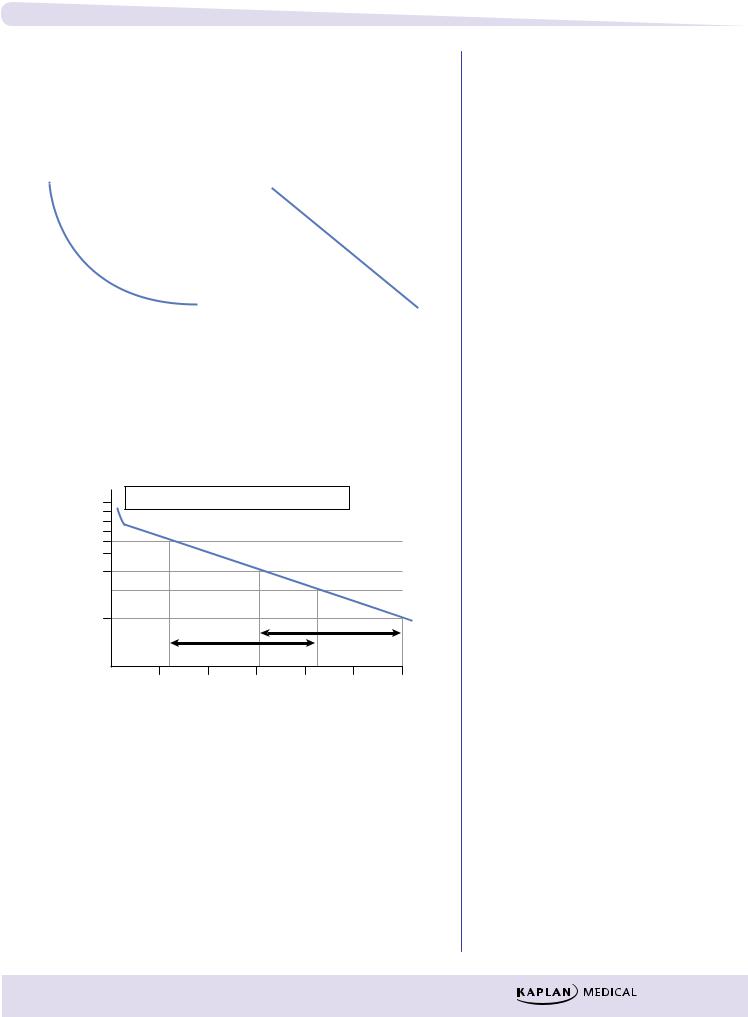
First-Order Elimination Rate
●A constant fraction of the drug is eliminated per unit time (t1/2 is a constant). Graphically, first-order elimination follows an exponential decay versus time.
●For example, if 80 mg of a drug is administered and its elimination halflife = 4 h, the time course of its elimination is:
4 h |
4 h |
4 h |
4 h |
|
80 mg → 40 mg |
→ 20 mg |
→ |
10 mg → |
5 mg |
12
Chapter 1 l Pharmacokinetics
●Rate of elimination is directly proportional to plasma level (or the amount present)—the higher the amount, the more rapid the elimination.
●Most drugs follow first-order elimination rates.
●t1/2 is a constant
Units of drug |
|
Log units of drug |
|
|
|
|
|
|
Time |
|
Time |
Figure I-1-9b. Plots of First-Order Kinetics
Graphic Analysis
Example of a graphic analysis of t1/2:
|
10 |
C0 = plasma concentration at zero time |
|
||||
(µg/ml) |
8C0 |
|
|
|
|
|
|
6 |
|
|
|
|
|
|
|
|
|
|
|
|
|
|
|
levels |
4 |
|
|
|
|
|
|
|
|
|
|
|
|
|
|
Plasma |
2 |
|
|
|
|
t 1/2 |
|
|
|
|
|
|
|
||
|
|
|
|
|
|
|
|
|
1 |
1 |
2 |
3 |
4 |
5 |
6 |
|
|
||||||
|
|
|
|
Time (h) |
|
|
|
Figure I-1-10. Plasma Decay Curve—First-Order Elimination
Figure I-1-10 shows a plasma decay curve of a drug with first-order elimination plotted on semilog graph paper. The elimination half-life (t1/2) and the theoretical plasma concentration at zero time (C0) can be estimated from the graphic relationship between plasma concentrations and time. C0 is estimated by extrapolation of the linear plasma decay curve to intercept with the vertical axis.
In A Nutshell
Elimination Kinetics
●Most drugs follow first order—rate falls as plasma level falls.
●Zero order is due to saturation of elimination mechanisms; e.g., drugmetabolizing reactions have reached
Vmax.
●Zero order elimination rate is constant; t1/2 is a variable.
●First order elimination rate is variable; t1/2 is a constant.
13