Материал: 2147
1.Canada’s motto is ‘From_________ to ___________’
2.Canada’s new territory. In Inuktitut (the language of the Inuit, or Eskimos) it means ‘Our land’.
3.The largest city in Canada. It has one of the world’s tallest buildings, the CN Tower.
4.The latest big craze in Canada is ________-watching. Special boats go out into the ocean and you have a 99% chance of seeing these wonderful animals.
5.The national tree of Canada. Its leaf is on the Canadian flag.
6.This territory is associated with the Klondike Gold Rush.
7.The oldest and the largest if Canada’s provinces. Eight out of every ten people there are of French origin.
8.These animals died out millions of years ago, but many of their fossils have been found in Canada. What is this animal called?
9.this sport was invented by the native people of Canada.
10.The name of this city starts with ‘M’. It’s unlike any other city in Canada. You can see here couples kissing on the street and strangers talking to each others!
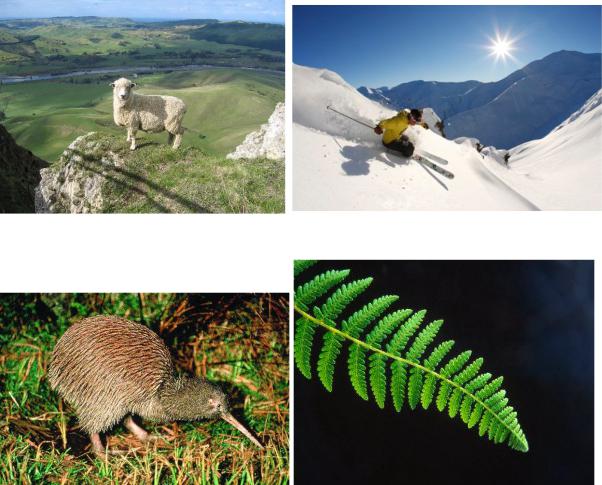
The Land of the Long White Cloud
7. Look at the pictures (pic. 25 - 28). Which country do they illustrate?
Pic. 25 |
Pic. 26 |
Pic. 27 |
Pic. 28 |
8. Here are some facts about one country. Do they help you to guess the country in question? Try to complete the missing information.
Name origin: |
|
Total area: |
268,680 km2 |
Population: |
4,331,600 |
Official languages: |
English (98%), Māori (4.2%) |
Ethnic groups: |
78% European/Other, 14.6% Māori, 9.2% Asian, |
|
6.9% Pacific peoples |
Motto: |
none, formerly Onward |
National anthem: |
"God Save the Queen" |
Capital: |
|
Largest city: |
Auckland |
Government: |
Parliamentary democracy and Constitutional |
|
monarchy |
Head of state: |
HM Queen Elizabeth II |
Longest river: |
the Waikato River (425 km) |
Highest mountain: |
Aoraki Mt Cook (3,754 metres high) |
Currency: |
|
9. Look at the map (pic. 29) and name the largest cities. Work in groups. Choose any city you like and tell what it is famous for.
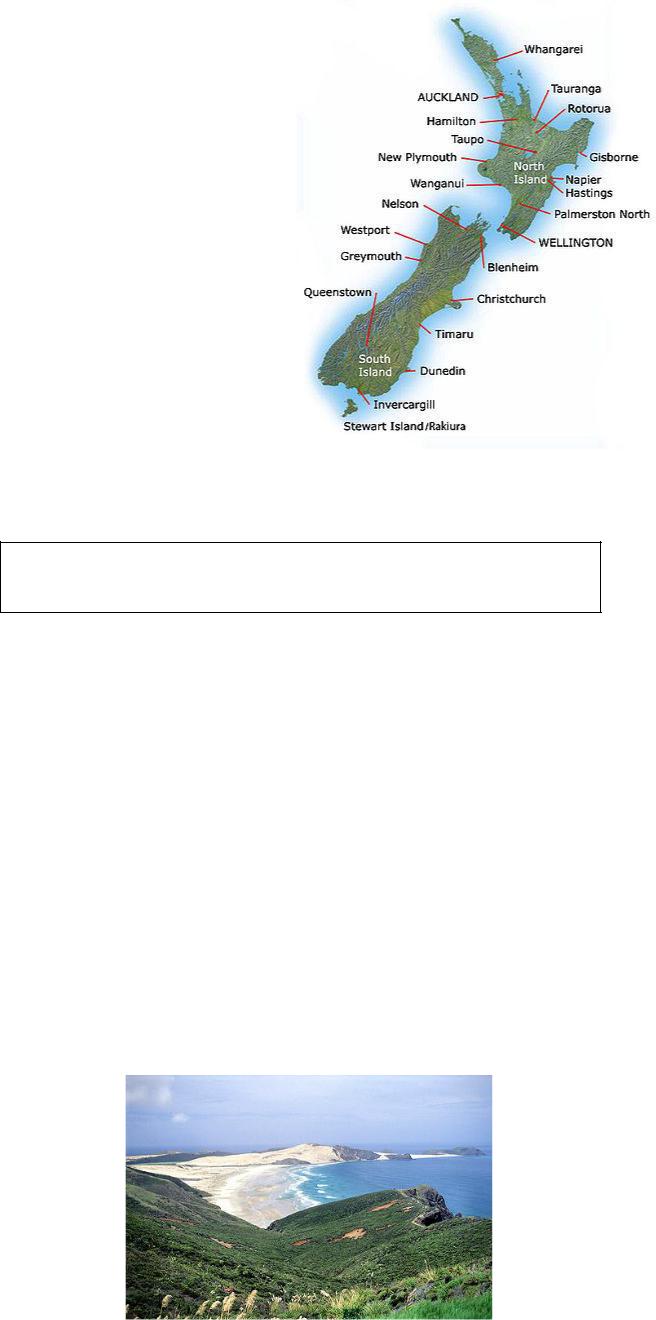
Pic. 29
10. Look at the title of the text. Which of the words/phrases below would you expect to find in the text? Choose three words / phrases to make your own sentences, as in the examples.
Volcano; extraordinary; earthquake; Maori; newspaper; island; table; Fox Glacier; towel; trilogy; whale; car; TV; mild climate; pressing of noses; waterfall; rim; clever; river; ocean; The Lord of the Rings.
Ex: There are a lot of volcanoes and beautiful lakes in New Zealand.
11. Read the sentences and guess which are true and which are false. Then read the text and check your answers.
1.This land is a place of earthquakes and living dinosaurs.
2.New Zealand is located in the Indian Ocean.
3.The coldest month is January and the warmest is July.
4.The Lord of the Rings was filmed in New Zealand.
5.The Maori people had a written language until the Europeans arrived.
6.The eighth wonder of the world is Lake Taupe.
7.Wellington is the capital of New Zealand.
8.Auckland is the national park in New Zealand.
The Land of the Long White Cloud
Imagine a place where the constellations of stars above your head are different from those that you have ever seen, where the night sky can glow with strange swirling lights, and where the cold of winter comes when summer arrives in Russia. Imagine a place where there are volcanoes, rivers of ice and hot lakes of extraordinary colours, and where forests are full of strange trees. This land is a place of earthquakes and living dinosaurs, where the people were once fierce warriors who worshipped mysterious spirits.
This place is not from a fairy tale – it is New Zealand.
Pic. 30
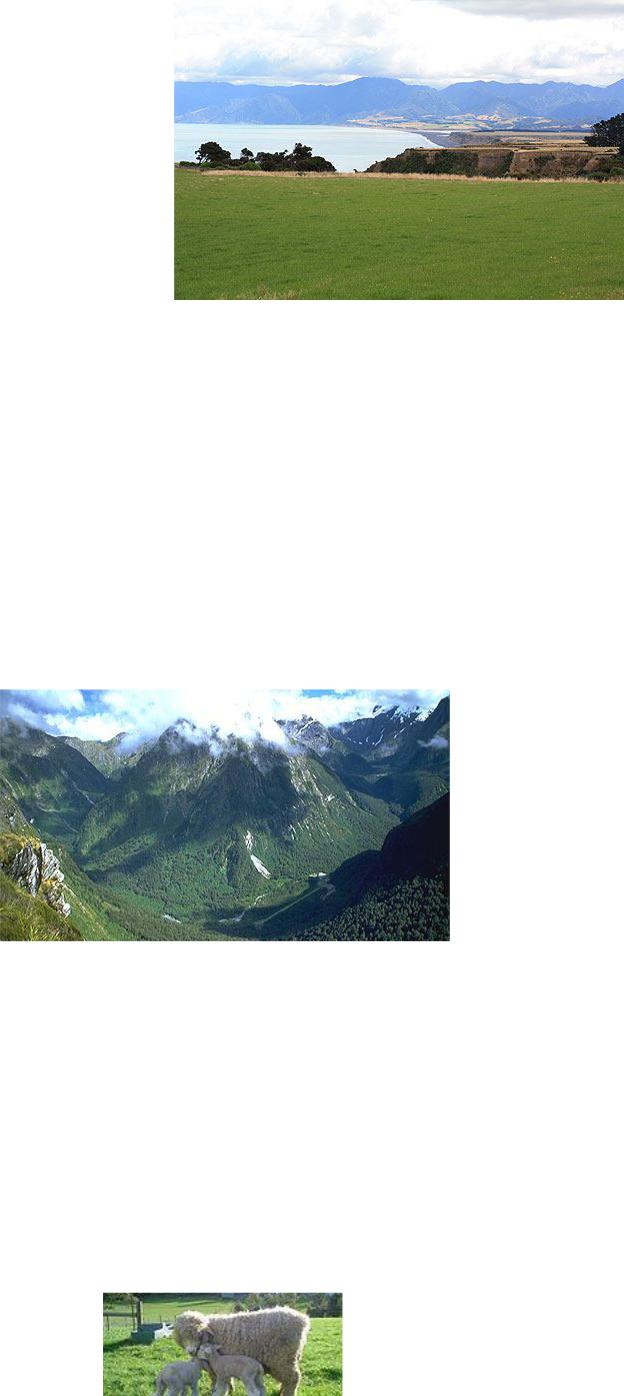
New Zealand is a country of islands located in the Pacific Ocean. The North Island and the South Island are the main ones, and there are number of small ones, some of which are hundreds of kilometers from the main islands. The country’s nearest neighbor is Australia, which lies more than 1,600 km northwest of New Zealand.
Pic. 31
It’s never very hot or very cold in New Zealand because it is surrounded by water. Summer and winter temperatures in most places differ by less than 10°C. The coldest month is July, and the warmest is January.
New Zealand has another name, Aotearoa, which means ‘the land of the long white cloud’ in the Maori language. The first Maori settled in New Zealand about a thousand years ago. They came from Polynesia and were excellent sailors and fierce warriors. Zeeland means ‘Sea Land’ in Dutch. But the Dutch never settled there. In 1769, the English explorer James Cook claimed New Zealand for Britain.
New Zealand has got it all – snow-capped mountains, fast-flowing rivers, green forests and peaceful lakes with crystal clear water. You can spend a whole day by some lake or river and be the only person there. There are places in this beautiful land that have never felt a human footstep. In fact, New Zealand is one of the least populated countries in the world. A little more than 4 million people live there.
New Zealand is a land of volcanoes. Most of them are sleeping, but some are active and you can see steam and smoke coming from them! The largest and most active volcano is the White Island Volcano. The whole place smells of rotten eggs, and you can hear a roaring sound – like the growl of a living creature – coming from beneath the ground.
Pic. 32
The White Island volcano last erupted – without warning – in 2000. The acid-filled lake is now boiling away at 55°C. In spite of the terrible smell the White Island is a popular tourist attraction. Walking through the crater is like being on another planet!
Lake Taupo in the centre of the North Island is the largest lake in New Zealand. It was created by the most violent volcanic eruption the world has ever seen! It was so big that its ashes reached China and Europe.
Fox Glacier falls 2,600m on its 13-km journey from the Southern Alps. It is unusual in that it comes down from mountains right into coastal rainforest. Rivers coming out of the mountains here are of a pale blue-green colour. The water also looks milky, because it carries ground rock, or “rock flour”. Here, just as with places with volcanoes, you can see that the Earth is an amazing, living, constantly changing place.
The famous Tolkien’s trilogy, ‘The Lord of the Rings’, was filmed in New Zealand. Hobbiton, the village where some of the Hobbits lived, was created on a picturesque private sheep farm in the North Island. You can still see Hobbit holes and some structures from the film there. As for the sheep, there are lost and lost of them in New Zealand: for every person living in the country there are twenty sheep.
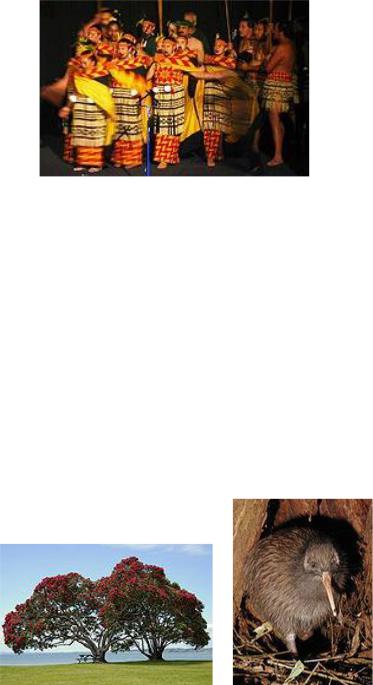
Pic. 33
In Kaikoura, hazy mountains reach down to the blue waters of the Pacific Ocean – and you can swim the dolphins! The guides tell you how to entertain them – splash around, make strange noises through your snorkel, and amuse them by snowing what terrible swimmers humans are. Kaikoura is also a great place for whale watching.
The Waitomo Caves were made by a river. The best part of a visit to this amazing place is a journey along the river in a boat. You travel silently through the darkness until suddenly you see thousands of little stars above you. Actually, these stars are lights; they belong to very small animals, roof of the caves.
The most unusual place in New Zealand is probably Rotorua, a city in the northern part of the North Island. It was built in the heart of a volcanic crater. Here the air smells of eggs. And steam and hot water explode out of the hot ground. The hot water lakes in Rotorua are of extraordinary colours: yellow, green and even orange! And there are pools of natural hot water where you can swim.
Near here is the Lady Knox geyser, which can shoot water 20 meters into the air. Rotorua is also the centre of Maori legend and history and the place where traditions and culture are kept alive. Beautiful carvings, artwork, music, dance, and traditional buildings - all from part of the Maori heritage. The Maori people had no written language until the Europeans arrived, so all traditions were handed down orally. They used songs and carvings to tell stories of the past that held lessons for the young.
Pic. 34
In the south-west of the South Island, where land and sea meet, is one of the most beautiful places in the world – Milford Sound. No wonder Rudyard Kipling called it ‘the eight wonder of the world’. This is a place of breath-taking views, hundreds of waterfalls and fairy-tale wildlife. It’s also a place where seals, dolphins and penguins are frequent guests. Milford Sound is the wettest place in New Zealand – and one of the wettest places in the world. About 7 metres of rain fall hear each year.
The isolation of New Zealand from other lands allowed the survival of animals and plants from the time of the dinosaurs. Ancient tree ferns, plants that produce spores rather than seeds, and primitive relatives of pine trees still grow in the forest.
The oldest tree in New Zealand is Tane Mahuta. It’s a Maori name which means ‘Lord of the Forest’. Nobody knows for sure how old it is but it is estimated to be between 1250 and 2500 years old!
The beautiful pohutukawa tree has red flowers at Christmas time, and people call it ‘the New Zealand Christmas time’.
Pic. 35 |
Pic. 36 |
The kiwi is the country’s national bird and emblem. It’s an unusual bird. It has nostrils at the end of its beak and it can’t fly. New Zealanders also like to call themselves Kiwis.
Before the first human beings arrived, there were many flightless birds in New Zealand. The biggest of them was the moa. It was about 3 metres tall and weighed about 250 kg. Now it is extinct.