Материал: 2147
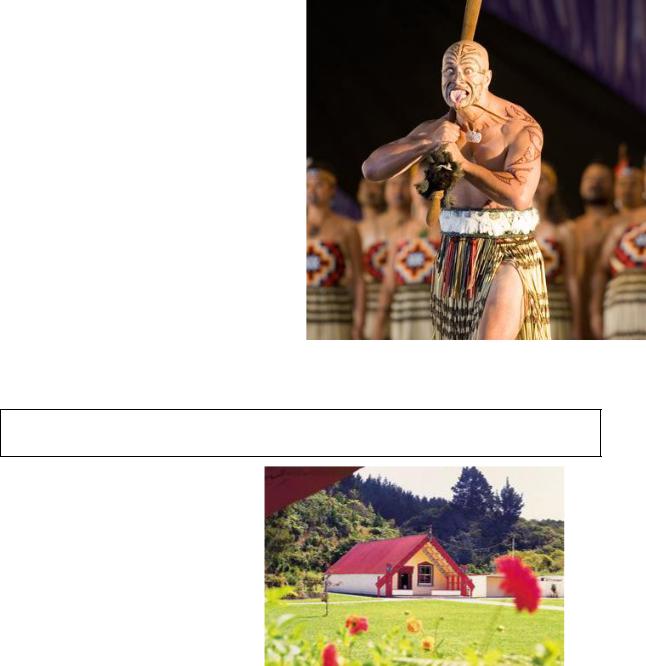
Today, most Maori people have adopted the lifestyle of the Pakeha - they live in regular houses, do regular jobs, and dress in regular clothes. At the same time, Maori culture is very strong. Many schools teach in the Maori language and train the children in the ways of their ancestors. The Maori people are passionate, humble, warm-hearted and friendly
– but also fierce when they need to be.
From: Speak Out/2, 2008
Pic. 47
16. Fill in the words from the box. Then make sentences using the completed phrases:
Whales; passionate; fierce; songs; caught; carvings; songs; wooden houses; landed; original.
1.……people of New Zealand
2.men……in New Zealand
3.lived in……
4.they……birds and fish
5.used……to tell
6.died in…… battles
7.all the……and seals
8.people are……
Pic. 48
17. Correct the false statements as in the example.
E.g. - It’s believed that the Maori came from Australia.
-They didn’t come from Australia. They came from Polynesia.
1.They were not good hunters.
2.They didn’t use songs and dances to tell the stories to the young.
3.Maori culture is not very strong.
4.The Pakeha (the Maori name for white people) didn’t bring guns, strong drinks and cigarettes, and diseases that were new to the Maori.
18.Write a short article about one of the small nationalities in your country. Write about:
-history;
-traditions;
-culture;
-language;
-national character;
-national food;
-national clothes.
The Southern Land
19. Brainstorm ideas: Australia is …
the continent
Australia
kangaroo
20.Read the text and make a list of facts discussed. E.g. Australian’s population is only about 22 million.
………………………………………………………………………………………
21.Match the words to make word combinations. Look through the texts below to check your ideas. Choose any three to make sentences about Australia.
fertile |
attempts |
outstanding |
land |
flightless |
coast |
southern |
successful |
wild |
feature |
repeated |
density |
partially |
animals |
international |
bird |
population |
kilometre |
square |
immigrant |
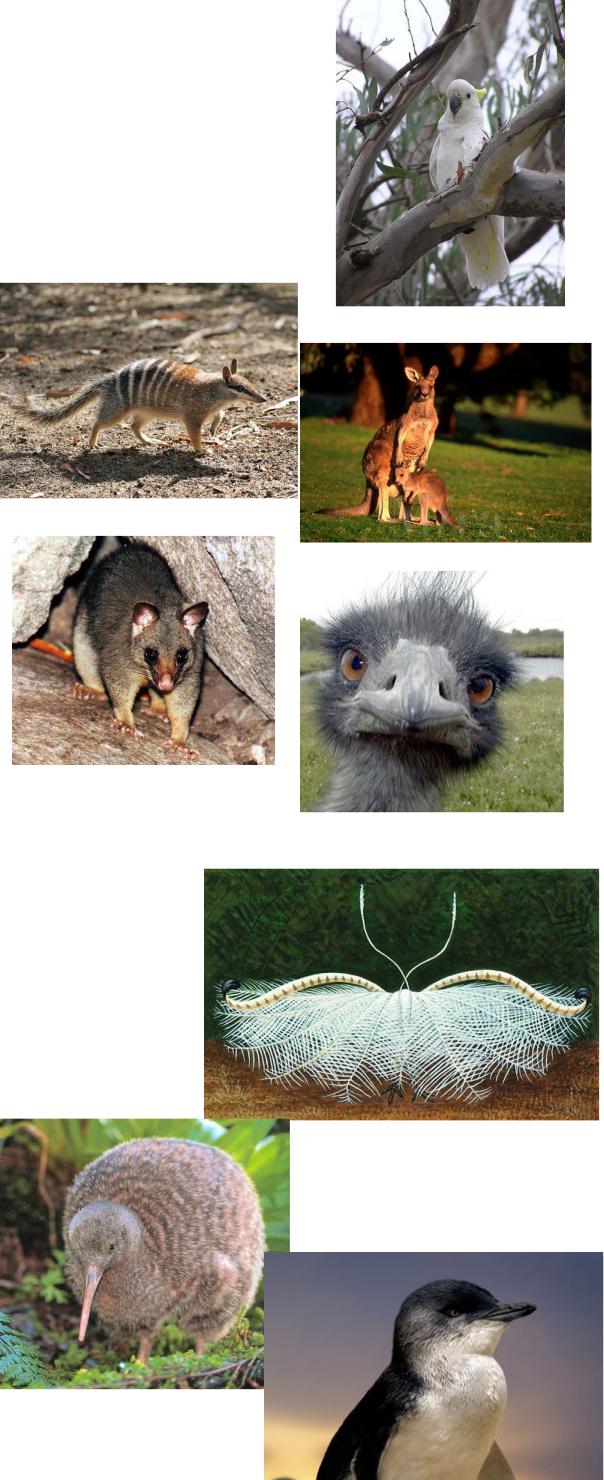
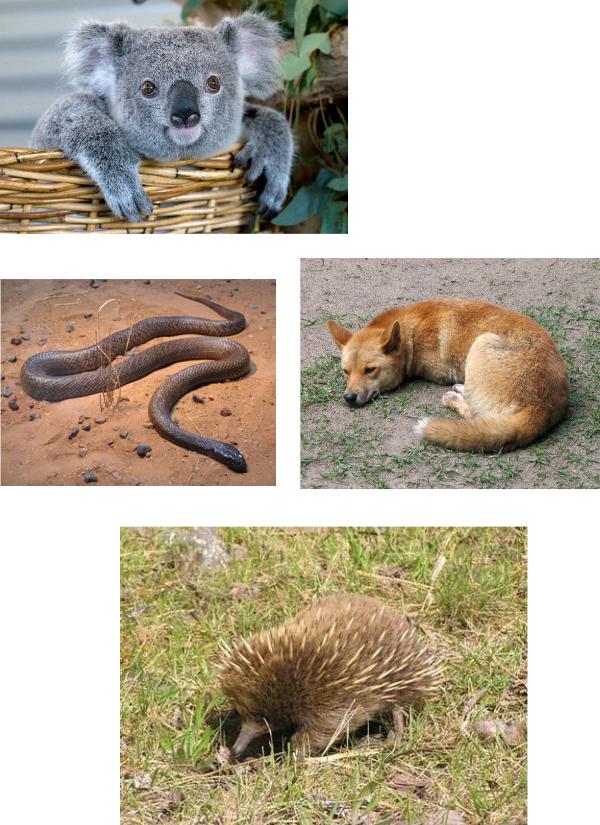
22. Match the animals to the pictures (pic. 49a – 49l). What are you going to read about?
1)numbat
2)koala
3)kangaroo
4)lyrebird
5)cockatoo
6)opossum
7)snake
8)duck-billed platypus
9)dwarf penguin
10)emu
11)dingo
12)kiwi
49a) ___
49b) ___
49c) ____
49d) ____
49e) ___
49f) ___
49g) ___
49h) ___
49i) ___
49j) ___ |
49k) ___ |
49l) ___
23.Which of them are marsupial mammals, reptiles and birds?
24.Read the text and entitle it.
Australia is the only country in the world to include an entire continent. Australia the country has the same territory as Australia the continent. Also, its population, only about 22 million, is one-fourteenth as large as that of the United States. This is mainly because most of Australia consists of deserts. It lacks the large expanse of fertile, wellwatered land that has made America a “fruited plain.” Because of its much smaller population, Australia is divided into only six states – Queensland, New South Wales, Victoria, Tasmania (“Tassie”), South Australia, and Western Australia. A seventh administrative unit, the huge Northern Territory, has not yet become a state. In addition, the separate Australian Capital Territory (ACT) – the equivalent of the District of Columbia – houses the national capital, Canberra. It, too, lacks the status of a state.
The most outstanding feature of the Australian climate is the huge expanse of desert land, a “red heart, dead heart” dominating the center of the continent. Some people call Australia the “desert continent.”
The word dead describes the desert character of the continental interior. Red comes from the mainly reddish hue of soil and rocks of these deserts. In fact, the color “signal” given off by the continent Australia, like other continents, has not remained in one place. Instead, it broke away from Antarctica, Africa, and South America eons ago and drifted northeast. During most of this strange journey, the continent was isolated from all others. Isolation allowed unique forms of plant and animal life to develop. Among the animals, marsupials became dominant. Marsupials are
mammals that place the newborn offspring in maternal pouches for additional development. Marsupials existed before continental drift began, and in the Americas the opossum is an example.
In isolated Australia, the marsupials developed into many distinctive animals, such as kangaroos, wombats, and koalas. Other unique species also developed, such as the duck-billed platypus, an egg-laying, web-footed water creature. Australia shares with Africa the crocodile, a danger to swimmers in many waterways. Another danger is the wide variety of Australian snakes – all of them deadly. The continent also evolved its own versions of the giant flightless birds of southern Africa, represented in Australia by the emu. Another flightless bird, the dwarf penguin of Australia’s southern coast, demonstrates the continent’s former link to Antarctica. Phillip Island, near Melbourne, is the best place to see those endangered penguins. Until about 50,000 years ago, no invader animal species except birds and fish reached Australia. Then Aborigines came, bringing dogs with them, and some of those canines evolved into the wild dingo, a meat-eating predator. With the European colonization of Australia came many wild animals. The most destructive were the rabbit and the fox (introduced so the English could continue their pastime of fox hunting). Repeated attempts to eradicate the rabbit have proven futile. An enormous fence was erected across Australia to try to stop the spread of rabbits, but it has proven only partially successful.
25. Read the text again. For questions (1 – 4), choose the correct answer (A, B or C).
1.The separate Australian Capital Territory houses… a) ACT.
b) Canberra.
c) the District of Columbia.
2.“Red heart, dead heart” stands for …
a)huge expanse of desert land.
b)reddish hue of soil and rocks.
c)an Australian superhero.
3.Among the animals … became dominant. a) marsupials.
b) snakes. c) birds.
4.An enormous fence was erected to …
a)stop the spread of rabbits.
b)continue fox hunting.
c)see endangered penguins.
26.Read the sentences. Do you think they are true? Read the text and check your answers.
____ Australia the country has nearly the same territory as Australia the continent.
____ Australia is divided into only sixty states.
____ Queensland is the capital of the huge Northern Territory.
____ Canberra likes the status of a state.
____ Australia is known as the “desert continent.”
____ Mammals are marsupials that place the newborn offspring in maternal pouches.
____ It’s not a good idea to visit Phillip Island, near Melbourne, if you want to see dwarf penguins.
27.Read the text and say what these figures stand for:
2.8
1200
1.7
50000000
55th
2050
6390
How Many of Us
As of 26 January 2010, the population of Australia was 22 140 000. According to the Australian Bureau of Statistics, this figure rises by one person every 1 minute and 12 seconds (or 1200 a day). On average, there is a birth every 1 minute and 44 seconds, a death every 3 minutes and 39 seconds, and a net gain of one international immigrant every 1 minute and 53 seconds.
Our population grows at 1.7 per cent a year (faster than Indonesia’s, at 1.2 per cent, and India’s, at 1.6 per cent). But some parts of the country are more popular than others: this decade the populations of Western Australia and Queensland have been growing at 2.5 per cent a year.