Материал: 2249
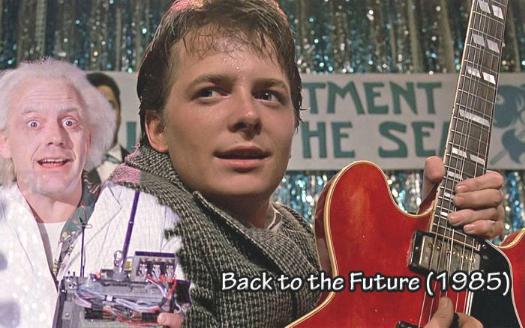
2. Back to the future
Back to the Future is a combination science fiction and comedy about a suburban teenager, Marty McFly (Michael J. Fox), and the adventures he has with his best friend, the eccentric scientist and inventor Dr. Emmett Brown (Christopher Lloyd) who has invented a time machine. Marty is portrayed in the film as being very "cool" by teen standards: he's an expert skateboarder, plays guitar in a rock band, and has a serious girlfriend, Jennifer (Mary Steenburgen). In contrast his home life is rather pathetic: his unhappy mother, Lorraine (Lea Thompson), drinks a lot, criticizes her daughter for calling boys on the telephone, and tells Marty she doesn't approve of Jennifer. One of the things that makes Back to the Future work so well as a film is the attention to details and the comedy that is generated by the contrast in attitudes and lifestyles between the fifties and the eighties. When Marty walks into a drug store to find a phone book and the owner asks him why he is wearing an inner tube (his sleeveless parka), or when Lorraine calls him Calvin because she saw Calvin Klein embroidered on his underwear.
Director Robert Zemeckis deserves a lot of credit for keeping the action well paced, the audience on the edge of their seats, and for the fine performances he achieved from the cast. In fact, he is responsible for putting Michael J. Fox into this film after a lot of it had been shot. Fox's energy and enthusiasm make the film work, and he is a good foil for Christopher Lloyd, who always acts as if he actually believes the scientific flim-flam he is saying. And Thomas F. Wilson seems to relish his role as Biff the town
16

bully, the guy you love to hate. But the best part of this film is the closing scene after all has been resolved. Imagine what it would be like if you were able to change just one or two incidents of the past. Because of those little changes Marty made in his family's space-time continuum, he gets to experience a very different life from what you saw in the opening scenes.
More than just a series of anachronisms, Back to the Future has a real heart. You suffer along with Marty's teenaged dad, George, at the depredations of his tormentor, Biff, and get a genuine surge of adrenaline and pride when George finally takes his stand. Could this event lead to a changed life? In Back to the Future it does, believably. In fact, the film has more in common with the sentimental fantasy of It's a Wonderful Life than with the often-mindless action of the science fiction pictures that followed, proving that bigger budgets and more elaborate special effects didn't exactly lead to a higher-quality summer blockbuster.
26. Find phrases in the review of Ocean’s eleven that you can replace with the phrases below.
A)I particularly liked.
B)It is certainly worth seeing.
C)Take place in.
D)The film is about.
E)The starring roles are taken.
F)The story is hard to follow.
G)Very popular with movie-goers.
27. Look at the examples in the box. Then think of a film that you know and choose the best way to complete the sentences.
Making generalisations
On the whole,
In general, the acting is excellent.
By and large,
The acting is generally excellent.
A) On the whole, the plot is a little confusing / not terribly believable / quite engaging.
17
B)In general, the main characters of the film are a little disappointing / very convincing / very interesting.
C)By and large, the action scenes are rather boring / thrilling / very well done.
D)The film’s soundtrack is generally just right / quite inspiring / very annoying.
28. Write a review of a film that you have seen. Use the paragraph plan below to help you.
Paragraph 1
•What is the film’s title?
•What kind of the film is it?
•When was it made?
•Who stars in it?
•Who directed it?
•How successful or popular was it?
Paragraph 2
•Where is it set?
•Who are the main characters?
•What happens in the film (NB Use the present simple to tell the story of the film.)
Paragraph 3
•What did you like or dislike about the film?
•What were the acting, the script, the soundtrack, etc like?
•Were some parts of the film better or worse than others?
Paragraph 4
•On the whole, did you enjoy the film?
•Would you recommend it to other people? Why or why not?
18
ALICE IN WONDERLAND (2010)
Pre-watching activities:
1. Do you know who Alice is? Originally, she is the main character of a well-known novel. Read the following information from Wikipedia and tell about main facts of this novel’s creation and distribution.
Alice's Adventures in Wonderland (commonly shortened to Alice in Wonderland) is an 1865 novel written by English author Charles Lutwidge Dodgson under the pseudonym Lewis Carroll. It tells of a girl named Alice who falls down a rabbit hole into a fantasy world populated by peculiar, anthropomorphic creatures. The tale plays with logic, giving the story lasting popularity with adults as well as children. It is considered to be one of the best examples of the literary nonsense genre, and its narrative course and structure, characters and imagery have been enormously influential in both popular culture and literature, especially in the fantasy genre.
Alice was published in 1865, three years after the Reverend Charles Lutwidge Dodgson and the Reverend Robinson Duckworth rowed in a boat, on 4 July 1862, up the Isis with the three young daughters of Henry Liddell (the Vice-Chancellor of Oxford University and Dean of Christ Church): Lorina Charlotte Liddell (aged 13, born 1849), Alice Pleasance Liddell (aged 10, born 1852) and Edith Mary Liddell (aged 8, born 1853).
The journey began at Folly Bridge nearOxford and ended five miles away in the village of Godstow. During the trip the Reverend Dodgson told the girls a story that featured a bored little girl named Alice who goes looking for an adventure. The girls loved it, and Alice Liddell asked Dodgson to write it down for her. He began writing the manuscript of the story the next day, although that earliest version no longer exists. The girls and Dodgson took another boat trip a month later when he elaborated the plot to the story of Alice, and in Novemberhe began working on the manuscript in earnest.
To add the finishing touches he researched natural history for the animals presented in the book, and then had the book examined by other children particularly the children of George MacDonald.
On 26 November 1864 he gave Alice the handwritten manuscript ofAlice's Adventures Under Ground, with illustrations by Dodgson himself, dedicating it as "A Christmas Gift to a Dear Child in Memory of a Summer's Day".Some, includingMartin Gardner, speculate there was an earlier version that was destroyed later by Dodgson when he wrote a more elaborate copy by hand.
19
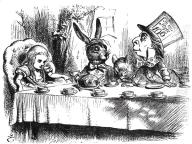
But before Alice received her copy, Dodgson was already preparing it for publication and expanding the 15,500-word original to 27,500 words, most notably adding the episodes about the Cheshire Cat and the Mad Tea-Party.
In 1865, Dodgson's tale was published as Alice's Adventures in Wonderland by "Lewis Carroll" with illustrations by John Tenniel. The first print run of 2,000 was
held back because Tenniel objected to the print quality. A new edition, released in December of the same year, but carrying an 1866 date, was quickly printed. As it turned out, the original edition was sold with Dodgson's permission to the New York publishing house of Appleton. The binding for the Appleton Alice was virtually identical to the 1866 Macmillan Alice, except for the publisher's name at the foot of the spine. The entire print run sold out quickly. Alice was a publishing sensation, beloved by children and adults alike. Among its first avid readers were Queen Victoria and the young Oscar Wilde. The book has never been out of print. Alice's Adventures in Wonderland has been translated into at least 97 languages. There have now been over a hundred editions of the book, as well as countless adaptations in other media, especially theatre and film.
(http://en.wikipedia.org/wiki/Alice's_Adventures_in_Wonderland.)
2. Match the words with their definitions:
a hole |
камзол, жилет |
a caterpillar |
жених |
an engagement |
пищеварение |
digestion |
помолвка, обручение |
a fiancé |
коготь |
to slay |
развернуть |
to unroll |
исчезать, испаряться |
a claw |
гусеница |
distracted |
должный, приличный |
a waistcoat |
нора |
proper |
рассеянный, растерянный |
to evaporate |
уничтожать, убить |
20