Материал: 5577
56
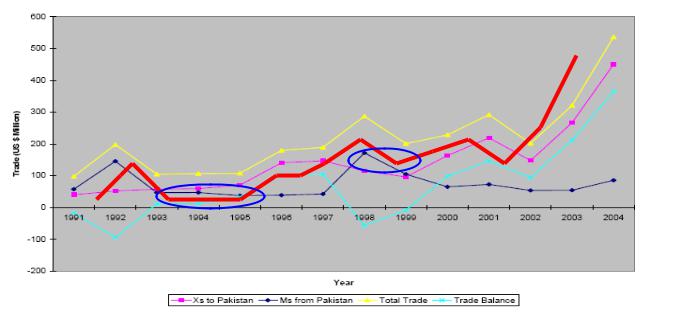
Picture 2 - India-Pakistan trade
Source: Direction of trade IMF, 2006
The experience of the different countries can be used to prevent future conflicts and to establish the dynamic economic and trade growth. Russian Federation can and should take into account the reasons and consequences of military conflicts to build stable economic and political bilateral and multilateral relations. For instance, Russia can use the trade connections with Georgia to prevent the opportunities of future conflicts, making at the same time strong political, economic and trade ties with South Osetia and Abkhasia. And maybe not the ballistic missiles are guarantees of peace and security in the world. The guarantee for peace is stable, constantly improving economic relations, because economics is a hard work, the opportunity to show the best features of the State for its benefit.
References
1.Data Dissemination Branch of the Foreign Trade Division - Trade in Goods (Imports, Exports and Trade Balance) with Iraq, 2009
2.ICRIER – Working paper #182, Nisha Taneja – India-Pakistan trade
3.Heidelberg institute for International conflict research, the Department of Political Science, University of Heidelberg – Political conflicts of 2008
Irina Kulgina, Elvira Shakhverdieva,
5th year students, Business Department, Institute of Technology and Business, Scientific adviser: Olga A. Berezkina, PhD in Pedagogical Sciences, Instructor
STABILITY AND SECURITY OF THE WORLD COMMUNITY UNDER GLOBALIZATION CONDI-TIONS
Introduction
Urgency of the theme “Stability and security of the world community under globalization conditions” is undisputed. In the last several decades, countries around the world were shaken with various cataclysms. Last decade of present millennium suffers from universal problems, on which decision doesn’t depend on only existence of mankind, but also public progress.

57
The main problem is the maintenance of peace. Modern system of international relationship suffers from rude and criminal actions of government in the international scene, and there are not reliable mechanisms to prevent international conflicts. National egoism and military - power thinking are far from being overcome. For example, North Korea – is one of the world's most secretive societies, has exacerbated its nuclear ambitions and meanwhile, it rigidly maintains isolation from the rest of the world. Also the sovereignty of many states does not lead to automatic overcoming century economic backwardness, poverty and famine. The problem, concerning overcoming of economic backlog and “the third world” countries’ modernization, is not only a problem on national level. It is a problem of global scale.
Recently financial crisis was tempered the ecological one, where imbalance of relationships between human and nature has reached warning stage: the human environment collapses, and all this consequences cause huge damage in their health (depletion of atmosphere ozone layer, shortage of potable water, overpopulation, the epidemics of AIDS and various forms of a flu, narcomania and etc.). Immediate cooperation and collective efforts of all governments are required for prevention of this threat.
Demographic situation develops not always successfully for the separate states: both a population explosion (China) and monstrous demographic recession are observed (European countries). Concerning Russia, at the last few years, population upsurge however can’t be really favorable situation, because of population growing we have such unstable, and so pessimistic situation in demographic sphere. This question has a number of complications. Regulation of infant natality is not only personal problem, is the social and economic problem too. That’s why Russia and other states carry out certain program (maternal capital) for stimulation growth of the population. Birth-rates in many developed, industrialized countries are stagnant or declining. But when this is combined with very low life-expectancy and an increasing unhealthy population – it is "catastrophe".
In the 2008, world faced with the global crisis, which threatens stability of world and national economy. That’s why urgent problem, concerning all states, is the search of different collaboration forms aimed at the prevention of the financial crisis and its disastrous consequences. New millennium has brought a great of problems to mankind and the very Earth. In order that the world will develop stably, efforts of all people, living in the world, and international relations are needed. So, what does prevent to stable mankind’s progress, what are the main disadvantages and advantages of human activities, what does prevent to do the world community stable and safety? In our report we try to find the answer on this important questions, reporting step-by-step the principles of globalization in political, economic, cultural sphere, consider the international relations essence.
Let’s notice, that international relations are in constant dynamic progress. There are a number of areas, which are supported by someone governments, whereas another one are not maintain it. All along, the process of development various organization occurs – military, economic and political alliances constantly are established and also failed, that in turn leads up to emergence new alliances or organizations. Such tendencies in international politics as globalization and anti-globalization, liberalization and democracy are known around the world, thanks to the greatest quantity of supporters, which conduct manifestations, marches and protests in support of their ideas. Let’s consider such questions: Globalization – what is it? Is it innocuous or not? And what does globalization bring to mankind in a whole?
Globalization
Literally globalization means “international integration”. It can be described as a process due to which people all over the world are united in one society. This process is a combination of economical, technological, sociocultural and political forces1. As a term,
1 Инфра-М. Практика глобализации: игры и правила новой эпохи. М., 2000

58
globalization is very often used in order to address to economic globalization, which in fact is integration of national economies affecting on global economics through trade, foreign direct investment, capital movements and distribution of technologies. Also globalization can be defined as internationalization of everything, concerning different countries.
Globalization has various aspects which affect the world in several different ways such as: industrial, financial, economic, political, informational, cultural, ecological and social.
Apparently globalization has touched various aspects of life activity, but we shall divide globalization into three main kinds: a policy, economy and culture so that to understand merits and demerits comparatively how globalization will help to make the world steady and safe1.
Political Globalization
Globalization means the weakening of the national states in a policy structure. On the one side, it takes place due to that the modern states delegate more and more authority to the powerful international organizations, such as the United Nations Organization, the World Trade Organization, the European Union, the NATO, IMF and World Bank. On the other hand, due to reduction of the state intervention in economy and decreasing of taxes the enterprises’ political influence (especially large transnational corporations) is increased. The states’ authority in relation to own citizens also decreases because of easier people’s migration and free capitals movement abroad.
Economic Globalization
For economic globalization aspects are significant free trade, free movement of capital, tax enterprises profit deduction, simplicity of moving productive industry between the divers states on behalf of costs reduction on labour and natural resources, and also developed and less developing countries steadily approach on a level of salaries, the quotation for goods and profitability of the enterprises. The outsourcing tendency is from no profile operation of companies to the specialized companies and many other things.
Cultural Globalization
For cultural globalization rapprochement of business and consumer culture between the different countries and growth of the international communication is typical. On the one hand, this results in popularization of separate kinds of national culture in worldwide. On the other hand, the popular international cultural event can displace national or transform them in international. Many people regard it, as loss of national cultural values and struggle for revival of national culture. It is essential to dot one’s ‘i’s’ in this case and not to confuse the process of humanity evolution in its foreign communications and relations, and the propagation’s process of the American mode of life and thought.
Foreign relations and superpowers
The foreign states’ relations are one of the bases on which the modern society is under construction. Today, existence of a civilization depends on mutual relation between the states. Modern foreign relations represent complicated system of political, economical, cultural and other. There are a number of superpowers such as the United Nations (UN) which activity is directed on peacekeeping and safety, and also on strengthening of the international cooperation of all countries2. UN is an international organization with the purposes of maintaining international peace and security, developing friendly relations among nations on the principle of equal rights and self-determination, and encouraging international cooperation in solving international economic, social, cultural, and humanitarian problems. For example, let’s consider the alarming situations, concerning North Korea3. This country
1Зевин Л.З. Экономические структуры разного уровня в глобальных процессах: особенности взаимодействия. М., 2003
2Морозов Г.И. Международные организации. Некоторые вопросы теории. 2-е изд. М., 1974
3www.un.org/ru
59
despite of the United Nation’s demands continues to expand its nuclear programme. And the wrong situation forms, because international inspectors can’t resist to Korea’s action. We all remembered that fact that international observers were ejected from this country and as a result the United Nations was never able to get a complete picture of the North Korea's programme and was never in a position to state with certainty that its character was peaceful.
This program and Korea’s statements about successfully tested of nuclear weapon, spread alarm throughout the Asian-Pacific region and the whole world.
And what measures must be taken by the UN’s members? UN applies intensive diplomatic efforts, aimed to rein in North Korea's nuclear ambitions. But it’s very strange from Korea’s side firstly agreed with shutting down its main nuclear reactor in return for aid and diplomatic concessions and then retracted its own words, meanwhile accusing negotiating partners - the US, South Korea, Japan, China and Russia - of failing to meet agreed obligations. What is the position of North Korean government? It wants to show their superiority, intimidating not only world community, but also innocent civilians around the world. Maybe in this situation the disadvantages of globalization reveal …maybe exactly these unstable positions, sometimes military and dangerous, undermine UNO's authority. We suppose that all conflicts must be regulated on the diplomatic level, we live in the third millennium and governments must submit to international laws and declarations. Times of territory conquest have gone; nowadays we want to live in the peace world without any wars.
But it is impossible, as we can see in practice. Certain organizations, blocks or countries outrage the law, in spite of international conventions. The striking example of this is the Somali pirates, who are not just mythological characters with peg legs, parrots and pistols. Nowadays they carry Kalashnikov's rifles and use speedboats to rule the high seas of the world. Piracy is a major problem off the Somali coast. Piracy has become a way of life for many young Somali men, as they simply do not know any better. These men have no education and no understanding of the rule of law. Exactly difficult living conditions instigate them to crime. And the problem solving consists in rising standard of education, providing local citizens with work places, in order to diminish all wants to break the law.
Somalia is a unique problem, because there is no effective central government and no navy to protect its territorial waters. Even 191 commercial vessels have suffered from pirates for 2008 year. Despite of taken measures (such as patrolling or forming the “safe channels”), Somali pirates don’t observe the international laws. That’s why world community must combine forces, because no one nation has a responsibility for policing international waters. In this question countries concerned must be involved, as they have an economic or strategic interest in maintaining the security of sea lines of communication. And without help from other countries, it is very difficult to imagine whether Somalia will have sufficient resources and infrastructure to deal with piracy itself?
The role U.N.O. in development stimulation on the assumption of globalization
The management of globalization remains large-scale problem. Economic integration has a global market forces, which essentially effect on countries’ level of influence in forming national politics. But then international obligations tie countries to certain international rules and processes. This obligations are very extensive, it spreads on economic, social and ecological sphere, but at the same time, they are often complex. Many countries have no an idea about this obligations. In the world policy, countries are faced with numerous problems, trying coordinate international obligations with national priority, especially under conditions, when all nations intimately related. Developing countries, particularly the least developed and most vulnerable of them, are on the bit in the world arena. Their ability of having brave and specific purpose-oriented national development strategy is restrained by some of international politics and obligations requirement, by demand of international processes and rules.
60
Although all countries are faced with such restrictions, developing countries have more problems, arising at the negative fallout elimination.
Conclusion
We would like briefly formulate a conclusion about a place and role of globalization and about main aspects without which there cannot be stability, safety and progress of the world community. Globalization and continuing fast technical advance open unimaginable in past opportunities for social and economic development. At the same time they are still connected with grand problems, including large-scale financial crises, uncertainty in tomorrow's day, poverty, isolation and an inequality both inside societies, and between them. Significant obstacles are kept in terms of the further integration and full participation in the global economics of underdevelopment, especially hard developing countries and also some countries with transitive economy. The increasing number of people in all countries and even the whole regions will remain on periphery of global economy until all countries will not use the benefits of social and economic development. In the world where interdependence more and more goes deeply, perfection of economic management at all levels gets more and more important value so as possibly to increase benefits of process globalization for all.
There are wheels within wheels between globalization processes and development indexes. All globalization factors (financial cooperation, trade, investments, technical progress and migration) have the social, economic and environmental consequences and influence on development and realization of a policy at national, regional and global levels.
Among such consequences the important value has restriction of state’s independence in questions of policy development and the necessity of caused by it that formation of a national policy was carried out on a basis of more full international duties, obligations and imperatives account. Purposes achievements in the sphere of the development formulated in the Declaration of millennium demand strengthening of global partnership with a view of development. The small countries, being exposed by independent adverse economic forces, cannot provide achievement of these purposes by themselves.
Let's compare merits and demerits of globalization to make a final conclusion all in all. Generally merits are related to:
1.Growth of quantity and quality of consumer production in the world market.
2.Rapid technologic progress where the first cost of produced goods decreases and the prices for a significant part of the goods of mass demand are reduced (Let's recollect even computer’s and mobile phone’s transformation from a luxury into universal inexpensive attribute of the modern person for some 5-7 years).
3.Creation of new workplaces.
4.Considerably wider and free access to the information and the appropriate expansion of opportunities and ways of the communications globally than 10-15 years ago.
5.Advance in living standard, relative improvement of the basic social factors in the majority of world’s regions. According to the United Nations, average standard of living in the most developed countries has increased from 69 till 75 years, in developing countries from 46 till 63 years. In less developed countries the level of education has grown from 46 up to 69 percents, in the poorest - from 29 up to 46.
6.Improvement of mutual understanding between various cultures and civilizations. Demerits are related to:
1.The global economic becomes more instable and weak. Negative tendencies in one or
another country or region have immediately effect on economic well-being of the others one.
2.The gap in economic and social process between the rich North and the poor South has reached the unprecedented sizes and continues to be increased.
3.The scales of population migration considerably grow primarily from poor countries
into the prosperous ones. This process is beyond under the control of the national