Материал: 5577

51
technologies, whose capabilities considerably surpass the capabilities of the existing living beings, the human being must direct these attainments for the achievement of the most important aim – an ensuring of possibility of stable existence for his future generations.
The Earth climate was never constant. It was subjected to fluctuations within all time scopes – from centuries to millions of years.1 The Ice Age that lasted about one hundred thousand years is one of the most remarkable periods of fluctuations, when the Earth climate was much severe than nowadays. And during the interglacial periods the climate was warmer. Earlier those cycles have been provoked by natural causes. However, with the beginning of the industrial revolution, the changes in the Earth climate began to go more faster due to the human activities.
On the whole, the factors influencing on the climate and caused by human beings are called anthropogenic.
Economic development is always accompanied by the increased consumption of such kinds of fossil fuels as: coal, oil and natural gas. The active usage of these types of fuel by industrial enterprises increased the volume of carbon dioxide exhausts in the atmosphere that became an important component of the “greenhouse gas”. Besides carbon dioxide retains infrared radiation of the Earth and creates a real threat of the annual temperatures’ increase on the planet’ surface – and it is the result of the so called greenhouse effect.
Other anthropogenic factors effecting to the Earth’s changes of climate are the discharge of the aerosol particles, deforestation and urbanization.
We live in the XXI century. It is the time for new deeds and great accomplishments. But why are all these deeds harmful for our world? According to International Meteorological Organization, more and more facts testify that the rate and the duration of warming-up in the XX century were higher than in any given period for the last millennium.
The nineties of the XX century were probably the warmest decade of this millennium especially in the Northern hemisphere of our planet. The year 1998 was the hottest for the above mentioned period of climate change; the year 2001 followed after it. The maximum and minimal average temperatures are going up; however the minimal average temperatures are increasing at faster rates.
According to the report of the UN Intergovernmental Commission on global climate change (dated by 1995)2, if the existing tendency for greenhouse gas discharge persists, the annual average temperatures may increase by 1-3.5 degrees Celsius in the lower atmosphere layers by the year 2010. This will result in the increase of the sea level by 15-95 cm. All this can lead to numerous negative aftereffects. Many ecological systems like forests will not be able to adjust to the rapid temperature and precipitation’s changes. In countries with humid climate floods may become more frequent. The harvests will dramatically go down. The people living along the many seashore zones will be forced to leave the areas of their domicile, e.g. millions of people living in Republic of Bangladesh.
13% of the world population lives in the "Group of Eight" countries, however their account for world’s GDP makes 60%. That is why an influence of these countries on ecological balance and climate is predominant. But industrial developments and economical activity cannot be stopped – it contradicts the principle of development and progress of human consciousness. Consequently, every country which strives for the further development should contribute to protecting the planet’s ecology in appropriate proportion with carried damage.
I consider, a single country's industrial, economic and intellectual potential is not enough to prevent ecological catastrophes and stop global warming - it's just like entrusting a single
1Internet-source: http://www.aip.org/history/climate/rapid.htm
2UN Framework Convention on Climate Change (http://unfccc.int)

52
person out of billions of people with a protection of the whole Earth. That's why it is so important to unite efforts of all countries to protect the planet.
In 1992, during Summit in Rio de Janeiro (Brazil) the heads of the developed countries set forward a goal to preserve till 2000 the same volume of CO2 emissions as it had been in 1990. However, when in December 1997 representatives of 165 States gathered in Kyoto (Japan) at the UN Conference on global climate changes, it became evident that many countries were unable to fulfill this task. The final document, adopted by the Conference (the so-called “Kyoto Protocol”), stated that a special international treaty obligatory for all participating countries was needed to adopt for cutting down the greenhouse gas emissions by 6-8% by 2012. This Protocol is an unexampled achievement of global ecological thinking in spite of the fact that it doesn’t involve in developing countries.
The Kyoto Protocol is an international instrument adopted in addition to the UN Framework Convention on Climate Change (UNFCC). Federal Law "On ratification of the Kyoto Protocol of the UN Framework Convention on Climate Change" was signed by Vladimir Putin, President of the Russian Federation, on November 4th, 2004.
The Kyoto Protocol became the first global agreement on environment protection based on market regulation mechanisms – namely, mechanism of emission quotas' international trading system1.
World developed countries took upon themselves the leading role in preventing global climate changes. Various organizations in many countries are engaged in elaboration of ecological programs, the newest and pollution-free technologies, the most effective methods of energy production and its consumption. The most striking example on this point is
Germany’s experience. In comparison with the year 1980, power consumption per capita in this country was reduced by 11 %, while the emission of carbon dioxide per capita was fell almost by 20 %.
Today only the countries of the European Union and Japan have started to cut down carbon dioxide exhausts. Meanwhile the quantity of carbon dioxide being exhausted by the USA forms a quarter of the world’ exhaust volume and steadily continues to increase. China and India, accelerating their development pace, started to exhaust the bigger carbon dioxide quantity into the atmosphere.
Russia is the country which occupies the largest territory in the world. Considerable part of this territory is covered with forest which account for 25 % of the world forests’ reserves. I live in the Far East of Russia. This region is unique. It has 30 % of Russian’s forests.
Forest ecosystems are vitally important. Forests are the lungs of the Earth. They store large carbon volumes which otherwise would accumulate in atmosphere as CO2 and would lead to creation and increase of the greenhouse effect. Moreover, forests regulate hydrological conditions of rivers and soils. Forest destruction leads to soil erosion, floods or, contrariwise, to drying of water resources. Increase in commercial logging and forest fires inflicts serious damage to forest ecosystems.
All countries should pursue the policy of effective use and preservation of forests’ resources. To achieve this, it is necessary to use all possible technical capabilities of these
States: to monitor forests’ regions, including use of spacecraft and aviation. It is also necessary to provide for the system of measures to prevent, detect and quickly suppress forest fires. Education starting from primary age and aiming at proper attitude development (safe use and protective care of forests) can also become a quite effective measure.
In the framework of the Kyoto Protocol realization, Russia plans to fulfill a number of projects in power engineering sector. It is in the Russian Far East, namely in Khabarovsky Krai, one of the first projects of conversion the power plants from the use of coal as a source
1 The text of the Kyoto Protocol (http://unfccc.int/resource/docs/convkp/kpeng.html)
53
of energy into natural gas use will be started. These projects will be realized in collaboration with the Danish Environmental Protection Agency.
Current situation with environment and climate changes is very complicated. It is necessary to start right away the realization of all measures what representatives of the
“Group of Eight” were talking about at their joint meetings.
Also, the representatives of the Group of Eight concentrated their attention on the problem of global warming during the summits carried out in Hokkaido, Japan, in 2008 and in L’Aquila, Italy, on the 8-10th of July, 2009. They emphasized the necessity of using nuclear power as one of the sources that may partly reduce dependence on fossil fuel, and at the same time they reiterated that safeguards (nuclear nonproliferation), nuclear safety and nuclear security (3S) are fundamental principles for the peaceful use of nuclear energy. Then, it was announced that the volume of carbon dioxide emissions is planned to be reduced by almost 50 % by the year 2050.
In my opinion, the decision of the Group of Eight is absolutely right, and to prevent an ecological catastrophe the whole world community should unite its efforts:
-step by step lead the policy of emission reduction in developed countries,
-to give technological assistance to developing countries and help them to support their economic growth by energy without coal firing, for instance, using biological fuel,
-more actively introduce the cars using alternative types of fuel into everyday life,
-develop nuclear technologies to use this power as a substitute of fossil fuel, while being guided by the principals of safety and peaceful usage of nuclear power.
Usage of new technologies and renunciation of old habits could give us hope for the preservation of the planet. But only if we act together in quick and drastic manner.
Today, only a narrow window of possibilities is open, and this window is quickly closing. However, it is quite wide open yet for the ray of hope to pass through.
Natalia Ivanova,
4th year student, International Economic Relations Department, Khabarovsk State Academy of Economics and Law Scientific adviser: Galina V. Klishina, Instructor
ECONOMY AS A REFLECTION OF THE POLITICAL INFLUENCE
We live in the century of global changes. The whole world of 21st century shows enormous rates of developing. All spheres of life exist in close co-operation. There is interdependence of economic policy of development and the political regime of the country. The development of economic, trade and commercial relations during the political crisis or even in the period of a military conflict between states is an extremely actual problem nowadays, but there is a lack of information about this problem.
That’s why the aim of our work is to analyze the interconnection between political environment and the rates of economic development and trade relations.
Global political environment combines a great number of components:
 bilateral and multilateral relations between countries, including national and international relations and military defense;
 economic bilateral and multilateral relations, including issues of functioning national economy, commerce, and trade;
 political relations, including interaction of international organizations (governmental and non-governmental organizations, parties, alliances, associations).
On the basis of the practical interaction of these components we can establish that economy follows the politics.
54
Theoretical issue of political and economic interaction is based on two mechanisms through which political relations between countries influence their commercial relations.
The first mechanism is state-centered. Taking into account that cross-border economic relations can influence interstate security relations, state leaders can consider all consequences and limit cross border economic integration even to the total reduction, if there are complications right up to military conflict. The impact of economic interdependence on military conflict is significant. [3]
The second mechanism of components’ interaction is based on economic benefit of individual commercial agents, who realize that worsening of political relations between countries increase the risk of economic failure of agents’ business. These arguments concentrate on the issues of cross-border commerce, functioning of military industrial complex. It means that commercial integration has an important influence on bilateral and multilateral political relations. [3]
At the same time conflict’s effect on commerce isn’t completely universal. For example, despite of well-known political confrontation between Taiwan and Mainland of China, economic connections and flows between the mainland and the island have increased substantially for the past two years.
So, we can make a conclusion that economic integration and interdependence can reduce the risk of military conflicts between countries. Realizing what way commercial ties can develop even in the shadow of severe conflict’s political tension we can therefore understand which political actions can result in war and which can not. To illustrate these theoretical aspects, we should analyze concrete practical cases. We need to proof the following statements bilateral and multilateral commercial and trade relations depend on:
(a)Present conditions of the military environment in this or that region;
(b)The fact if there is political conflict.
For example considering the relations between the USA and Iraq we can notice the presence in them periods of both «war» and «piece».
Volume of Iraq - USA trade
|
7000 |
|
|
|
|
|
|
|
6076,1 |
5866,6 |
|
|
|
|
|
|
||
|
6000 |
|
|
|
|
|
|
|
|
|
|
|
|
|
||||
|
|
|
|
|
|
|
|
|
|
|
|
|
|
|
|
|
|
|
|
5000 |
|
|
|
|
|
|
|
4236 |
|
|
3580 |
|
|
|
|
3964,3 |
|
volume |
4000 |
|
|
|
|
|
|
|
|
|
|
|
|
|
|
|||
|
|
|
|
|
|
|
|
|
|
|
|
|
|
2864 |
|
|||
|
|
|
|
|
|
|
|
|
|
|
|
|
|
|
|
|||
3000 |
|
|
|
|
|
|
|
|
|
|
|
964,3 |
|
|
|
|
||
2000 |
|
|
|
|
393,7 |
1283,4 |
|
|
|
1078,5 |
957,2 |
|
|
|
||||
|
|
|
|
|
|
|
|
|
|
|
2742,1 |
|||||||
|
|
|
|
|
|
|
|
|
|
|
|
|||||||
|
1000 |
0,4 |
4 |
0,7 |
0,2 |
2,8 |
|
|
|
|
|
|
|
|
|
|
||
|
|
|
|
|
|
|
|
|
|
|
|
|
||||||
|
0 |
|
|
|
|
|
|
|
|
|
|
|
|
|
|
|
|
|
|
|
1992 |
1993 |
1994 |
1995 |
1996 |
1997 |
1998 |
1999 |
2000 |
2001 |
2002 |
2003 |
2004 |
2005 |
2006 |
2007 |
2008 |
|
|
|
|
|
|
|
|
years |
|
|
|
|
|
|
|
|
|
|
Picture 1 - Source: U.S. Census Bureau, Foreign Trade Division,
Data Dissemination Branch
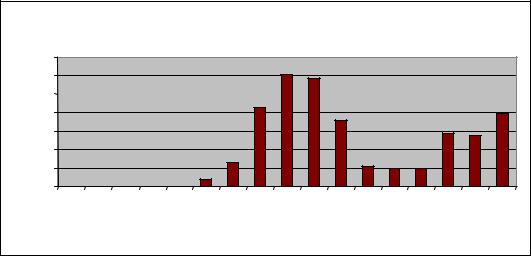
At the beginning of 90-s years of the 20th century Iraq was considered by the American State Department as a sponsor of global terrorism, country-invader, that caused the realization of military actions «Storm in the desert». According to the picture 1 we can see that the trade between these countries almost didn’t exist in that period.
55
But after the 1996 Iraq’s oil became very important source of energy for both – the USA and the whole world. That time there was enormous growth of trade volume between Iraq and the USA due to oil trade. The rapid increase of trade has changed political relations between these countries. During the 1997 and 2001 these relations were quite calm, according to the ASD documents Iraq as very important country for the USA was deleted from the list of «terrorist» States. [1].
However, after the terrorist attacks on the USA of the 11th of September 2001, Iraq was again declared as a State, supporting terrorism. The USA declared the struggle with the regime of Hussein. With the aim of searching for the chemical weapon the USA came into Iraq and overthrew Hussein without sanctions of the United Nations Security Council. The political relations were ruined. The trade between these countries rapidly decreased. This example gives the clear illustration of how the trade relations depend on the solution for political issues between two states during the conflict.
Another example describes India-Pakistan trade relations and interdependence between political and economic environments.
This region is has a great number of conflict situations between these countries based on inter-ethnic relations. Kashmir is the region of big number of military precedents.
After the Indo-Pak war in 1965, this conflict consists of periods of increasing and decreasing. After that war the trade between these States has broken up for 9 years. India and Pakistan signed after the 1871 war in 1974 the protocol for the restoration of commercial relations on the basis the government to the government. And following this protocol bilateral trade did resume in 1975-1976 and reminded in the insignificant level only recently. [2]
According to the picture 2, since 1996, trade between two countries was at much higher levels than before. But after 1998 and during 3 years the conflict appeared again and it caused the straight decrease of the trade volume.
Analyzing the commercial environment of firms engaged in trading between India and Pakistan due to a survey conducted in Delhi, Amritsar and Mumbai, we can see that several firms are entering into trading with Pakistan. Evidence of anonymous trading indicates that such trading should facilitate to improvement of information trade volume and quantity and quality of goods.
Transportation ties between two countries are weak with only two operational routes namely the Mumbai-Karachi sea route and Attari/Wagah land border. It can be easily explained by the border tensions and the fear of terrorist attacks. The first step of overcoming this obstacle must be the initiative of the governments to reduce the border tension and promote security on the way of exporting-importing goods. [2]
Nowadays the political relations between these two states are not stable. India has claims to Pakistan due to that fact, that citizens of Pakistan took part in terrorists attacks in regions of India in 2008. So we can suppose that statistics of India-Pakistan trade will have negative dynamics in this period and the nearest future, until they find solutions to certain number of political problems.
These examples illustrate the statement that during military conflicts the trade activity rapidly decreases. So we’ve considered the theoretical part in this work, practical examples of political and economic interdependence and demonstration of economics as a reflection of political thinking. This is an attempt to give businessmen, the military and entrepreneurs the main conception about the fact, military conflicts not only disturb political relations, but also damage or even break up commercial and business ties.