Материал: 5577
26
after responding to a provocation, and clarity of behavior so that the other player can recognize and adapt to your pattern of action.
The actual process of evolution of cooperation can be influenced by four factors: labels, reputation, regulation, and territoriality. A label is a fixed characteristic of a player, which can be observed by the other player. It can give rise to stable forms of stereotyping and status hierarchies. The reputation of a player is malleable and comes into being when another player has information about the strategy that the first one has employed with other players. Regulation is a relationship between a government and the governed. Governments cannot rule only through deterrence, but must instead achieve the voluntary compliance of the majority of the governed. Finally, territoriality occurs when players interact with their neighbors rather than with just anyone. Hence their success depends in large part on how well they do in their interactions with their neighbors. However, neighbors can also provide a role model. If the neighbor is doing well, the behavior of the neighbor can be imitated. In this way successful strategies can spread from neighbor to neighbor.
In sum, rational choice theorists view collective action as a social dilemma in which individual interests are at least partly in conflict with collective interests. Individuals cooperate and build trust when they have individual incentives that make cooperation in their interests. Formal or informal incentives that reward individuals for cooperative behavior, independent of collective rewards provide a basis for collective action. Interdependent actors who interact over time also have incentives to act reciprocally, even in the absence of direct incentives. That is, interdependence over time creates its own incentives, encouraging group cooperation through individual acts of cooperation and the threat of withholding future cooperation. Strategic interaction among interdependent actors is a mechanism by which individuals build trust and cooperate.
On the other hand, in normative theories, scholars explain that individuals cooperate because they share a common set of beliefs and values. These shared values emerge when individuals are interdependent, and comprise a collective or group identity. Normative theorists argue that the strength of commitment to this group identity creates the basis for trust and cooperation. Social psychologists who investigate small group behavior explain that cooperative behavior among group members depends on the salience of group identity to members. Experimental research has found that groups with a strong sense of identity have higher levels of cooperation than groups in which identity is not salient. Interdependence and experiencing a "common fate" are shown to increase the level of cooperation within the group by making group identity salient to individual members.
How does such cooperation emerge in the first place? One way is through trust, which has been identified as an attitude most critical to the formation of cooperation within groups and organizations. Normative theories identify two critical conditions necessary for trust in the group: group identification and psychological attachment to the group. By identification, they mean the extent to which individuals define themselves in terms of their membership in a particular group. Drawing on the literature on attachment styles, they introduce the concept of group attachment style, an attribute that reflects a person’s propensity to seek and feel secure in group situations. Group attachment styles is proposed to influence both the propensity to become identified with a group and the relationship between group identification and the individual’s trust in the group.
The above debate on cooperation can be summarized in two schemes (Figure 1).

|
27 |
|
|
|
|
Incentive theories |
|
|
|
|
|
|
|
|
Incentive |
|
Trust |
|
Cooperation |
|
|
|
|
|
|
Normative theories |
|
|
|
Identity |
|
Trust |
|
Cooperation |
|
|
|
|
|
Figure 1. Comparison of incentive and normative theories
However, there are several weak points in the present argument on identity. First, the concept of identity is unclear. Another question is, whether identity could be constructed. Finally, it is important to know what influences transnational identity.
The problem of identity definition arises because people have multiple identities. Psychologists divide all identities into three groups: personal, social and collective identities.
Personal identity explains how the actor percepts itself. Social identity defines actor’s role in relation to others. Collective identity means a sense of belonging to a group.
In order to maintain order in identities actors need to create a hierarchy, but quite often those identities come into conflict with each other. This is called identity crisis. Most often the conflict occurs between personal and collective identities. There can be two possible outcomes. If personal identity accepts collective identity it is called identity convergence (bridging). If not, identity construction is needed, namely amplification (change in hierarchy), consolidation (blend of identities), extension (adopting new identity for a specific project), or transformation (dramatic change of identity).
Thus, we move on to the second important question: can identity be constructed? Different social psychology theories give opposite answers to this question. Primordialism claims that identity exists objectively and depends on race, nationality and gender. Structuralism says that identity is constructed by cultural networks (for instance, collective memory). Constructivism insists that identities are constructed and reconstructed. However, construction of new identities is limited by primordialist and structural factors.
For international cooperation it is important that identity is considered by two major international relations theories, namely constructivism and poststructuralism.
Constructivists’ basic view is that human beings are purposeful actors whose actions reproduce and transform society, and that society is made up of social relationships which structure the interaction between human beings. Since the world is pre-organized – and prestructured – it shapes and moulds actors, but actors are also international agents who act in this world and who re-create or transform the structures it contains. Thus, constructivist theories do not take identities and interests as given. They focus on how inter-subjective practices between actors result in identities and interests being formed in the processes of interaction rather than being formed prior to the interaction.
Three major conclusion constructivism makes are as follows.
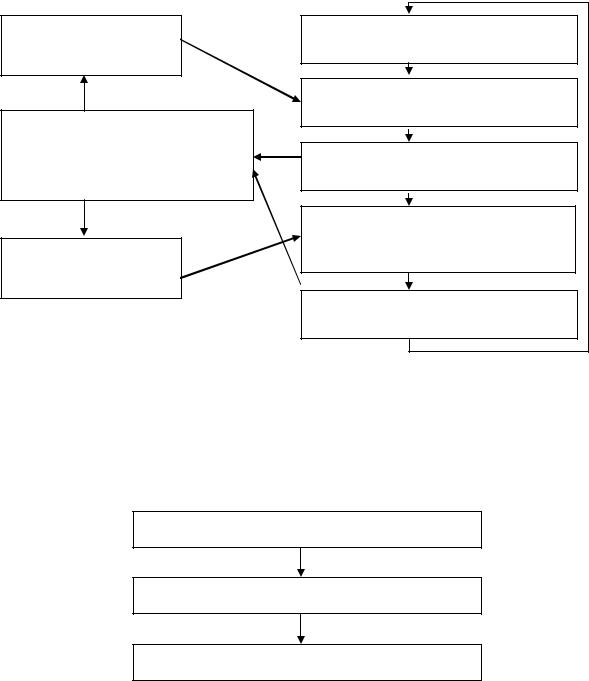
1. International system shapes states’ identities, and states’ identities shape international system (as shown in Figure 2).

28
Sequence 1 |
collective identity |
|
legitimating principles |
|
institutions |
|
|
|
|
|
|
system |
|
domestic and international norms/rules/principles |
|
|
|
Sequence 2 |
system |
domestic and international norms/rules/principles |
|
collective identity |
|
legitimating principles |
|
institutions |
|
|
|
|
|
Figure 2. Cycle construction of collective identity and system
The sequencing of this transformational logic, for a given society that is in route to a change in collective identity, depends strongly upon whether that society is experiencing transformations in domestic social relations (irrespective of whether the source of this transformation is exogenous to that society) and whether that society is in a position to make its agency felt throughout international society.
2. National identity defines national interests, which in turn define foreign policies, possible interdependence and collective identity (as shown in Figure 3).
National identity
Collective identity
Interdependence
National interests
Action (foreign policy)
Interaction
Cooperation |
|
Competition |
|
|
|
Figure 3. Co-determination of national identity, national interests and interdependence
3. National identity can be transformed into international collective identity through socialization (as shown in Figure 4).
INSTITUTIONS
State A with identities and interests
Intersubjective understandings and expectations possessed by and constitutive of A and B
State B with identities and interests
29
PROCESS
(1)Stimulus requiring action
(2)State A’s definition of the situation
(3) State A’s action
(4) State B’s interpretation of A’s action and B’s own definition of the situation
(5) State B’s action
Figure 4. The codetermination of institutions and processes
On the other hand, poststructuralism offers a different prospective. Identity here is understood as emerging within discourse. Public discourse may be defined as a totality of discursive acts, produced by mass media, politicians and power institutions, which are public, that is, oriented towards and accessible to a large public. All together these discursive acts construct, reconstruct and challenge identity or identities (Figure 5).
Power (mass media, politicians, institutions)
Discourse (speeches, public opinion, myths)
Identity (us, not us, our exclusive role)
Figure 5. Identity construction through discourse
Regional studies also consider identity. American researchers find that regionalism has five dimensions:
1.an accelerated increase in economic relations supported by a common strategy for economic integration (i.e., economic integration);
2.advancement of political relations through summitries and institutions designed to establish common action (i.e., institutional integration);
30
3.social integration through labor migration and corporate networks or a common agenda concerning various existing problems (i.e., social integration);
4.shared recognition of a regional identity facilitated by a common culture amidst globalization (i.e., identity formation); and,
5.an expanding security agenda for reducing tension and ensuring stability (i.e., security integration).
In particular, regional transnational identity appears when countries within a region percept each other as friends, and discriminate against countries outside the region. Region could be united by common norms and institutions, common goals, common history and culture and common boundaries.
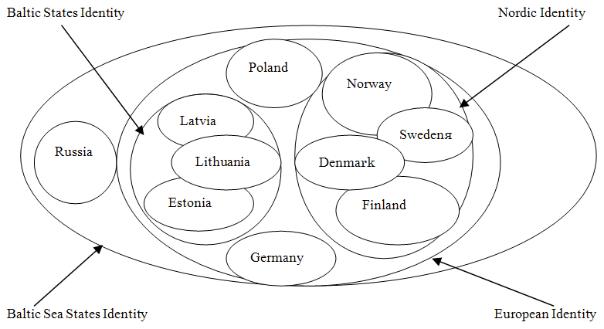
One of the regions with several existing transnational identities is the Baltic Sea Region, which includes Norway, Sweden, Finland, Denmark, Germany, Poland, Russia, Lithuania, Latvia and Estonia.
Transnational identities in the Baltic Region are comprised of Baltic States identity, Nordic identity, European identity and Baltic Sea States identity, as shown in Figure 6. Nordic identity is spread through the Scandinavian countries, namely Norway, Sweden, Finland, Denmark, and it the oldest one, dating back to the 16th century. The region of three Baltic States (Lithuania, Latvia, and Estonia) formed its transnational identity (Baltic States
identity) in 1990s. Since the middle of the 20th century being constructed is European identity, based on the EC/EU agreements. Region in question at present time includes Sweden, Finland, Denmark, Germany, Poland, Latvia, Lithuania and Estonia. Norway is not in the EU, but it has strong political, economic and cultural ties with other Scandinavian countries, which are active members of the Union. Finally, the Baltic Sea States identity involves the whole region and is based on Nordic, Baltic, European identities, and also spreads to the Russian North-West.
Figure 6. Multilayered transnational identity in the Baltic Sea Region