Материал: Myth A Very Short Introduction by Robert A. Segal
than the cautious Hooke; Johnson and especially Mowinckel, a weaker one.
Invoking Frazer, Bronislaw Malinowski, whose theory was considered in Chapter 1, applied his own, qualified version of the theory to the myths of native peoples worldwide. Malinowski argues that myth, which for him, as for Smith, explains the origin of ritual, gives rituals a hoary past and thereby sanctions them. Society depends on myth to spur adherence to rituals. But if all rituals depend on myth, so do many other cultural practices on which society depends. They have myths of their own. Myth and ritual are therefore not coextensive.
Mircea Eliade, whose theory was discussed in Chapter 3, applied a similar form of the theory, but he goes beyond Malinowski to apply the theory to modern as well as primitive cultures. Myth for him, too, sanctions phenomena of all kinds, not just rituals, by giving them a primaeval origin. For him, too, then, myth and ritual are not coextensive. But Eliade again goes beyond Malinowski in stressing the importance of the ritualistic enactment of myth in the fulfilment of the ultimate function of myth: when enacted, myth acts as a time machine, carrying one back to the time of the myth and thereby bringing one closer to god.
ritual and Myth
Application of the theory to literature
The most notable application of the myth-ritualist theory outside of religion has been to literature. Harrison herself boldly derived all art, not just literature, from ritual. She speculates that gradually people ceased believing that the imitation of an action caused that action to occur. Yet rather than abandoning ritual, they now practised it as an end in itself. Ritual for its own sake became art, her clearest example of which is drama. More modestly than she, Murray and Cornford rooted specifically Greek epic, tragedy, and comedy in myth-ritualism. Murray then extended the theory to Shakespeare.
73
Myth
Other standard-bearers of the theory have included Jessie Weston on the Grail legend, E. M. Butler on the Faust legend, C. L. Barber on Shakespearean comedy, Herbert Weisinger on Shakespearean tragedy and on tragedy per se, Francis Fergusson on tragedy, Lord Raglan on hero myths and on literature as a whole, and Northrop Frye and Stanley Edgar Hyman on literature generally. As literary critics, these myth-ritualists have understandably been concerned less with myth itself than with the mythic origin of literature. Works of literature are interpreted as the outgrowth of myths once tied
to rituals. For those literary critics indebted to Frazer, as the majority are, literature harks back to Frazer’s second myth-ritualist scenario. ‘The king must die’ becomes the familiar summary line.
For literary myth-ritualists, myth becomes literature when myth is severed from ritual. Myth tied to ritual is religious literature; myth cut off from ritual is secular literature, or plain literature. When tied to ritual, myth can serve any of the active functions ascribed to it by myth-ritualists. Bereft of ritual, myth is reduced to mere commentary.
Literary myth-ritualism is a theory not of myth and ritual themselves, both of which are assumed, but of their impact on literature. Yet it is not a theory of literature either, for it refuses to reduce literature to myth. Literary myth-ritualism is an explanation of the transformation of myth and ritual into literature, and it will be considered in detail in the next chapter.
René Girard
In The Hero, which will be discussed at length in the next chapter, Lord Raglan extends Frazer’s second myth-ritualist scenario by turning the king who dies for the community into a hero. In Violence and the Sacred and many subsequent works, the Frenchborn, American-resident literary critic René Girard (b. 1923) offers an ironic twist to the theory of Raglan, himself never cited. Where Raglan’s hero is willing to die for the community, Girard’s hero is
74
killed or exiled by the community for having caused their present woes. Indeed, the ‘hero’ is initially considered a criminal who deserves to die. Only subsequently is the villain turned into a hero, who, as for Raglan, dies selflessly for the community. Both Raglan and Girard cite Oedipus as their fullest example. (Their doing so makes neither a Freudian. Both spurn Freud.) For Girard, the transformation of Oedipus from reviled exile in Sophocles’ Oedipus the King to revered benefactor in Sophocles’ Oedipus at Colonus typifies the transformation from criminal
to hero.
Yet this change is for Girard only the second half of the process. The first half is the change from innocent victim to criminal. Originally, violence erupts in the community. The cause is the inclination, innate in human nature, to imitate others and thereby to desire the same objects as those of the imitated. Imitation leads to rivalry, which leads to violence. Desperate to end the violence, the community selects an innocent member to blame for the turmoil. This ‘scapegoat’ can be anyone and can range from the most helpless member of society to the most elevated, including, as with Oedipus, the king. The victim is usually killed, though, as with Oedipus, sometimes exiled. The killing is the ritualistic sacrifice. Rather than directing the ritual, as for Frazer, myth for Girard is created after the killing to excuse it. Myth comes from ritual, as for Smith, but it comes to justify rather than, as for Smith, to explain the ritual. Myth turns the scapegoat into a criminal, who deserved to die, and then turns the criminal into a hero, who has died voluntarily for the good of the community.
Girard’s theory, which centres on the place of the protagonist in society, would seem hopelessly inapplicable to the myth of Adonis. Adonis hardly dies willingly or selflessly. The very worlds he inhabits – the woods and the Underworld – seem as far removed from society as can be. In Chapter 8 this myth will nevertheless be interpreted socially, and Girard’s own interpretation of the myth of Oedipus will be presented.
ritual and Myth
75
Myth
While Girard never cites Raglan, he does regularly cite Frazer. Confining himself to Frazer’s second myth-ritualist scenario, Girard lauds Frazer for recognizing the key primitive ritual of regicide but berates him for missing its real origin and function. For Frazer, sacrifice is the innocent application of a benighted, pre-scientific explanation of the world: the king is killed and replaced so that the the god of vegetation, whose soul resides in the incumbent, can either retain or regain his health. The function of the sacrifice is wholly agricultural. There is no hatred of the victim, who simply fulfils his duty as king and is celebrated throughout for his selfsacrifice. According to Girard, Frazer thereby falls for the mythic cover-up. The real origin and function of ritual and subsequent myth are social rather than agricultural, as will be discussed in Chapter 8.
Walter Burkert
Perhaps the first to temper the dogma that myths and rituals are inseparable was the American anthropologist Clyde Kluckhohn. The German classicist Walter Burkert (b. 1931) has gone well beyond Kluckhohn in not merely permitting but outright assuming the original independence of myth and ritual. He maintains that when the two do come together, they do not just serve a common function, as Kluckhohn assumes, but reinforce each other. Myth bolsters ritual by giving merely human behaviour a divine origin: do this because the gods did or do it. Conversely, ritual bolsters myth by turning a mere story into prescribed behaviour of the most dutiful kind: do this on pain of anxiety, if not punishment.
Where for Smith myth serves ritual, for Burkert ritual equally serves myth.
Like Girard, Burkert roots myth in sacrifice and roots sacrifice in aggression, but he does not limit sacrifice to human sacrifice, and he roots sacrifice itself in hunting – the original expression of aggression. Moreover, myth for Burkert functions not to hide the reality of sacrifice, as for Girard, but on the contrary to preserve it
76
and thereby to retain its psychological and social effects. Finally, Burkert connects myths not only to rituals of sacrifice but also, like Harrison, to rituals of initiation. Myth here serves the same socializing function as ritual.
Ritual for Burkert is ‘as if’ behaviour. To take his central example, the ‘ritual’ is not the customs and formalities involved in actual hunting but dramatized hunting. The function is no longer that of securing food, as for Frazer, for the ritual proper arises only after farming has supplanted hunting as the prime source of food:
Hunting lost its basic function with the emergence of agriculture some ten thousand years ago. But hunting ritual had become so important that it could not be given up.
(Burkert, Structure and History in Greek
Mythology and Ritual, p. 55)
ritual and Myth
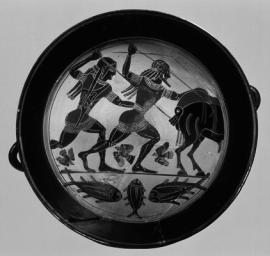
8. Hunting the Calydon Boar, Laconian Greek cup from Cerveteri, 6th century BC
77