Материал: Russian Journal of Building Construction and Architecture
Issue № 1 (41), 2019 |
ISSN 2542-0526 |
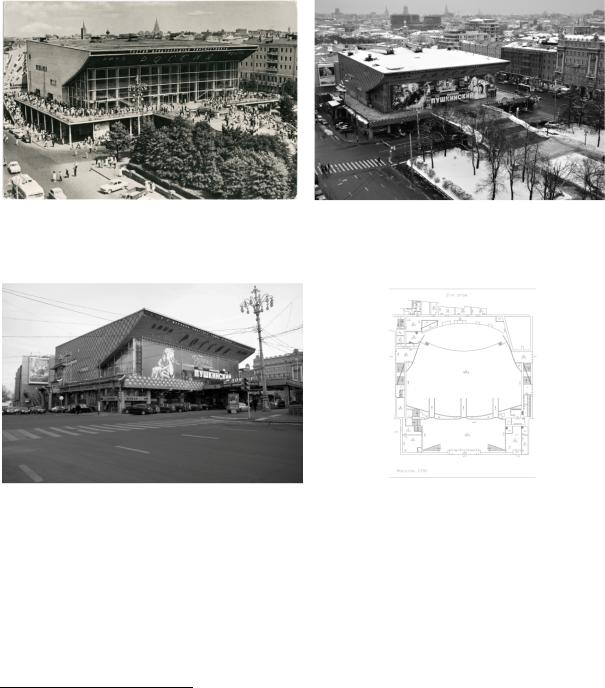
the cinematic development and the culture and construction of cinemas in the USSR and contemporary Russia [9] 2 (Figures 1, 2, 3, 4, 5).
Fig. 1. Pushkinsky Cinema Hall, built in 1961. Pushinsky 2011. Accessed May 11 [9]
Fig. 3. Pushkinsky Cinema Hall, view from street level. Pushinsky 2011. Accessed May 11 [9]
Fig. 2. Pushkinsky Cinema Hall, in 2011. Pushinsky 2011. Accessed May 11 [9]
Fig. 4. Pushkinsky Cinema Hall plan, Pushinsky 2011. Accessed May 11 [9]
That said, there is a problem with the Pushkinsky Cinema’s current location. After the cinema’s construction, its entrance was directly linked to Pushkin Square. Although this bridge provides direct and convenient access to the building from Pushkin Square, it creates a discontinuous visual and sensory perception that lacks integrity. However, there is a larger issue
2 The Red Narrative was designed as a new facade for the Dupont “Changing the Face” competition in Moscow in 2011. The aim of the competition was to redesign and reconstruct the facade of the Pushkinsky Cinema Hall, located in Pushkin Square, Moscow, and to create an organic relationship with the square. The iconic status of the existing building was marred by rapid growth in the urban space and the subsequent multiple annexes that were built with low-quality facade materials. In 1997, the building was refurbished and equipped with a sound and projection system. To engage the old use of the building, Dupont held a competition. To provide a formal multi-function, the building’s framework was to remain.
105
Russian Journal of Building Construction and Architecture
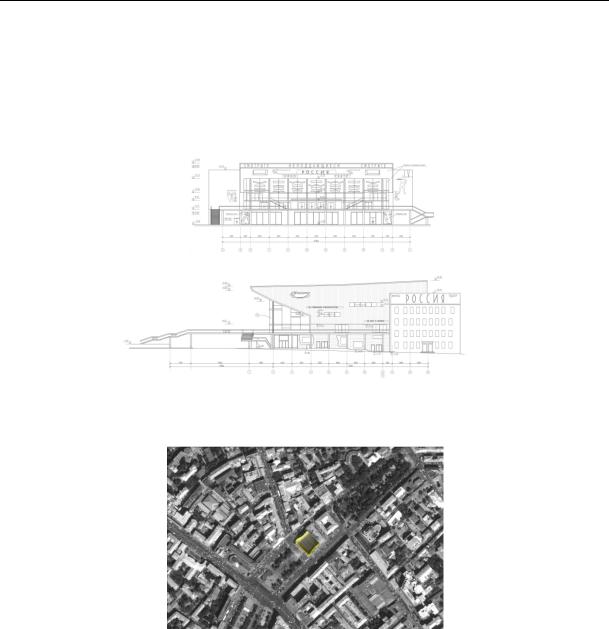
related to the current building’s emerging narrative and its context in the recent transformation of Moscow’s urban fabric. These problems outline some of the positive and negative traits of transformation in the Muscovite urban fabric, where the government takes different restructuring approaches (Figure 6).
Fig. 5. Pushkinsky Cinema Hall façade, Pushinsky 2011. Accessed May 11 [9]
Fig. 6. New site plan. Rendering by Burak Akpulat developed after the competition.
In Moscow, the urban space transformation began in the late 1980s. The concentration of political, economic, and financial power in the city and its integration into the international network of metropolises separate Moscow from the regional and national economic system. The changes in the liberal economy, new collective spaces of consumption, and the speed and reflection of power currently transform urban spaces [10]. Moreover, the rise of multicomplexes as displays of a market-oriented economy triggers this transformation. The Russian economy’s transformation and internationalization, and its reflections in the new postindustrial processes, gave rise to new tendencies in urban development [11] and as such, a spatial pattern emerged out of a new urban economy. However, in certain cases of uncon-
106
Issue № 1 (41), 2019 |
ISSN 2542-0526 |
trolled urban sprawl and the resulting discord and lack of integrity in urban space, buildings such as the Pushkinsky Cinema may be isolated urban elements.
In Moscow, the concept of urban transformation is referred to as the growth machine, a term related to how the city is exploited as a means of speculative growth that gives new meaning to the entrepreneurial character of post-socialist urban patterns [12]. Gritsai discusses Moscow’s restructuring, which requires different montage techniques:
“It has also always been characterized by a very chaotic land-use structure: under central planning, the mechanism of functional renewal did not exist and new functions simply coexisted in space with the old ones. In this context, we can assume that the spatial pattern of post-industrial restructuring in Moscow is likely to be of a traditional mono-centric type but should be very differentiated within the areas of concentration of new activities, following the differentiation of space accumulated through history” [13].
Pushkin Square has had an important place in Moscow’s changing spatial patterns. Derived from a need to revive and reveal the genius loci of this urban space, the Red Narrative Cinema was designed as a critical display of the transformation of the existing cultural icon, the reflections of the growth machine in the public space, where that transformation can be undertaken and perceived differently by residents. To revive its existential meaning in Russian cinematic culture and as an initial cultural milestone in cinema culture, the design transforms the character of the cinema. The Red Narrative Cinema aims to construct new relationships related to the memory of urban space and to stimulate the idea of Pushkin Square as a collective. The building transforms urban fabric into a unified structure through a new narrative by creating a visual and sensory perception in the existing urban narrative of Pushkin Square that provides spectators with different sensory layers, as in constructing narrative in cinema.
2. Constructing the narrative in films and architecture.The characteristics of a narrative depend on the characteristics of the montage. In the early Russian cinema of the 1920s, montage was accepted as a basic principle. According to film theorist Sergei Eisenstein, who was a former architect, there were multiple types of montage: metric, rhythmic, tonal, overtonal, and intellectual [16].However, Eisenstein refused to recognize the “brick by brick montage” (shot by shot) used by his contemporary Lev Kuleshov, known as the father of Soviet cinema, who placed shots one after another in a sequence to form a serial montage [17]. For Eisenstein, this montage technique had the potential to become a dead formula rather than a dynamic one [18]. Eisenstein found similarities between theatre and cinema. In his article “Montage of Attractions” (1923), he viewed cinema through its close links to theatre. He focused on creating emo-
107

Russian Journal of Building Construction and Architecture
tion, whereas his contemporary Dziga Vertov focused on the idea of motion [19]. Theatre and cinema had a common purpose: they “influenced the audience in the desired direction through a series of calculated pressures on its psyche” [20]. Instead, Eisenstein stated that “Montage is an idea that arises from the collision of independent shots”, which could also be opposite one another, and he developed the idea of the dramatic montage [21]. For him, montage was “not from the mechanical process of editing, but from any thematic connection with the actors” [22]. For Eisenstein, fragments of juxtaposed montages demanded an activity in which the spectator was active rather than passive. He focused his research on the audience because he was interested in how ideas were transferred to them from the narrative [23]. His montage views were not static or formulaic, which brings us to the ideas of Bazin, later to be undertaken by Deleuze. For Bazin, a montage of shots manipulates the spectator and reduces choice, activity, and freedom, which he thought spectators should have as they do in the theatrical aesthetic.
For Deleuze, who follows the ideas of Bazin, “the cinema itself is a philosophical instrument, a generator of concepts and a producer of texts which render thought in audiovisual terms, not a language but in blocks of movement and duration” [14]. ‘Film restores the real rather than represents it. The frame, for Deleuze, is unstable, dissolvable into the flux of time: time leaks out through the borders of the frame’ [15].Therefore, in contrast to the structuralist view of cinema, a Metzian view holds that the grammatical rather than purely linguistic, Deleuzian view of cinema depends on a form of becoming. Following Deleuze’s ideas on becoming, the Red Narrative Cinema renders ideas about urban fabric not only in visual terms but also in different levels of perception. The building becomes a transformative act of different urban fragments in Pushkin Square rather than a grammar or a language. The spectator, as a perceiver, is transformed among urban history, tradition, and memories and new forms of urban life.
Derived from the idea of montage theories in cinema, the Red Narrative Cinema is situated on the borders between what has slightly diminished and what is emerging in the urban space of Pushkin Square. It acts as a transformative idea of the collective in Moscow’s emerging urban space. The city’s market-oriented economy and ‘transition into a post-industrial type of economic development’ transform it whilst creating separate spatialities in different parts of the city. Both approaches lead to modifying population social patterns [24]. It is within these emerging fragments that residents encounter a new spatiality in Moscow that imparts something individual whilst also reflecting the residents’ daily experiences of the space.
The first issue is centered on the concept of the growth machine — i.e., the story or the scene depicted to the spectator, which is similar to the fabula in narrative cinema. The second issue
108
Issue № 1 (41), 2019 |
ISSN 2542-0526 |
is how residents form these different fragments and spatialities that emerge in the city and that signify syuzhet. Therefore, similar to a narrative film, the Red Narrative Cinema depends on the two essentials defined by the Russian Formalists: fabula and syuzhet. The fabula is the story in which a narrative is depicted, and syuzhet is how this narrative is applied or realized. In structuralist theory, the fabula and syuzhet take the name of story (histoire), the content or chain of events (actions, happenings), what may be called the existents (characters, items of setting), and a plot discourse (discourse-discourse in French tradition) that is the expression and the means by which the content is communicated [25]. The fabula is a pattern formed through the spectator’s assumptions and inferences. The form of picking up narrative cues, applying schemata, framing, and testing hypotheses are variables in the fabula. It is the order of the appearance (of the events) [26] and a pattern for creating assumptions and inferences.
Syuzhet, the second essential of narrative film, is a story patterning that refers to a film’s actual arrangement and presentation of the fabula. The syuzhet is an abstract concept, one that arranges components and story events according to specific principles; it is a system that arranges a film’s elements. The theoretical concept of the syuzhet offers a way to analyze the aspects of the film that the spectator organizes into an ongoing story [26]. In narrative films, constructing time and space relates the syuzhet to the fabula and serves to connect with the spectator’s internal perceptions. The narrative process occurs throughout the filmmaking procedure, from staging and shooting to editing and sound mixing. Time and space are particularly fractured and disrupted, but the spectator constructs fabula time and space according to hypotheses, cues, and patterns that are already fixed. The connection between the fabula and syuzhet, in other words, narrative logic, time, and space structuration, is formed through short cuts. Because short cuts provoke a different fabula for each spectator, the relationship between fabula, syuzhet, and style in the film fulfills a complete perception. Style, as a systematic use of cinematic devices, “encourages the spectator to construct a coherent, consistent time and space for the fabula action” [27].
In classical narrative films, this assemblage has a causal linear structure and serves as a mimetic representation of reality and film technique that is seen as a vehicle for the syuzhet’s transmission of fabula [28]. Analogically, the Red Narrative Cinema concretizes montage theories in cinema into space, thus bridging the classical narrative and the narrative of transformation through which the urban space’s meaning is symbolized as a grounds for creating debate on the formation of its backbone. The departure point of the idea of this new space is to create a perception of the continuous fading away of light and to reveal the urban space’s
109