Материал: Russian Journal of Building Construction and Architecture

Russian journal of building construction and architecture
Mathematical model
Let us consider a relatively large ventilated premises and small transverse sizes with stationary heat flows.In order to calculate a non-stationary concentration field emerging in this premises as a source of hazardous substances moves, it is necessary to solve a system of differential equations including the Navier-Stokes equation, of continuity and turbulent exchange [1, 4, 7, 14, 15, 19]. The solution of the above equations in a general threedimensional case is rather challenging.
Considering that the premises is large and has small transverse sizes, let us assume that the distribution of air velocitys and concentrations of hazardous substances along the width and height of the premises. Then calculating the dynamics of the distribution of concentrations comes down to solving a one-dimensional equation of turbulent exchange [2, 5, 6, 8, 10]:
c |
u |
c |
|
|
A |
c |
g x,t , |
(1) |
|
t |
x |
x |
x |
||||||
|
|
|
|
|
where с is the concentration of a hazardous substance, mg/m3; t is the time, sec; и is the average velocity of air flow along a transverse section of the premises, m/seс; х is the distance along the premises, m; A is the coefficient of turbulent exchange, m2/sec; g(х,t) is the function of a source of a hazardous substance.
The initial condition for solving the equation is the distribution of a hazardous substance along the premises at the initial point in time and the boundary one is a hazardous substance in the supply air. The average velocity of the air flow alogn the transverse section is distributed as a ratio of air consumption to the area of the transverse section of the premises.
The function of the source of the hazardous substance is given by the expression
G0 |
at _vt 0,5l x vt 0,5l |
|
|
|
|
|
, |
(2) |
|
|
||||
g x,t lS |
|
|||
|
|
|
|
|
0_at _ x vt 0,5lx vt 0,5l |
|
|
||
where G0 is intensity of the hazardous substance, mg/sec; l is the length of the source of the hazardous substance, m; S is the area of the transverse section of the premises, m2; v is the velocity of the source of the hazardous substance, m/sec.
The energy introduced by the supply air is given by the ratio [5, 12, 13]:
пс |
M v2 |
, |
(3) |
|
|||
n 2Mп |
|
|
|
where М is the mass of the air supplied into the premises; is a correction coefficient for the velocity pressure; v is the average speed of the output air of the fan inlet, m/sec; Мп is the air mass in the volume of the premises.
16
Issue № 1(33), 2017 |
ISSN 2542-0526 |
The energy introduced into the premises by the moving source of the hazardous substance:
|
|
|
kFv3 |
|
|
|
|
|
|
t |
|
, |
(4) |
||||
ma |
2g |
3600 |
||||||
|
|
|
|
|
where k is the coefficient of aerodynamic resistance of the moving source; Ft is the area of the transverse section of the source, m2; v is the velocity of the source, m/sec; is the average time of the motion of the source, sec.
The coefficient of turbulent exchange is given by the formula [5, 16]:
1 |
4 |
|
|
A 0,25 3l3 |
, |
(5) |
|
where l is the crucial size of the premises, m.
Implementation of the mathematical model
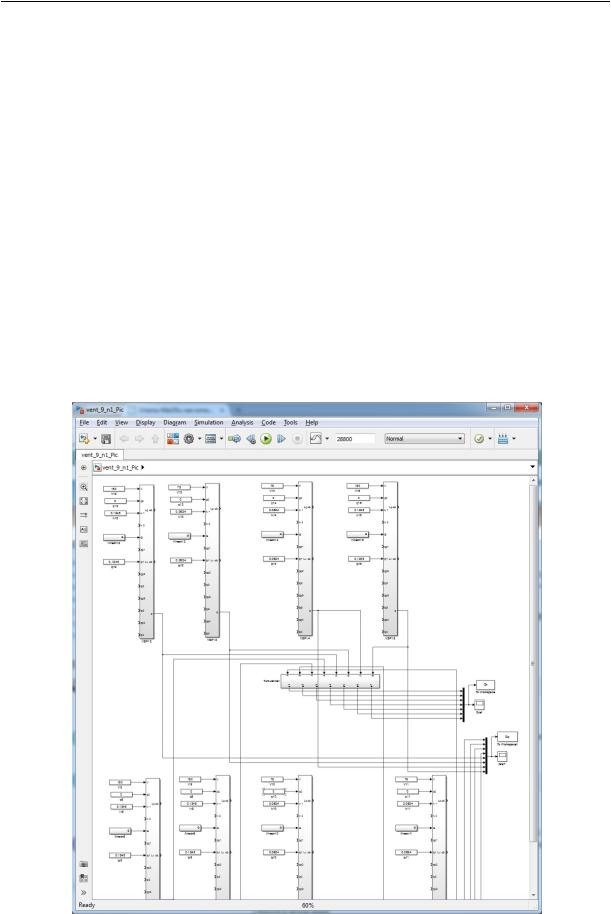
MatLab and Simulink in combination with the C ++ programming language were employed to design an environment for the mathematical model of the transfer of the hazardous substance in the premises with the moving source.
Fig. 1. Software for calculating transfer of hazardous substances in premises with a moving source in Simulink
17

Russian journal of building construction and architecture
Simulink is an environment for modelling synamic systems providing an interactive graphic environment and a user-friendly library to design and model systems changing in time. Simulink provides tools for hierarachical modelling, data management and settings. Simulink contains a large library of functions and common algorithm and structural blocks. In order to design a model, user sections to be employed for particular domains are created. After it is designed, it is dynamically modelled and evaluated. Fig. 1 presents the calculation of transfer of hazardous substances in premises with moving sources in Simulink.
The software enables the dynamics of concentrations in large premises to be computed in different schemes and air exchange, velocities and intensities of sources of hazardous substances.
Calculations using the mathematical model
The developed software was employed for choosing an effective scheme of a factor of air exchange in the premises with the length of 100 m, width of 12 m, height of 8 m.
The factor of air exchange was 5 and 2 h-1, the velocity of the inlet air is 3 m/seс. The source of a hazardous substance with the intensity of 785 mg/seс was moved along the premises with the speed of 0,2...10 m/seс. The number of finite volumes in calculating the turbulent exchange was taken to be 50. Five air exchange schemes were studied that are most common in designing long premises.
The air exchange scheme 1 involves supply of the inlet air from one side of the premises and removal of the air from the opposite one with both the air and source of a hazardous substance moving in the same direction.
The air exchange scheme 2 involves supply of 50% of the total the inlet air from the opposite ends of the premises and its removal along the centre of the premises.
The air exchange scheme 3 involves supply of the inlet air identically to scheme 2, the air is removed evenly along the premises.
The air exchange 4 involves even supply of the air along the premises and its removal identically to scheme 3.
The air exchange scheme 5 involves supply of the entire volume of the inlet air along the centre of the premises and its removal of the air identically to scheme 3.
The air exchange scheme 6 involves supply of the entire volume with one end of the premises and its removal from the opposite end with the same direction of the air motion and source of the hazardous substance.
For all of the above schemes the air exchange scheme using the developed answers, the concentrations at different velocities of the source of the hazardous substances. The dependence
18
Issue № 1(33), 2017 |
ISSN 2542-0526 |
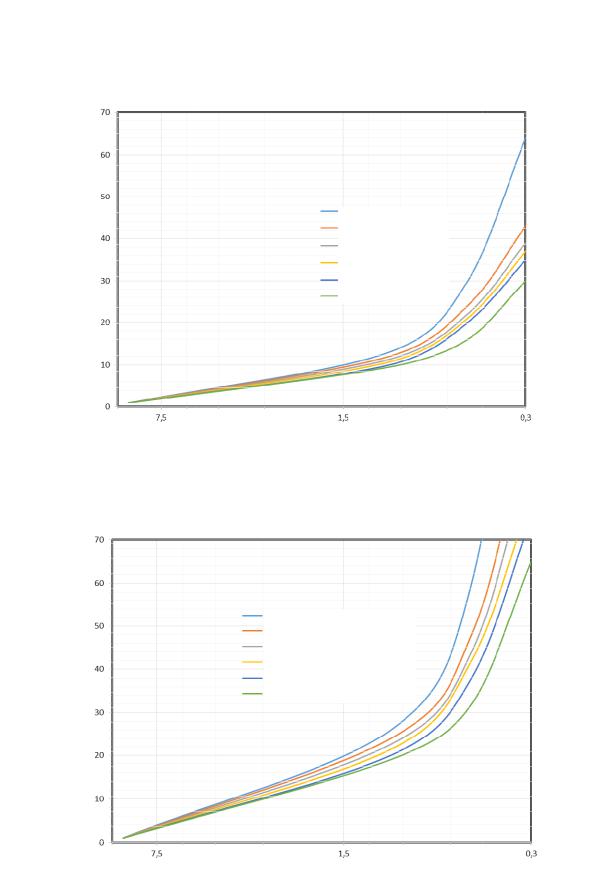
of the maximum concentration of a hazardous substance in this object on the velocity of the source of a hazardous substance is in Fig. 2 and 3.
Peak concentration of a hazardous substance, mg/m3
Scheme of air exchange 1
Scheme of air exchange 2
Scheme of air exchange 3
Scheme of air exchange 4
Scheme of air exchange 5
Scheme of air exchange 6
Velocity of the source of a hazardous substance, %
Fig. 2. Dependence of peak concentrations of a hazardous substance on the velocity of the source for different schemes o f air exchange with the factor of air exchange 5 h-1
Peak concentration of a hazardous substance, mg/m3
Scheme of air exchange 1
Scheme of air exchange 2
Scheme of air exchange 3
Scheme of air exchange 4
Scheme of air exchange 5
Scheme of air exchange 6
Velocity of the source of a hazardous substance, %
Fig. 3. Dependence of peak concentrations of a hazardous substance on the velocity of the source for different schemes of air exchange with the factor of air exchange 2h-1
19

Russian journal of building construction and architecture
The results show that when the source of a hazardous substance and airflow move in one direction, there is an area of extremely high concentrations around the source, which leads to a drastic increase in peak concentrations and conversely, when the source and airflow move in the same direction, there is even distribution of a hazardous substance along the premises with extremely low peak concentrations.
When sources of a hazardous substance move along a long premises in the same direction, the most effective scheme of air exchange is 1 when the airflow moves towards the source. When sources of a hazardous substance move in different directions, the most effective scheme of air exchange is 4.
Conclusions
Based on the non-stationary equation of turbulent exchange, a mathematical model of transfer of a hazardous substance in the premises with a moving source.
The developed model is implemented as a software in MatLab and Simulink. The sfotware is designed to calculate the dynamics of concentrations in long premises for different schemes and factors of air exchange, velocities and intensities of sources of hazardous substances.
The developed software was used to choose an effective scheme of air exchange of the premises with moving sources of a hazardous substance. The results of the calculations of six air exchange schemes, different factors of air exchange and velocities of a source.
When sources of a hazardous substance along long premises in one direction, the most effective scheme of air transfer is one when the airflow moves towards sources.
When sources of a hazardous substance move in different directions, the most effective scheme of air exchange is one with even supplyand removal of the air along the premises.
In choosing a scheme of air exchange in premises with moving sources of hazardous substances, what is to avoid is when a source and airflow move in the same direction as that leads to areas with extremelyhigh concentrations that are significantlyhigher than the average ones.
The suggested approach enables a scheme and scope of air exchange to be chosen for premises with moving sources of hazardous substances that uses the inlet air and thus the performance of the general ventilation to be improved.
References
1. Mel'kumov V. N., Kuznetsov S. N., Cheremisin A. V., Sklyarov K. A. Nestatsionarnye protsessy formirovaniya sistemami ventilyatsii vozdushnykh potokov v pomeshcheniyakh [Nonstationary processes of the formation of the ventilation air flow in rooms]. Izvestiya Orlovskogo gos. tekhn. un-ta. Stroitel'stvo i transport, 2007, no. 3––15, pp. 36––42.
20