Материал: chapter II
2. Image processing
2.1 General approaches
2.1.1 Pattern recognition
2.1.2 Computer graphics
2.1.3 Image transfer, reproduction
2.2 Original image and task of reproduction
2.3 Image transform in reproduction
2.3.1 Electro-optical analysis
2.3.2 Image signal transforms
2.3.3 Image output
2.3.4 Complete and hybrid reproduction system
2.4 Picture properties
2.4.1 Local parameters
2.4.2 Common properties
2.4.3 Image and imaging system parameters correlation
2.5 Picture quality control
2.5.1 Evaluation of an image data, means and reproduction results
2.5.2 Issues of providing the parameters conformity and standardization
Summary issues
Tests
2.1 General approaches
Image data are the most informative source of surroundings knowledge. It’s rather difficult to find any professional area where it wouldn’t be used. Weather forecasts are formed as result of processing the atmosphere photographs taken from satellites. Radioscopic, endoscopic and tomography pictures are used for the diagnoses in medicine. Photographs, handmade or computer graphic images, pictures taken by traditional or special equipment, transmitted by electric channels as well as by broadcast or special TV are used in cartography, geology, crime investigation, for publishing and military purposes… That’s why the issues of image processing, transmitting, storing and display are actual in modern scientific research and developments. All they are embraced by the technical area of Imaging Science and Technology.
There are, however, the principle differences in approaches, means and results of an image processing as applied for various goals and tasks. In the light of prepress picture treatment these approaches can be divided among three groups:
pattern recognition;
computer graphics;
transfer/reproduction.
2.1.1 Pattern recognition
The result of picture processing isn’t to be obligatory presented here as an image itself. It can be the tables, graphs, numerical data or the like to be used for taking the decision or to form the control signal in automatics.
The other distinctive feature of this cybernetic task solution is in that the resulting data can be brought to minimal volume of just one bit. Fingerprints processing may result, for example, in the identifying or excluding a person from the involved in a case. Output data can be also brought to the same minimum in the defect detecting system for a production line.
One else specific of this approach is in concerning the significant share of input pictorial data, which don’t comprise the indication for recognition, as unnecessarily, parasitic or noise.
Being complementary this kind of an image treatment has found some applications in prepress. It was the basic, for example, in automation the text input with Optical Character Recognition (OCR) devices being later on replaced by the software applications allowing for digitizing the scanned handwritten or printed text to further digest it by a standard word processor.
In imaging prepress the similar approach can be noticed in the so called adaptive methods where the process parameters are modified according to the kind of a picture. Combined original is used, for example, to be subdivided, onto continuous tone, line matter and textual fragments for further effective treatment according to their specific. Such modifying can be also locally adaptive, i.e. taking into account the properties of pictorial data in the close vicinity of a reproduced element. Border of a detail can be detected by some differential operator evaluating the gradient of optical parameter in target image area. That makes, for example, possible the selective, inside a border, changes or the withdrawal of an outer background.
2.1.2 Computer graphics
Contrary to the above case there can be no picture at an input in computer graphics. Two or three dimensional and even animated image appears here just as a result of work. Input and output data volumes relationship occurs to be correspondingly reverse.
This technique principles and instruments can be applied by the author, publisher, designer or prepress operator for auxiliary purposes of:
Creating image or decorative elements at the absence of original copies themselves;
editorial changing the content of originals after input by scanner and, in particular, for the mentioned sophisticated retouching;
technology attachments such as the color separation register marks, stepwise or continuous tone wedges, color gamut charts and other tests to control the plate making and printing.
2.1.3 Image transfer, reproduction
Goal of this, basic for prepress direction is in the reproduction itself, i.e. in the original image transform into such intermediate presentation (digital data, photo or printing plates…) which parameters would provide the best possible illustration quality in a press run.
As summarized in table 2.1, this way of processing characteristically differs from above two ones:
image does comprise here both the source data and result of work;
the great data volumes are dealt both at an input and output.
Table 2.1 Distinctive features of basic image processing approaches.
|
Presence of a picture (input / output) |
Data volume (input/ output) |
recognition |
yes / no |
great / minimal |
computer graphics |
no / yes |
minimal / great |
transmission |
yes / yes |
great / great |
This approach is consonant with the optimal image encoding in photo facsimile technique, television and computer network which provides the minimized data losses at transmission through analogous or digital communication channel of a certain bandwidth and noise level. Plate making - printing channel similarly limits the tonal range, color gamut and spatial frequency spectra of an original image. So, bringing the image data to a volume accommodated by print takes place just in prepress while further stages are being rigidly normalized according to their own criteria. So, the prepress comprises a flexible control means for bringing tone, color and other image properties to a print for achieving its possible match to original.
Modern technique allows for objective managing print parameters with the discretion of varying ink coverage of about just 25 – 100 square microns (corresponding to imagesetter resolution of 5000 or 2500 dpi). Nevertheless, even the most advanced prepress systems, as well as the whole printing process, don’t provide the completely optimal reproduction which would reproduce exactly that source image data and in such its particular volume which could be perceived by observer.
Principle of taking into account and providing mutual conformity of the three information system components are basic for rational organization of any data transfer process. These components are:
data source;
system itself or communication channel;
data recipient.
In reproduction technology they are related to:
original image copy;
plate making and printing;
human vision.
Such system is optimized at criteria of providing the conformity between the data source (original image) properties and input characteristics as well as between the output ones (print parameters) and that of data recipient (vision).
However, unlike TV and some pictorial data compression solutions, the printing technology doesn’t completely satisfy such principle. For example, it uses the same quantization scale or dynamic range per color separation ignoring the specifics both image local area content and vision.
This fact is schematically illustrated in figure 2.1. Three basic components (source, channel, receiver) are shown there streamed by the image data flow with the first of them being of the greatest width while that of the channel, with inherent in hindrances and band pass limit, the narrowest.
Arrow 1 indicates the image data which, in spite of being, in fact, present on a print copy, can’t be visually perceived by a viewer for in the digital prepress of today it is formally pretended to reproduce (to transmit through the printing channel) any detail of an image, for example, its quarter of millimeter thick line in as much as 16 million colors (2563). The fact that the eye can scarcely tell if such a line is somewhat darker or lighter, and whether it is green, blue or grey is ignored. So, the significant share of a print data stays unused in spite of the greater bandwidth of vision as compared to that of the print channel.
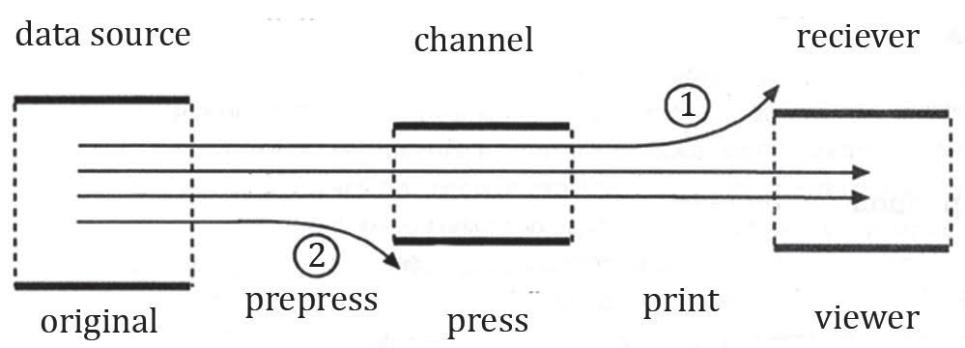
Figure 2.1, Non optimal image data encoding in prepress: 1 –the variations in tone and color of a fine detail objectively present on a print but not discerned by vision; 2 – definition and detail geometric accuracy lost as result of halftoning.
Such luxury of color interpretation isn’t available for the most of other imaging applications making them possible just by taking into account the facilities of an end user. The analogous color TV is, for example, more perfect in this relation as far as it transmits in complete frequency bandwidth just the brightness, b/w signal with placing the chromaticity components in a narrower bands. The lack of color on fine details doesn’t however deteriorate the subjective image quality on a TV screen [2.1]. Taking into account the mentioned vision property is also met in the other practices of an image data redundancy withdrawal [2.2].
Arrow 2 designates, from the other hand, the data of original which could be perceived on a print but had been, however, lost at the prepress stage. It happens because of the contour and fine detail distortion involved by screening, i.e. being inherent in the CT original transform into the bi-level (ink / no ink) output signal. Such losses were already illustrated by the enlarged fragment of a halftone print in right part of figure 1.6.
Halftone print definition is limited by the half of a screen ruling. At 200 Lpi of the latter it’s, for example, many times lower than definition of the printed line work – LW (characterized by just a couple of tone levels) as far as for the such kind of job the press is able to separately transfer the dots at resolution of 2400 dpi.
So, one of the fundamental objectives of a picture encoding in prepress is comprised in more effective use of the imaging system resources by shortening the gap between definition of halftones and printing process resolution with exploring the artificial intellect taken, by analogy, from engraver experiences.
2.2 Original image and goal of reproduction
Originals for print reproduction differ in:
type of substrate (transparent, opaque; hard, flexible);
color (b/w, monochrome, chromatic);
structure (line work - LW, continuous tone – CT, halftone – secondary);
kind of their creating (photographs, drawings, paintings, prints);
form of their presenting (on substrate and electronic, including those of the digital photography).
Reproduction of the latter kind pictorial data omits the stages of electro-optical analysis, color separation and digitizing but in the other relations doesn’t differ of that used for originals initially presented on a substrate. Nevertheless, in spite of being somehow shorter, the problem of adequate digital image file values interpretation is inherent in that kind of a source data processing. As will be shown lower, being picked up from the same visual object these values may essentially vary due to the difference in image capturing conditions, devices, etc. The need exists in defining the image property they present as well as the method, metric and numerical units used in encoding to reveal their factual meaning.
Type of original copy cardinally defines the character of required reproduction process, equipment and materials used therein as well as the staff qualification. From the other hand, it also determines the quality level of a copy could be attained at given printing conditions. There were the attempts to regulate publisher – printer relationships by the development of a standard adjusting the original properties and their possible reproduction parameters.
Images initially produced for another purposes and viewing conditions are also often used as illustrative originals. It can be, for example, the color transparent positive – slide intended for projection in a dark room by the light of a tungsten lamp. Negative films are used for making color pictures on photosensitive paper to be viewed in common indoor lightening environment. Characteristics of television signals and digital photography provide, first of all, the proper display on TV screens and computer monitors.
Color properties of dyes and pigments on images produced by traditional photography as well as with the use of thermo transfer, ink jet, electro photographic digital printers are non-identical too. So, the color presentation of a scene by various kinds of objects – originals is already inherent in certain specific which results in the difference of signals produced at their capturing by the same scanner or digital camera. From the other hand, the signals generated for the same original by different kinds of image inputs aren’t identical too because of non similarity of their characteristics. This creates the problem of the so called signals compatibility by input in the reproduction environment operating with various kinds of originals and multiple image capturing means as was indicated in figure 1.12.
Resulting copy quality interpretation stays problematic too because it’s, as a rule, given in the absence of a source imaged object and mostly estimated by memory, with the use of individual viewing experience, preferences and expectations. Quality level can also be corresponded to the simplified evaluation of a customer or specified examination of an expert [2.3; 2.4].
Such questions are in greater degree related to the creative, editorial stage rather than to reproduction technology itself. So, the goal of the latter is more suitable to be concerned not in relation of a source viewed object or scene but as applied to some of its secondary presentations such as a certain kind of original copy or a signal of digital camera, TV channel, etc.
It’s also useful to see as the congruent part of reproduction technology the issue of signals compatibility by output which is stipulated by the requirement of visual matching an original in all the variety of methods for print copies and proofs production as was designated earlier in figure 1.13.
So, the goal of illustrative printing can be in general defined as the producing of a copy which at the target precision rate matches a certain original or visual object with the reproduction quality estimation by the degree of their corresponding each other. Such purpose motivates, in turn, the need in described lower the quality measurement quantitative parameters to make this estimation objectively realistic.