Материал: 2016_Kaplan_USMLE_Step_1_Lecture_Notes_Pharmacology

Section II λ Autonomic Pharmacology
Chapter Summary
λNeurotransmission across adrenergic junctions is mediated by norepinephrine
(NE). Adrenergic effectors may act indirectly by influencing NE synthesis, monoamine oxidase (MAO) enzymes, the mobile NE pool, the NE transporter, prejunctional α-adrenoceptors, granule uptake, or release of NE, or they may act directly on the postjunctional receptor as agonists or antagonists.
λExcess NE normally subjects tyrosine hydroxylase to feedback inhibition, making this enzyme the rate-limiting step in the synthetic pathway of NE and epinephrine. Tyrosine conversion to DOPA can be inhibited by methyl-p- tyrosine, a tyrosine hydroxylase inhibitor.
λMAO inhibitors regulate presynaptic NE levels.
λAmphetamine, ephedrine, and tyramine act, in part, by releasing NE from the mobile pool (NE stored outside granules but within the neuron).
λCocaine and the tricyclic antidepressants act by inhibiting NE reuptake, which normally removes NE from the environment and makes it unavailable as a transmitter and also conserves it for future use.
λPrejunction availability of NE can also be decreased by inhibiting NE release from the granules. This can be achieved by drugs such as clonidine or
methyldopa, which are activators of the prejunctional α2-adrenoceptor; by drugs such as guanethidine, which act directly on the granules; or by drugs such as reserpine, which reduce NE levels by inhibiting granule uptake.
λTable II-3-1 summarizes the distribution and physiologic effects associated
with the activation of alpha 1 and 2, beta 1 and 2, and D1 receptors. Table II-3- 2 summarizes the mechanism through which these receptors work.
λThe major direct-acting adrenoceptor agonist drugs are described. The alpha agonist phenylephrine increases mean BP, has no effect on pulse pressure, and elicits a reflex bradycardia. Isoproterenol, a beta agonist, decreases mean BP, increases pulse pressure, and causes marked tachycardia. Cardiovascular effects of norepinephrine (NE) are similar to phenylephrine,
but it is also a cardiac β1 adrenoceptor activator. The cardiovascular effects of epinephrine (E) are betalike at low doses and alphalike at high doses.
λThe nonselective alpha blockers (phentolamine, phenoxybenzamine) are
described. The α1-selective blockers (e.g., prazosin) are used in hypertension and BPH.
λThe properties, clinical uses, and adverse effects of the nonselective beta receptor antagonist propranolol are described. A comparison of beta adrenoceptor antagonists that are cardioselective and those that have intrinsic sympathomimetic activity is made (Table II-3-3). Drugs that block both alpha and beta adrenoceptors are identified.
64
Autonomic Drugs:
Glaucoma Treatment and ANS
Practice Problems
Learning Objectives
Solve problems concerning glaucoma treatment
GLAUCOMA TREATMENT
Glaucoma
Open-angle glaucoma
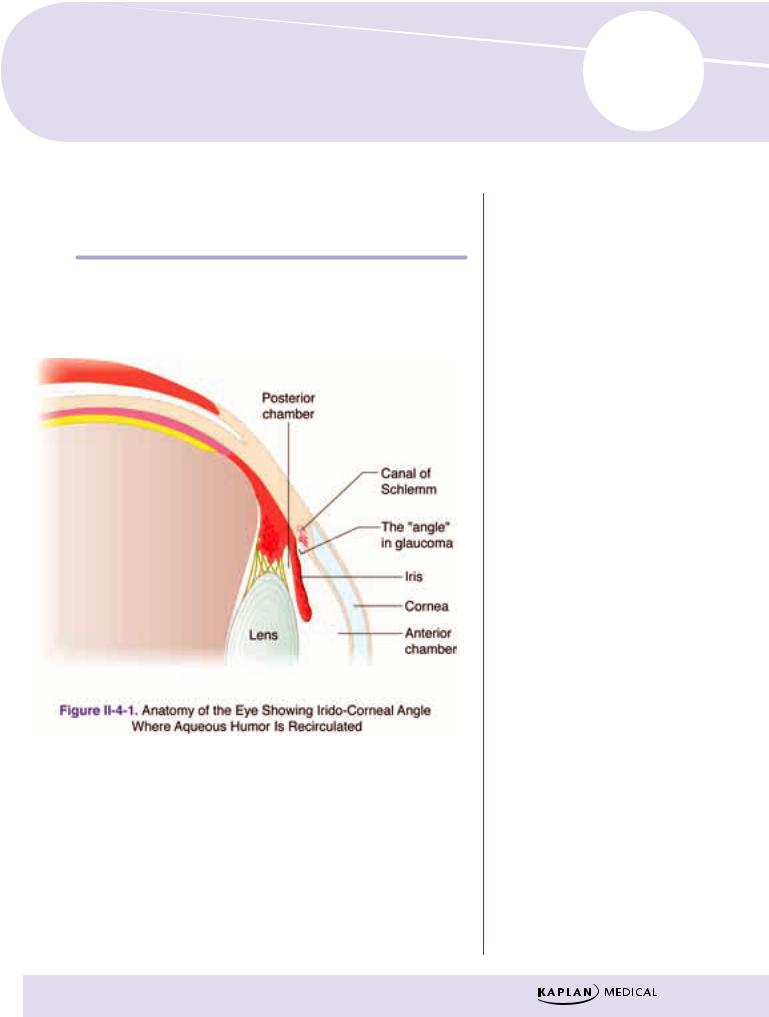
A chronic condition with increased intraocular pressure (IOP) due to decreased reabsorption of aqueous humor, leading to progressive (painless) visual loss and, if left untreated, blindness. IOP is a balance between fluid formation and its drainage from the globe. Strategies in drug treatment of glaucoma include the use of beta blockers to decrease formation of fluid by ciliary epithelial cells and the use of muscarinic activators to improve drainage through the canal of Schlemm (see Table II-4-1).
4
65
Section II λ Autonomic Pharmacology
Note
Antimuscarinic drugs and
α1 agonists are contraindicated in closed-angle glaucoma.
Closed-angle glaucoma
An acute (painful) or chronic (genetic) condition with increased IOP due to blockade of the canal of Schlemm. Emergency drug management prior to surgery usually involves cholinomimetics, carbonic anhydrase inhibitors, and/or mannitol.
Treatment
Table II-4-1. Mechanism of Action of Drugs Used to Treat Glaucoma
Drug |
|
Drug Class |
|
Mechanism of Action |
Pilocarpine |
Cholinomimetic |
Activation of M receptors causes |
||
|
|
|
|
contraction of ciliary muscle, which in- |
|
|
|
|
creases flow through the canal of Schlemm |
Timolol |
Beta blockers |
Block actions of NE at ciliary epithelium |
||
|
|
|
|
↓ aqueous humor formation |
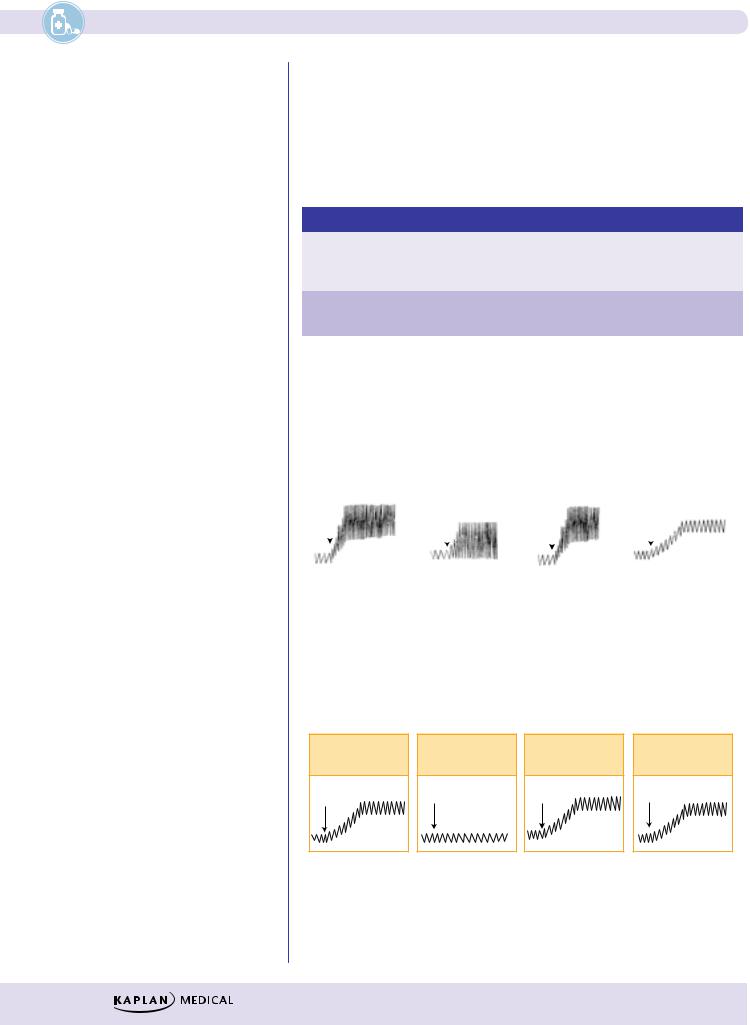
ANS PRACTICE PROBLEMS
Answers and explanations follow on page 80.
|
|
Control |
|
Phenoxy- |
|
|
Meca- |
|
Propranolol |
||
|
|
|
benzamine |
|
mylamine |
|
|||||
|
|
|
|
|
|
|
|
||||
R |
|
|
R |
|
R |
|
R |
||||
|
|
|
|
|
|
|
|
|
|
|
|
|
|
|
|
|
|
|
|
|
|
|
|
|
|
|
|
|
|
|
|
|
|
|
|
R is A. |
Epinephrine |
B. |
Norepinephrine |
C. |
Phenylephrine |
D. |
Isoproterenol |
E. |
Terbutaline |
Figure II-4-2
Control |
U |
Phenoxy- |
benzamine |
U |
U is A. |
Epinephrine |
B. |
Norepinephrine |
C. |
Phenylephrine |
D. |
Isoproterenol |
E. |
Tyramine |
Meca- |
mylamine |
U |
Propranolol |
U |
Figure II-4-3
66
Chapter 4 λ Autonomic Drugs: Glaucoma Treatment and ANS Practice Problems
|
Control |
|
Phenoxy- |
|
|
Meca- |
|
Propranolol |
||
|
|
benzamine |
|
mylamine |
|
|||||
|
|
|
|
|
|
|
||||
S |
|
S |
|
S |
|
S |
||||
|
|
|
|
|
|
|
|
|
|
|
|
|
|
|
|
|
|
|
|
|
|
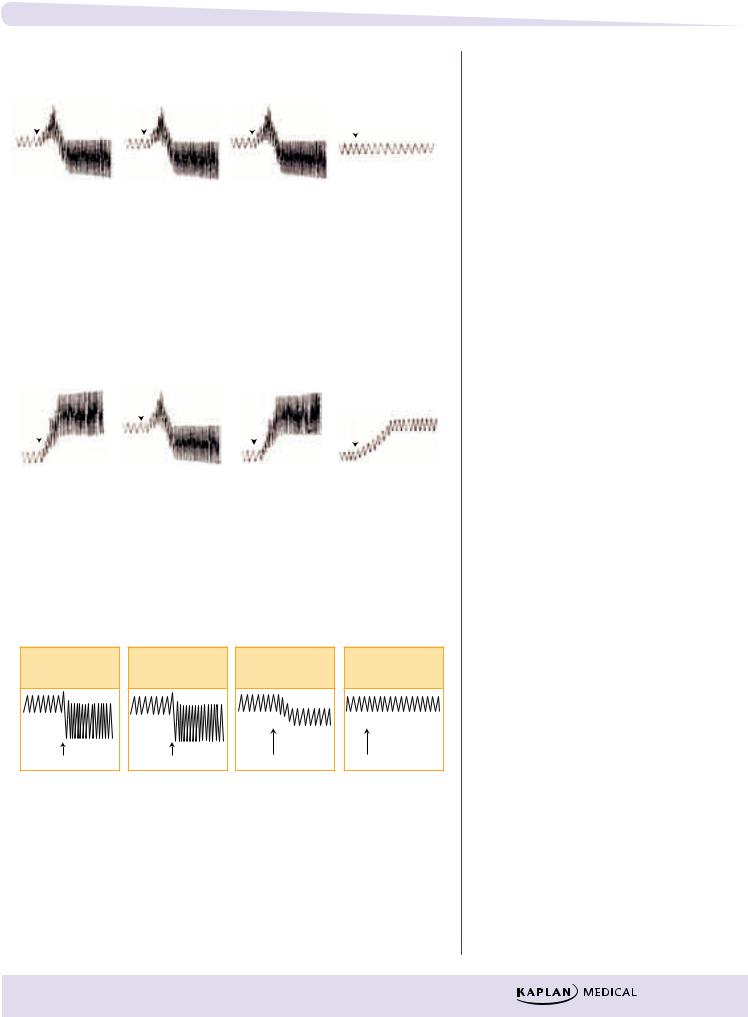
S is A. |
Epinephrine |
B. |
Norepinephrine |
C. |
Phenylephrine |
D. |
Isoproterenol |
E. |
Terbutaline |
Figure II-4-4
|
Control |
|
Phenoxy- |
|
|
Meca- |
|
Propranolol |
||
|
|
benzamine |
|
mylamine |
|
|||||
|
|
|
|
|
|
|
||||
H |
|
H |
|
H |
|
H |
||||
|
|
|
|
|
||||||
|
|
|
|
|
|
|
|
|
|
|
|
|
|
|
|
|
|
|
|
|
|
|
|
|
|
|
|
|
|
|
|
|
H is A. Epinephrine
B. Norepinephrine
C. Phenylephrine
D. Isoproterenol
E. Albuterol
Figure II-4-5
Control |
X |
Phenoxy- |
benzamine |
X |
Drug X is most like
A.epinephrine
B.isoproterenol
C.norepinephrine
D.phenylephrine
E.terbutaline
Meca- |
mylamine |
X |
Propranolol |
X |
Figure II-4-6
67
Section II λ Autonomic Pharmacology
X |
X + Y |
CO
TPR
BP
Resp.
resist.
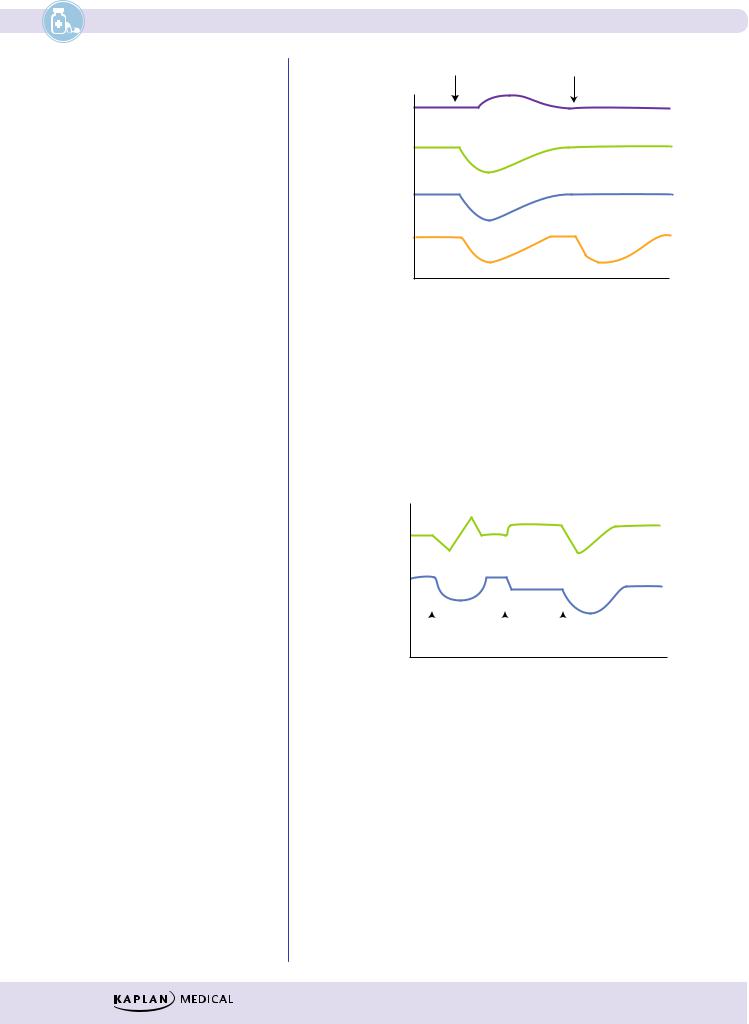
X and Y are, respectively:
A. Isoproterenol and Propranolol
B. Epinephrine and Phenoxybenzamine
C. Norepinephrine and Phentolamine
D. Terbutaline and Phenylephrine
E. Acetylcholine and Hexamethonium
Figure II-4-7
HR
BP
|
|
|
|
|
|
ACh |
Drug X |
ACh |
|||
What is drug X?
A. Hexamethonium
B. Neostigmine
C. Atropine
D. Scopolamine
E. Ipratropium
What would you expect to see if the infused drug was Neostigmine?
Figure II-4-8
68