Материал: 2016_Kaplan_USMLE_Step_1_Lecture_Notes_Pharmacology

Adrenergic Pharmacology |
3 |
Learning Objectives
Answer questions about catecholamine synthesis, action, and degradation
Explain information related to direct-acting adrenoceptor agonists and indirect-acting adrenergic receptor agonists
Differentiate between alpha receptor antagonists and beta receptor antagonists
CATECHOLAMINE SYNTHESIS, ACTION, AND
DEGRADATION
The important aspects of the adrenergic neuroeffector junction are summarized in
Figure II-3-1.
55
|
Section II λ Autonomic Pharmacology |
|
|
|
|
|
|
|
|
|
|
|
|
|
|
Dopa |
|
|
Tyrosine |
Tyrosine |
|||
|
|
|
|
|
|
Hydroxylase |
|||||
|
|
|
|
|
|
|
|
|
|
||
|
|
|
|
Dopa |
Decarboxylase (aromatic |
|
|||||
|
|
|
|
|
amino acid decarboxylase) |
|
|||||
|
|
|
|
Dopamine |
|
|
|
||||
1 |
MAO inhibitors |
|
|
|
|
|
|||||
|
|
|
Vesicular dopamine β |
|
|
||||||
|
|
|
|
|
|
|
|||||
2 |
Releasers |
|
|
|
Hydroxylase |
|
|
||||
|
|
|
|
|
|
|
|||||
3 |
Reuptake blockers |
|
Norepinephrine |
|
|
|
|||||
4 |
α2 agonists and antagonists |
|
MAO-A |
(NE) |
|
|
|
||||
|
|
|
|
|
|
|
|
|
|
||
|
|
|
|
|
|
|
|
||||
5 |
Agonists and blockers of α1, |
|
NE |
|
|
|
|
|
|
|
|
|
β1 receptors |
|
Mobile Pool |
|
|
|
|
|
|
|
|
|
|
|
|
|
|
|
|
|
|||
|
|
|
|
NE |
– |
|
|
||||
|
|
|
|
|
|
||||||
|
|
|
|
|
|
|
|
α |
|
||
|
|
|
|
|
|
|
|
|
|||
|
|
|
|
|
|
|
|
|
|
||
|
|
|
Exocytosis |
|
|
|
|
2 |
|
||
|
|
|
|
|
|
|
receptors |
|
|||
|
|
|
Reuptake |
|
|
|
|
|
+ |
|
|
|
|
|
|
NE |
|
|
Metabolites |
|
|
||
|
|
|
+ |
COMT |
|
|
|||||
|
|
|
|
|
+ |
|
|
||||
|
|
|
|
|
|
|
|
||||
|
|
|
|
Receptors |
|
|
|
||||
|
|
|
|
Effector Cells |
|
|
|
||||

 Junction
Tyrosine is actively transported into nerve endings and is converted to dihydroxyphenylalanine (DOPA) via tyrosine hydroxylase (1). This step is rate limiting in the synthesis of NE. DOPA is converted to dopamine (DA) via L-aromatic amino acid decarboxylase (DOPA decarboxylase). DA is taken up into storage vesicles where it is metabolized to NE via DA beta hydroxylase (6). Inactivation of NE via monoamine oxidase A (MAO-A) (2) may regulate prejunctional levels of transmitter in the mobile pool (3) but not the NE stored in granules.
Presynaptic membrane depolarization opens voltage-dependent Ca2+ channels. Influx of this ion causes fusion of the synaptic granular membranes, with the presynaptic membrane leading to NE exocytosis into the neuroeffector junction
(7). NE then activates postjunctional receptors (8), leading to tissue-specific responses depending on the adrenoceptor subtype activated.
Termination of NE actions is mainly due to removal from the neuroeffector junction back into the sympathetic nerve ending via an NE reuptake transporter system
(4). At some sympathetic nerve endings, the NE released may activate prejunctional
56
Chapter 3 λ Adrenergic Pharmacology
alpha adrenoceptors (5) involved in feedback regulation, which results in decreased release of the neurotransmitter. Metabolism of NE is by catechol-O-methyltrans- ferase (COMT) in the synapse or MAOA in the prejunctional nerve terminal.
Table II-3-1. Adrenergic Receptor Activation
Receptor
α1
Eye—radial (dilator) muscle Arterioles (skin, viscera)
Veins
Bladder trigone and sphincter and prostatic urethra
Male sex organs Liver
Kidney
α2
Prejunctional nerve terminals Platelets
Pancreas
β1
Heart SA node AV node
Atrial and ventricular muscle
His-Purkinje
Kidney
β2 (mostly not innervated)
Blood vessels (all)
Uterus
Bronchioles
Skeletal muscle
Liver
Pancreas
D1 (peripheral)
Renal, mesenteric, coronary vasculature
Response
Contraction—mydriasis
Contraction—↑ TPR—↑ diastolic pressure, ↑ afterload
Contraction—↑ venous return—↑ preload Contraction—urinary retention
Vas deferens—ejaculation ↑ glycogenolysis
↓renin release
↓transmitter release and NE synthesis Aggregation
↓insulin secretion
↑HR (positive chronotropy)
↑conduction velocity (positive dromotropy)
↑force of contraction (positive inotropy), conduction velocity, CO and oxygen consumption
↑automaticity and conduction velocity
↑renin release
Vasodilation—↓ TPR—↓ diastolic pressure— ↓ afterload
Relaxation Dilation
↑glycogenolysis—contractility (tremor)
↑glycogenolysis
↑insulin secretion
Vasodilation—in kidney ↑ RBF, ↑ GFR, ↑ Na+ secretion
In A Nutshell
Adrenoceptor Sensitivity
Beta receptors are usually more sensitive to activators than alpha receptors. With drugs that exert both effects, the beta responses are dominant at low doses; at higher doses, the alpha responses will predominate.
Note
Dopamine Use in Shock
D1 |
β1 |
α1 |
increasing doses of dopamine
Fenoldopam is a D1 agonist used for severe hypertension.
57
Section II λ Autonomic Pharmacology
Table II-3-2. Mechanisms Used by Adrenergic Receptors
α1 |
Gq coupled |
↑ phospholipase C → ↑ IP3, DAG, Ca2+ |
α2 |
Gi coupled |
↓ adenylyl cyclase → ↓ cAMP |
β1 β2 D1 |
Gs coupled |
↑ adenylyl cyclase → ↑ cAMP |
|
|
|
DIRECT-ACTING ADRENOCEPTOR AGONISTS
α1 Agonists
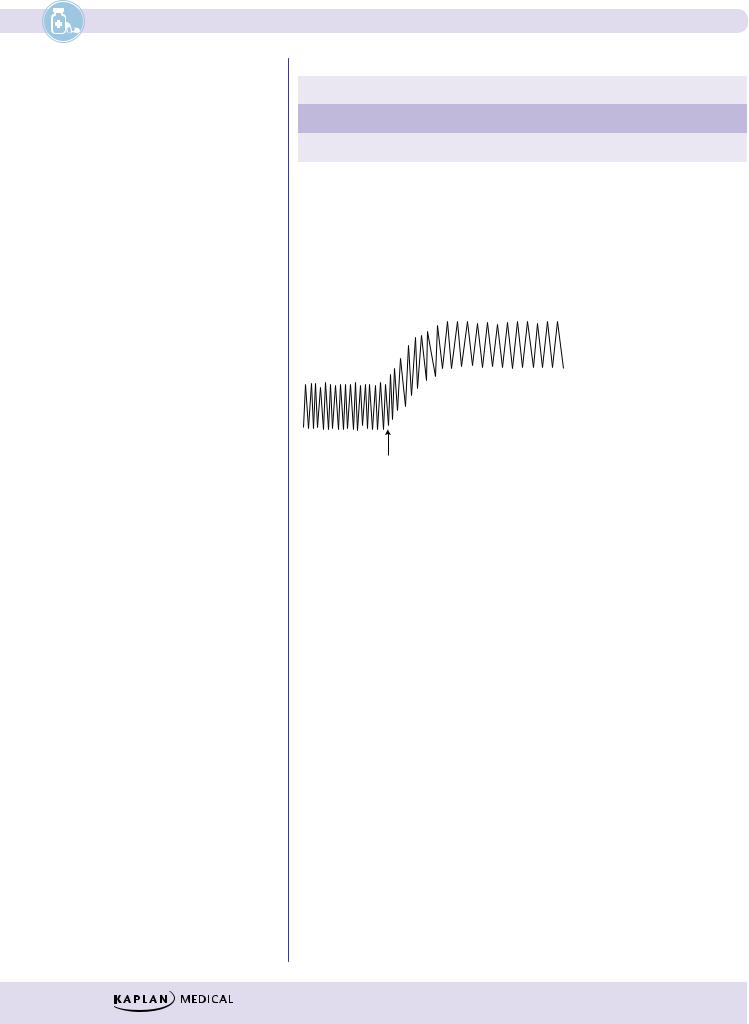
• α1: ↑ TPR, ↑ BP
• Potential reflex bradycardia
• No change in pulse pressure
α1 activation (e.g., Phenylephrine)
Figure II-3-2. Effect of Alpha Activators on Heart Rate and Blood Pressure
λSystemically, ↑ mean blood pressure via vasoconstriction
λ↑ BP may elicit a reflex bradycardia
λCardiac output may be ↓ but also offset by ↑ venous return
λDrugs and uses:
−Phenylephrine: nasal decongestant and ophthalmologic use (mydriasis without cycloplegia), hypotensive states
α2 Agonists
Stimulate prejunctional receptors in the CNS to decrease sympathetic outflow. Primary use is in mild to moderate HTN.
λDrugs and uses: clonidine and methyldopa (mild to moderate hypertension)
λSee Cardiovascular section.
58