Материал: 2048
this electronic stream is always in one direction, while with alternating current the electronic stream reverses its direction of motion with regular frequency. All pure metals are good conductors of electricity, silver being the best since it offers the least resistance to a flow of current of electricity. We know copper to be very nearly as good a conductor as silver and, being
Сvery much cheaper, it is extensively used for electrical apparatus of all kinds. It is universally employed in all automobile electrical equipment.
Roughly speaking a conductor is a body which readily permits the passage of an electric current, an insulator being a body which offers a veryиhigh resistance to the passage of the current. As a matter of fact, there is no sharp distinction between conductors and insulators, however, a material which for some cases would be regarded as an insulator would, in other circumstances, be regarded as a conductor. A substance which is a good insulatorбАat law temperatures may be a fair conductor at high temperatures.
Glass is the most striking illustration of this change of character with the change of temperature; at ordinary temperature it ranks high with the very best insulators. If glass be heated in some way to a red heat, it becomes a fair conductor and will permit the passage of enough current to melt itself.
3. Прочитайте и выучите.
4.Прочтите текст повторно и Двыпишите ключевые слова и сло-
восочетания, составляющие тематическую основу текста.
5.Прочтите и переведите следующие словаИ:6. Переведите следующие пары слов, обращая внимание на зна-
чение приставок: mis, dis, un, im, in, ir.
To use – to misuse, to match – to mismatch, to cover – to discover, to appear – to disappear, usual – unusual, common – uncommon, perfect – imperfect, possible – impossible, dependent – independent, discriminate – in-
11
discriminate, regular – irregular, respectively – irrespectively, legal – illegal.
7. Укажите прилагательные и наречия в приведенном списке слов.
СSubstance, force, motion, stream, rapid, rate, since, nearly, extensively, to employ, readily, good, ordinary, permit, determination, electrical, striking, high, some, impressed.
и 1. What is responsibleбАfor a flow of current of electricity? 2. What sub-
8. На англ йском языке опишите свойства: a) conductors of electricity, b) insulators.
8. Используя матер ал текста, ответьте на вопросы.
stances are considered to be good conductors of electricity? 3. When do free electrons move in some definite direction and what is the result of this movement? 4. What is the stream of electrons both in a direct and alternating current? 5. At what frequency does the electronic stream reverse its direction of motion? 6. What are the best conductors of electricity? 7. What is an insulator? 8. Is there any sharp distinction between conductors and insulators? 9. What can be said about glass in this respect?
г) с иной задачей общения. Д
9. Прочтите следующий диалог. Составьте диалог по аналогии с образцом в рамках данной устной темы, но …
а) в иной ситуации; |
|
б) при ином характере общения; |
И |
в) смене собеседников; |
|
|
CONDUCTORS AND INSULATORS
Demonstrator: What substance is a conductor of electricity?
Student: Any substance or material which will afford continuous passage of an electric current when subjected to a difference of electric potential is a conductor of electricity.
Demonstrator: When is a conductor said to be more efficient?
Student: The greater the density of current for a given potential difference the more efficient the conductor is said to be.
Demonstrator: What substances are efficient conductors and which are poor ones?
12
Student: Virtually all substances in solid or liquid state possess the property of electric conductivity in some degree. The metals, for example, are the best conductors, many other substances, such as metal oxides and salts, minerals and fibrous materials being relatively poor conductors of electricity.
СDemonstrator: Which of less efficient conducting materials are of great use in electricity?
Student: Some of the less efficient conducting materials such as carbon and certain metal alloys have very useful applications in electrecal arts, as well as the efficient conductors such as copper and aluminum.
Demonstrator: What substances are classed as non-conductors? Student: Certain substances are known to possess so little conductivity that they are classed as non-conductors, a better term being insulators or
dielectrics. |
бА |
|
|
Demonstrator: Define a conductor, please. |
|
Student:иA conductor is a body so constructed of conducting material that |
|
it may be used as a carrier of electric current. In ordinary engineering usage a conductor is a material of relatively high conductivity. Demonstrator: Could you define a circuit, please.
Student: An electric circuit is the path of an electric current or, more specifically, it is a conducting part or a system of parts through which an electric current is intended to flow.
10. Прочтите и выучите следующие слова:
density – плотность |
alloy – сплав, сплавлять |
solid – твердый, сплошной |
dielectric – изоляционный |
liquid – жидкий |
path – путь, траектория |
fibrous – волокнистый |
И |
application – применение |
|
oxide – окись, окисел |
aluminumД– алюминий |
carbon – углерод |
conductivity – удельная проводи- |
|
мость, электропроводимость |
11. Посмотрите видео 2 и передайте его основную идею на английском языке.
13
TEXT 4
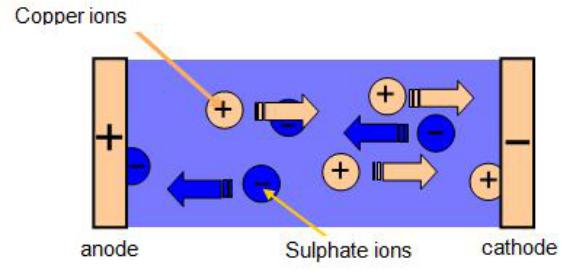
1. оставьте2 вопроса покартинке (рис.4) и обсудите ихв группе.
Си бАРис. 4
2. Прочтите текст, разделите его на смысловые части, подберите названия к каждой из них.
DIFFERENCE BETWEEN CONDUCTORSДAND INSULATORS
FROM THE ELECTRON VIEWPOINT
When a conductor is carrying an electric current, the electrons are moving gradually along through the substance of the conductor. Now in a solid body, such as a metalic conductor, the atoms or molecules comprising the substance are known practically to be fixedИin position. They are not actually stationary in space at ordinary temperature, of course; as a matter of fact, the atoms have an irregular to-and fro-motion similar to that of the electrons. But there cannot be a progressive motion of the atoms as there may be of the electrons. The reason for this is more or less evident. Suppose a current to be flowing along a copper wire. The electrons move all the way around the circuit through the wire, connections, solution in the battery, etc.
The atoms of copper being charged positively after an electron has left them, it might seem that as the electrons move from B to A through the wire the atoms would move from A to B, then into and through the battery and so back to the wire. But the atoms are thу real substance of the wire,
14
and hence if the atoms should progress one way or the other it would result in the copper itself being carried from one end of the wire to the other and then through the battery. This state of affairs is not possible in solid bodies like metals, it would result in the mixing of metalswherever a current left
one metal and went into another.
Сmolecule are called ions; the metallic ion (in above case, copper) lacks one electronиand so is charged positively. If now a current is passed through such a solution, the metallic ion does move through the solution and is carried from the solution to one of the wires by which the current is led into the solution. Here copper itself is transported by the current and we have the process ofбАelectro-plating.
In chemical solutions, e.g., copper sulphate in water, the salt mole-
cule breaks up into two parts, one of which has one electron more than its proper number, the other part lacking one electron. The two parts of the
Thus, the molecules of a body clinging to the electrons so tightly that none of them are free to move away from the molecule, there can be no current in such a substance. As long as the mplecule keeps all the electrons, it remains electrically neutral, and so has no tendency to move in an electric field. This is the essential difference between insulators and conductors; in one the electrons cannot move from the atom or molecule and in the other the electrons are perfectly free to leave the atom.
connection – связь, присоединениеД;
3. Прочитайте и выучите.
Substance – вещество;
stationary – неподвижный, стационарный, постоянный; irregular – неравномерный, неправильный;
solution – раствор, разрешение (вопроса, проблемы);
sulphate – сульфат, соль серной кислоты; sulphate of copper (of iron, of zinc) медный (железный, цинковый) купорос;
electro-plating – гальванопокрытие; |
И |
cling – цепляться, прикреплять; |
|
tightly – плотно, без зазоров, тесно. |
|
|
4. Найдите в тексте английские эквиваленты следующих слов:
такой, как; конечно; по сути; взад и вперед; причина этого в том; более или менее приводить к (чему-либо); где бы ни; например; пока; следовательно.
15