Материал: 5577

41
"world culture". Some bemoan the resulting consumerism and loss of languages. Also see Transformation of culture.
Spreading of multiculturalism, and better individual access to cultural diversity (e.g. through the export of Hollywood and Bollywood movies). Some consider such "imported" culture a danger, since it may supplant the local culture, causing reduction in diversity or even assimilation. Others consider multiculturalism to promote peace and understanding between peoples.
Greater international travel and tourism. WHO estimates that up to 500,000 people are on planes at any time?
Greater immigration, including illegal immigration
Spread of local consumer products (e.g. food) to other countries (often adapted to their culture).
Worldwide fads and pop culture such as Pokémon, Sudoku, Numa Numa, Origami, Idol series, YouTube, Orkut, Facebook, and MySpace. Accessible to those who have Internet or Television, leaving out a substantial segment of the Earth's population?
Worldwide sporting events such as FIFA World Cup and the Olympic Games.
Incorporation of multinational corporations in to new media. As the sponsors of the All-Blacks rugby team, Adidas had created a parallel website with a downloadable interactive rugby game for its fans to play and compete.
Social – development of the system of non-governmental organizations as main agents of global public policy, including humanitarian aid and developmental efforts.
Technical – development of a global telecommunications infrastructure and greater transborder data flow, using such technologies as the Internet, communication satellites, submarine fiber optic cable, and wireless telephones. Increase in the number of standards applied globally; e.g. copyright laws, patents and world trade agreements.
Legal/Ethical – the creation of the international criminal court and international justice movements, crime and raising awareness of global crime-fighting efforts and cooperation, the emergence of Global administrative law.
Negative effects of globalization
It is too easy to look at the positive aspects of Globalization and the great benefits that are apparent everywhere, without acknowledging several negative aspects. They are often the result of globalized corporations and the delocalization of economies that were once selfsustaining. Globalization–the growing integration of economies and societies around the world–has been one of the most hotly-debated topics in international economics over the past few years. Rapid growth and poverty reduction in China, India, and other countries that were poor 20 years ago, has been a positive aspect of globalization. But globalization has also
generated significant international opposition over concerns that it has increased inequality and environmental degradation.1 In the Midwestern United States, globalization has eaten away at its competitive edge in industry and agriculture, lowering the quality of life in locations that have not adapted to the change.
The Consequences of Globalization: India's Software Industry and Cross-Border Labour Mobility
India, officially the Republic of India is a country in South Asia. It is the seventhlargest country by geographical area, the second-most populous country, and the most populous democracy in the world. Bounded by the Indian Ocean on the south, the Arabian Sea on the west, and the Bay of Bengal on the east, India has a coastline of 7,517 kilometers. It is bordered by Pakistan to the west; People's Republic of China (PRC), Nepal, and Bhutan
1 Longworth, Richard, C. Caught in the Middle: America's Heartland in the Age of Globalism. New York: Bloomsbury, 2007.
42
to the north; and Bangladesh and Myanmar to the east. India is in the vicinity of Sri Lanka, the Maldives, and Indonesia in the Indian Ocean.
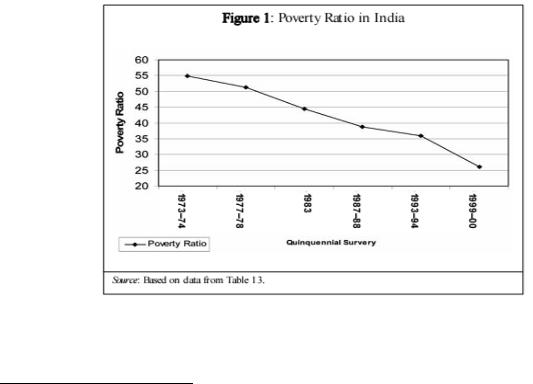
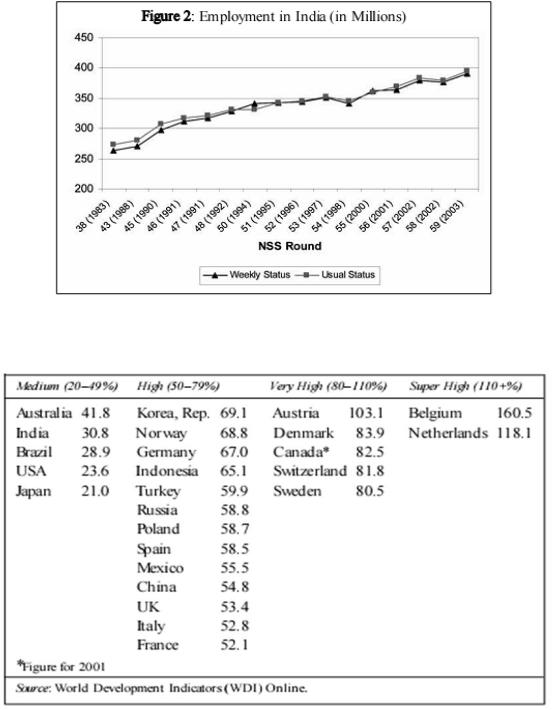
Since 1991, the nation has moved towards a market-based system. The policy change in 1991 came after an acute balance of payments crisis, and the emphasis since then has been to use foreign trade and foreign investment as integral parts of India's economy. With an average annual GDP growth rate of 5.8% for the past two decades, the economy is among the fastest growing in the world. It has the world's second largest labor force, with 516.3 million people. In terms of output, the agricultural sector accounts for 28% of GDP; the service and industrial sectors make up 54% and 18% respectively. Major agricultural products include rice, wheat, oilseed, cotton, jute, tea, sugarcane, potatoes; cattle, water buffalo, sheep, goats, poultry; fish. Major industries include textiles, chemicals, food processing, steel, transport equipment, cement, mining, petroleum, machinery, software. India's trade has reached a relatively moderate share 24% of GDP in 2006, up from 6% in 1985. India's share of world trade has reached 1%. Major exports include petroleum products, textile goods, gems and jewelry, software, engineering goods, chemicals, leather manufactures. Major imports include crude oil, machinery, gems, fertilizer, and chemicals1. India's GDP is US$1.089 trillion, which makes it the twelfth-largest economy in the world or fourth largest by purchasing power adjusted exchange rates. Despite India's impressive economic growth over recent decades, it still contains the largest concentration of poor people in the world, and has a higher rate of malnutrition among children under the age of three (46% in year 2007) than any other country in the world. But if India can fulfill its growth potential, it can become a motor for the world economy, and a key contributor to generating spending growth. «Although the Indian economy has grown steadily over the last two decades; its growth has been uneven when comparing different social groups, economic groups, geographic regions, and rural and urban areas. World Bank suggests that the most important priorities are public sector reform, infrastructure, agricultural and rural development, removal of labor regulations, reforms in lagging states, and HIV/AID.
1 Country Profile: India" (PDF). Library of Congress - Federal Research Division. December 2004. http://lcweb2.loc.gov/frd/cs/profiles/India.pdf. Retrieved on 2007-06-24
43
Table 1 – Share of Trade in GDP (%) of the Worlds Top 25 Economies in 2002
The Indian software industry is a prime example of globalization. The industry has been characterized by large cross-border mobility of its skilled labor force. Cross-border labor refers to both temporary and permanent labor flows by Indian software professionals. The picture that emerges is of a highly mobile world in which temporary mobility has been an important characteristic of the industry. A significant number of workers have work experience abroad in a developed country. Moreover, the share of skilled workers with such experience has been positively associated with the incidence of skilled migration from the firm. This suggests network effects are at work. Further, the evidence suggests that there have been important external effects at work, as through changes in the willingness of workers to
44
acquire skills, as well as through increased provision of educational services. These have further abated the risk of a brain drain. However, the software industry may be rather different from other industries.
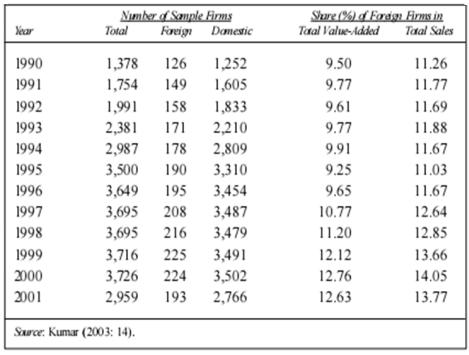
Table 2 – Share of Foreign Firms in Indian Manufacturing, 1990 – 2001
The stunning victory of the Congress party in India’s recent election is a shot in the arm for globalization. The results show that most Indians approve of a policy of gradual economic reform—including openness to foreign investment—as long as the benefits are seen to trickle down to the country’s vast rural population. The lesson: A pro-globalization and democratic government can succeed in a poor country if its policies are seen as favoring the majority and not merely a tiny elite. Despite the global downturn, the International Monetary Fund expects India's economy to grow by 5.1 % this year, and 6.5% next year, making it an engine of global economic recovery. The victory of Prime Minister Manmohan Singh and his economic team determined prospects of development. He with team are intellectually inclined toward reform, temperamentally they are wedded to gradualism. In foreign policy, the drubbing of the left and the setback to the right gives Congress more room for maneuver. The U.S.-India relationship, which has steadily deepened since the end of the Cold War, will no longer be held hostage by communist antipathy to Washington. The failure of the BJP’s campaign, which focused on the government’s dismal handling of Pakistan-backed terrorism—including the Mumbai attacks last November—makes it easier to resume negotiations with Islamabad if it can prove that it has mended its ways.
In the region, India will continue to use development aid and institution building to strengthen moderates in Afghanistan. In Pakistan too, India’s interests are aligned with America’s—the prospect of jihadists getting their hands on a nuclear weapon causes as many sleepless nights in New Delhi as it does in Washington.
In the meantime, India will continue to lobby for a permanent seat on an expanded United Nations Security Council, and will welcome the shift of the locus of international decision making from the G-8 group of industrialized democracies to the more representative (but also
45
more unwieldy) G-20. On climate change, it will (along with China) continue to make the case that countries ought to be judged by per capita rather than total emissions, and that rich countries are morally bound to bear the brunt of the costs of slowing down global warming.
On trade, the politics that shape India’s demand for lower agricultural tariffs and greater labor mobility, especially for its skilled workers, are virtually set in stone.
In the long run, however, India’s global influence will be determined less by the sum of its policies than by the evidence from two central debates that set it apart from China and most of the Muslim world: the compatibility of democracy and development, and of poverty and human rights. By growing its economy an average of 8% per year over the past five years, India has shown that democracy and development can go hand in hand. At the same time, however, the average Chinese is already twice as rich as the average Indian, and the gap is widening rather than shrinking. Unless India can rapidly close the gap with China and much of Southeast Asia, the appeal of its development model will continue to be greater in industrialized countries that see democracy as an end in itself than in Asia and Africa, where
China’s success spurs envy rather than moral outrage.
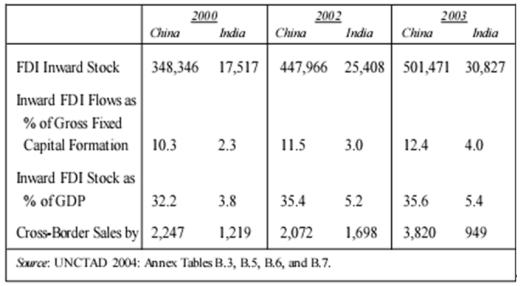
Table 3 – Comparison between China and India Regarding FDI ($, in millions)
Conclusion
The world today is more dangerous and less orderly than it was supposed to be. Ten or 15 years ago, the naive expectations were that the “end of history” was near. The reality has been the opposite. The world has more international terrorism and more nuclear proliferation today than it did in 1990. International institutions are weaker. The threats of pandemic disease and climate change are stronger. Cleavages of religious and cultural ideology are more intense. The global financial system is more unbalanced and precarious.
It wasn’t supposed to be like this. The end of the Cold War was supposed to make global politics and economics easier to manage, not harder. What went wrong? The bad news of the 21st century is that globalization has a significant dark side. The container ships that carry manufactured Chinese goods to and from the United States also carry drugs. The airplanes that fly passengers nonstop from Mexico to Moscow also transport infectious diseases. And the Internet has proved just as adept at spreading deadly, extremist ideologies as it has e- commerce. The conventional belief is that the single greatest challenge of geopolitics today is managing this dark side of globalization, chipping away at the illegitimate co-travelers that