Материал: 5577
81
Pavel Nadzhyk,
4th year student, International Economic Relations Department, Far Eastern Institute of International Relations Scientific advisers: Elena N. Albey, Lydmila A. Fisyk, Instructors
INSURING ENVIRONMENTAL SUSTAINABILITY: PROBLEM OF CLIMATE
The climate is changing. The earth is warming up, and there is now overwhelming scientific consensus that it is happening, and human-induced. With global warming on the increase and species and their habitats on the decrease, chances for ecosystems to adapt naturally are diminishing. Many are agreed that climate change may be one of the greatest threats facing the planet. Recent years show increasing temperatures in various regions, and/or increasing extremities in weather patterns. This report looks at what causes climate change, what the impacts are and where scientific consensus currently is.
Global warming and climate change refer to an increase in average global temperatures. Natural events and human activities are believed to be contributing to an increase in average global temperatures. This is caused primarily by increases in “greenhouse” gases such as
Carbon Dioxide (CO2).
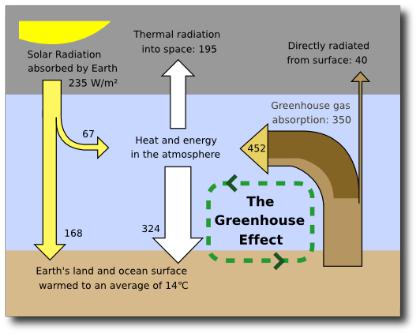
What is the “Greenhouse Effect?” The term “greenhouse” is used in conjunction with the phenomenon known as the “greenhouse effect”:
-Energy from the sun drives the earth’s weather and climate, and heats the earth’s surface;
-In turn, the earth radiates energy back into space;
-Some atmospheric gases (water vapor, carbon dioxide, and other gases) trap some of the outgoing energy, retaining heat somewhat like the glass panels of a greenhouse;
-These gases are therefore known as greenhouse gases;
-The greenhouse effect is the rise in temperature on Earth as certain gases in the atmosphere trap energy.
It’s better to make a picture in order to create an image in minds of those, who read it. Note: image below expresses energy exchanges in watts per square meter (W/m2).
82
Six main greenhouse gases are carbon dioxide (CO2), methane (CH4) (which is 20 times as potent a greenhouse gas as carbon dioxide) and nitrous oxide (N2O), plus three fluorinated industrial gases: hydrofluorocarbons (HFCs), perfluorocarbons (PFCs) and sulphur hexafluoride (SF6). Water vapor is also considered a greenhouse gas. Many of these greenhouse gases are actually life-enabling, for without them, heat would escape back into space and the Earth’s average temperature would be a lot colder. However, if the greenhouse effect becomes stronger, then more heat gets trapped than needed, and the Earth might become less habitable for humans, plants and animals.
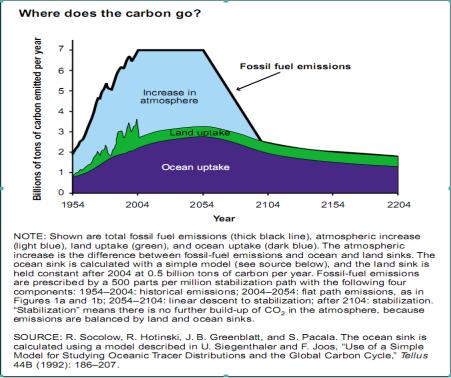
Carbon dioxide, though not the most potent of greenhouse gases, is the most significant one. Human activity has caused an imbalance in the natural cycle of the greenhouse effect and related processes. NASA’s Earth Observatory is worth quoting the effect human activity is having on the natural carbon cycle, for example:
“In addition to the natural fluxes of carbon through the Earth system, anthropogenic
(human) activities, particularly fossil fuel burning and deforestation, are also releasing carbon dioxide into the atmosphere. When we mine coal and extract oil from the Earth’s crust, and then burn these fossil fuels for transportation, heating, cooking, electricity, and manufacturing, we are effectively moving carbon more rapidly into the atmosphere than is being removed naturally through the sedimentation of carbon, ultimately causing atmospheric carbon dioxide concentrations to increase. Also, by clearing forests to support agriculture, we are transferring carbon from living biomass into the atmosphere (dry wood is about 50 percent carbon). The result is that humans are adding ever-increasing amounts of extra carbon dioxide into the atmosphere. Because of this, atmospheric carbon dioxide concentrations are higher today than they have been over the last half-million years or longer”.
For decades, greenhouse gases, such as carbon dioxide have been increasing in the atmosphere. But why does that matter? Won’t warmer weather be nicer for everyone?
83
A documentary aired on the National Geographic Channel in Britain on August 9, 2003 titled What’s up with the weather. It noted that the levels of carbon dioxide for example, were currently at their highest levels in the past 450,000 years.
Increased greenhouse gases and the greenhouse effect is feared to contribute to an overall warming of the Earth’s climate, leading to a global warming (even though some regions may experience cooling, or wetter weather, while the temperature of the planet on average would rise).
Consider also the following: 1) The five warmest years on record, in order (warmest first) are: 1998; 2002; 2003; 2004; 2005. 2) According to the World Meteorological Organization (WMO), the 1990s was the warmest decade. 3) The 1900s was the warmest century during the last 1,000 years.
However, it is the rapid pace at which the temperature will rise that will result in many negative impacts to humans and the environment and this why there is such a world-wide concern.
Most scientists believe that the warming of the climate will lead to more extreme weather patterns such as:
-More hurricanes and drought;
-Longer spells of dry heat or intense rain (depending on where you are in the world);
-Scientists have pointed out that Northern Europe could be severely affected with colder weather if climate change continues, as the arctic begins to melt and send fresher waters further south. It would effectively cut off the Gulf Stream that brings warmth from the Gulf of Mexico, keeping countries such as Britain warmer than expected;
-In South Asia, the Himalayan glaciers could retreat causing water scarcity in the long run. While many environmental groups have been warning about extreme weather conditions
for a few years, the World Meteorological Organization announced in July 2003 that “Recent scientific assessments indicate that, as the global temperatures continue to warm due to climate change, the number and intensity of extreme events might increase.”
The WMO also notes that “New record extreme events occur every year somewhere in the globe, but in recent years the number of such extremes have been increasing.” (The WMO limits the definition of extreme events to high temperatures, low temperatures and high rainfall amounts and droughts.) The U.K’s Independent newspaper described the WMO’s announcement as “unprecedented” and “astonishing” because it came from a respected United
Nations organization not an environmental group!
84
Super-Storms
Mentioned further above was the concern that more hurricanes could result. The link used was from the environmental organization WWF, written back in 1999. In August/September 2004 a wave of severe hurricanes left many Caribbean islands and parts of South Eastern United States devastated. In the Caribbean many lives were lost and there was immense damage to entire cities. In the U.S. many lives were lost as well, some of the most expensive damage resulted from the successive hurricanes.
In its wake, scientists have reiterated that such super-storms may be a sign of things to come. “Global warming may spawn more super-storms”, Inter Press Service (IPS) notes.
Interviewing a biological oceanography professor at Harvard University, IPS notes that the world’s oceans are approaching 27 degrees C or warmer during the summer. This increases the odds of major storms.
-When water reaches such temperatures, more of it evaporates, priming hurricane or cyclone formation.
-Once born, a hurricane needs only warm water to build and maintain its strength and intensity.
Furthermore, “as emissions of greenhouse gases continue to trap more and more of the sun’s energy, that energy has to be dissipated, resulting in stronger storms, more intense precipitation and higher winds.”
There is abundant evidence of an unprecedented number of severe weather events in the past decade, [professor of biological oceanography at Harvard University, James] McCarthy says. In 1998, Hurricane Mitch killed nearly 20,000 people in Central America, and more than 4,000 people died during disastrous flooding in China. Bangladesh suffered some of its worst floods ever the following year, as did Venezuela. Europe was hit with record floods in 2002, and then a record heat wave in 2003.
More recently, Brazil was struck by the first-ever recorded hurricane in the South Atlantic last March.
“Weather records are being set all the time now. We’re in an era of unprecedented extreme weather events,” McCarthy said.
Historical weather patterns are becoming less useful for predicting the future conditions because global warming is changing ocean and atmospheric conditions.
“In 30 to 50 years’ time, the Earth’s weather generating system will be entirely different,” he predicted.
Ecosystem Impacts
With global warming on the increase and species’ habitats on the decrease, the chances for various ecosystems to adapt naturally are diminishing.
Many studies have pointed out that the rates of extinction of animal and plant species, and the temperature changes around the world since the industrial revolution, have been significantly different to normal expectations.
An analysis of population trends, climate change, increasing pollution and emerging diseases found that 40 percent of deaths in the world could be attributed to environmental factors.
Jaan Suurkula, M.D. and chairman of Physicians and Scientists for Responsible Application of Science and Technology (PSRAST), paints a dire picture, but notes that he is only citing observations and conclusions from established experts and institutions. Those observations and conclusions note that global warming will lead to the following situations, amongst others:
-Rapid global heating according to a US National Academy of Science warning;
-Dramatic increase in greenhouse gas emissions;
-Ozone loss aggravated by global warming;
85
-Ozone loss likely to aggravate global warming;
-Warming of the oceans leads to increased green house gasses;
-Permafrost thawing will aggravate global warming;
-Oceanic changes observed that may aggravate the situation;
-A vicious circle whereby each problem will exacerbate other problems which will feedback into each other;
-Massive extinction of species will aggravate the environmental crisis;
-Sudden collapse of biological and ecological systems may occur, but will have a very slow recovery;
-While effective measures can decrease global warming and other problems the World community has repeatedly failed to establish cooperation.
Rising Sea Levels
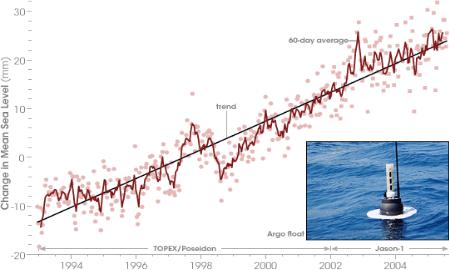
Water expands when heated, and sea levels are expected to rise due to climate change. Rising sea levels will also result as the polar caps begin to melt.
Rising sea levels is already affecting many small islands.
The World Watch Institute reports that “[t]he Earth’s ice cover is melting in more places and at higher rates than at any time since record keeping began”. (March 6, 2000).
Rising sea levels will impact many coastlines, and a large mass of humanity lives near the coasts or by major rivers.
Rising or falling sea level can reshape the world’s coastlines and affect some of the most densely populated areas on Earth. Not surprisingly, scientists want to understand sea level as thoroughly as possible. They have discovered that the ocean’s behavior is not uniform all over the world; neither are the factors that affect sea level. When sea level rises, it can do so for a few reasons. It can rise due to thermal expansion—the tendency of warm water to take up more space than cooler water. It can rise due to the addition of water, for instance from melting glaciers. It can also rise due to changes in salinity; fresh water is less dense than salt water and therefore takes up slightly more space than an equal mass of salt water.
Differences in Greenhouse Gas Emission Around the World
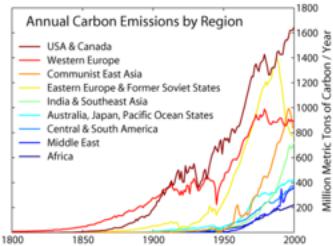
As the World Resources Institute highlights there is a huge contrast between developed/industrialized nations and poorer developing countries in greenhouse emissions, as well as the reasons for those emissions. For example: