Материал: Russian Journal of Building Construction and Architecture
|
Issue № 1 (41), 2019 |
|
|
ISSN 2542-0526 |
|
|
|
|
|
Таble 3 |
|
|
|
Coefficients of the equation (3) |
|
|
|
|
|
|
|
|
|
|
K1×10−7 |
K2×10−5 |
K3×10−3 |
K4×10−5 |
|
|
4.22906 |
−6.766495953 |
−1.99014586676 |
−1.5215618e-05 |
|
|
|
|
|
|
|
|
K5×10−3 |
K6×10−2 |
K7×10−5 |
K8×10−2 |
|
|
2.43449886309 |
7.160290767428 |
6.9347586 |
−1.109561368293 |
|
|
|
|
|
|
|
|
K9×10−1 |
K10×10−4 |
K11×10−2 |
K12 |
|
|
−3.2634157861956 |
−3.7457774200 |
5.993243830371 |
1.76271877207132 |
|
|
|
|
|
|
|
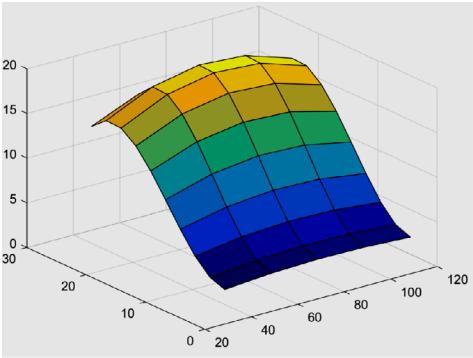
Fig. 1 shows an approximation dependency of the compression strength of the and sandy loam phosphor-gypsum on the pressing pressure, MPa, and time of mixing, min.
Fig. 1. Approximation dependence of the strength on the pressing pressure, MPa, and time of mixing, min. The energy of the connection is represented with a dependence quadratic function on the time of mixing
of the mix and the compression of the molecules during the pressing from all sides is similar to a cubic polynom, which corresponds with the area of a maximum set of the pressing pressure strength of 21,7 МPа and the time of mixing of the mix of 82 min. In the range of 0 to 10 МPа there is a small gradient of an increase
in the strength, which is due to another packing of the mineral particles. A further increase of the pressing pressure of over 22 МPа does not increase the strength, which is due to the typical composition of the lime and sandy loam phosphor-gypsum material
55
Russian Journal of Building Construction and Architecture
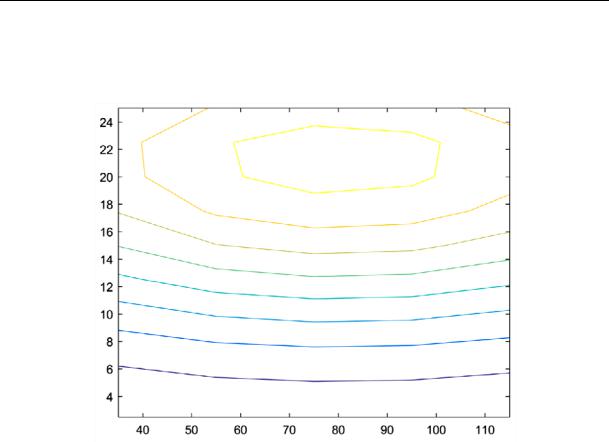
Fig. 2 shows a model dependency of the strength on the pressing pressure, МPа, and time of mixing, min.
Fig. 2. Model dependency of the strength on the pressing pressure, МPа, and time of mixing, min. The maximum strength of the examined material corresponds with the point of an optimal solution of the equation with the pressure of 21.75 МPа and the time of preliminary mixing of 82 min
Conclusions. The research methoв is presented which is used to obtain the analytical dependence of the strength of the lime and sandy loam phosphor-gypsum material on the technological parameters (pressing pressure and time of mixing) where the energy of the connection is presented as a quadratic function of the dependence of time on mixing of the mix and the compression of the molecules from all sides is similar to a cubic polynom, which shows the range of the maximum set of the strength under the pressing pressure of 21.7 МPа and time of mixing of the mix of 82 min.
In the range of 0 to 10 МPа there is a small gradient of an increase in the strength, which is due to another packing of the mineral particles. A further increase of the pressing pressure of over 22 МPа does not increase the strength, which is due to the typical composition of the lime and sandy loam phosphor-gypsum material
The use of this research method would allow the technological process to be optimized and the specified properties of the lime and sandy loam phosphor-gypsum material to be controlled.
56
Issue № 1 (41), 2019 |
ISSN 2542-0526 |
References
1.Akhnazarova S. L., Kafarov V. V. Optimizatsiya eksperimenta v khimii i khimicheskoi tekhnologii [Optimization of experiment in chemistry and chemical technology]. Moscow, Vysshya shkola Publ., 1978. 319 p.
2.Grachev Yu. V. Matematicheskie metody planirovaniya eksperimenta v pishchevoi promyshlennosti [Mathematical methods of experiment planning in food industry]. Moscow, Pishchevaya promyshlennost' Publ., 1979.
199p.
3.Zolotukhin S. N., Kukina O. B., Abramenko A. A. e.a. Bestsementnye bezobzhigovye stroitel'nye materialy s ispol'zovaniem fosfogipsa [Cementless annealing-free building materials using phosphogypsum]. Nauchnyi vestnik Voronezhskogo GASU. Vysokie tekhnologii. Ekologiya, 2016, no. 1, pp. 115—121.
4.Zolotukhin S. N. K voprosu o strukturoobrazovanii i tekhnologii nekotorykh effektivnykh kompozitsionnykh stroitel'nykh materialov [On the question of structure formation and technology of some effective composite building materials]. Stroitel'nye materialy, 1993, no. 5, p. 26.
5.Zolotukhin, S. N., Abramenko A. A., Kukina O. B. [Advantages and problems of using phosphogypsum in the production of building materials]. Problemy i perspektivy sovremennoi nauki [Problems and prospects of modern science]. Moscow, 2017, pp. 163—169.
6.Zolotukhin S. N., Kukina O. B., Abramenko A. A. e.a. Prognozirovanie svoistv kompozitsionnykh stroitel'nykh materialov s ispol'zovaniem sovremennykh komp'yuternykh programm i metodov [Prediction of composite building materials properties using modern computer programs and methods]. Innovatsionnye, informatsionnye i kommunikatsionnye tekhnologii, 2017, no. 1, pp. 375—379.
7.Zolotukhin, S. N., Kukina O. B., Abramenko A. A. Effektivnye bezobzhigovye stroitel'nye materialy na osnove fosfogipsa [Effective non-burning building materials based on phosphogypsum]. Sovremennoe stroitel'stvo i arkhitektura, 2017, no. 4 (08), pp. 8—14.
8.Kukina O. B. Tekhnogennye karbonatkal'tsievye otkhody i tekhnologiya ikh ispol'zovaniya v stroitel'nykh materialakh s uchetom strukturoobrazuyushchei roli. Diss. kand. tekhn. nauk [Technogenic carbon-calcium waste and the technology of their use in building materials, taking into account the structure-forming role. Cand. eng. sci. diss.]. Voronezh, 2002. 184 p.
9.Ruzinov L. P. Statisticheskie metody optimizatsii khimiko-tekhnologicheskikh protsessov [Statistical methods of optimization of chemical and technological processes]. Moscow, Khimiya Publ., 1972. 200 p.
10.Stepanova M. P., Potamoshneva N. D., Kukina O. B. K razrabotke tekhnologii portlanditovykh sistem tverdeniya dlya polucheniya besklinkernykh stroitel'nykh kompozitov [The development of technology portlandite systems hardening to obtain a construction clinkerless composites]. Izvestiya Yugo-Zapadnogo gosudarstvennogo universiteta, 2011, no. 5 (38), pp. 166––170.
11.Zolotukhin S. N. e.a. Syr'evaya smes' dlya izgotovleniya stroitel'nykh izdelii po bezobzhigovoi tekhnologii
[Raw material mixture for the manufacture of construction products by non-annealing technology]. Patent RF, no. 2015106177/03, 2016.
12.Chernyshov E. M., Potamoshneva N. D., Kukina O. B. Portlanditovye i portlandito-karbonatnye bestsementnye sistemy tverdeniya [Portlandite and portlandite-carbonate cementless system hardening].
Stroitel'nye materialy, oborudovanie, tekhnologii XXI veka, 2002, no. 5, vol. 2, pp. 8—9.
57

Russian Journal of Building Construction and Architecture
13.Chernyshov E. M., Potamoshneva N. D., Kukina O. B. Portlanditovye i portlandito-karbonatnye bestsementnye sistemy tverdeniya [Portlandite and portlandite-carbonate cementless system hardening].
Stroitel'nye materialy, oborudovanie, tekhnologii XXI veka, 2002, no. 4, vol. 1, p. 12.
14.Shmit'ko E. I., Verlina N. A. Protsessy press-formovaniya i ikh vliyanie na kachestvo kirpicha-syrtsa [Molding processes and their impact on the quality of raw bricks]. Stroitel'nye materialy, 2015, no. 10, pp. 5––7.
15.Borisov Yu., Polikutin A., Nguyen Ph. D. Research of Reinforced Two-Layer Beams Made from Conventional and Rubber Concretes. Scientific Israel — Technological Advantages, 2012, vol. 14, no. 2, p. 11.
16.Hua Sudong, Kejin Wang, Xiao Yao. Effects of Fibers on Mechanical Properties and Freeze-Thaw Resistance Ofphosphogypsum-Slag Based Cementitious Materials. Construction and Building Materials, 2016, no. 121, pp. 290—299.
17.Liu Laibao, Yunsheng Zhang, Kefeng Tan. Cementitious Binder of Phosphogypsum and Other Materials. Advances in Cement Research, 2015, vol. 27, no. 10, pp. 567—570.
18.Rashad Alaa M. Potential Use of Phosphogypsum in Alkali-Activated Fly Ash under the Effects of Elevated Temperatures and Thermal Shock Cycles. Journal of Cleaner Production, 2015, no. 87, pp. 717—725.
19. |
Shen Yan, Jueshi Qian, Yongbo Huang. Synthesis of Belite Sulfoaluminate-Ternesite Cements |
with Phosphogypsum. Cement & Concrete Composites, 2015, no. 63, pp. 67—75. |
|
20. |
Yoon Seongjin, Kyoungju Mun, Wongil Hyung. Physical Properties of Activated Slag Concrete Using |
Phosphogypsum and Waste Lime as an Activator. Journal of Asian Architecture and Building Engineering, 2015, vol. 14, no. 1, pp. 189—195.
58

Issue № 1 (41), 2019 |
ISSN 2542-0526 |
DOI 10.25987/VSTU.2018.41.1.006
UDC 691.327.32
S. D. Semenyuk1, Yu. G. Moskal'kova2
CALCULATION METHOD FOR THE FORMATION
OF MICROCRACKS TAKING INTO ACCOUNT THE DENSITY
OF CLAYDITE CONCRETE
Belarusian-Russian University
Republic of Belarus, Mogilev
1D. Sc. in Engineering, Prof. of the Dept. of Industrial and Civil Construction, tel.: +375(29)7433872, e-mail: skzs@tut.by
2PhD in Engineering, Assoc. Prof. of the Dept. of Industrial and Civil Construction, tel.: +375(29)7429183, e-mail: julia43@tut.by
Statement of the problem. An important aspect of concrete behaviour under loading is the formation and development of microcracks. The existing methods for the calculation of values of the limits of microcrack formation for lightweight aggregate concrete do not provide sufficient convergence with the experimental data. In this regard, it is advisable to derive new formulas applicable for lightweight aggregate concrete.
Results. The paper presents the test results on concrete of different strength and density classes. It also suggests new formulas for the calculation of the limits of microand macrocrack formation. According to the obtained research results, an empirical coefficient is introduced based on the density class of lightweight aggregate concrete.
Conclusions. The calculation method of the upper and lower limits of microcrack formation for lightweight aggregate concrete of various strength and density classes is proposed. The method is harmonised with the provisions of the Eurocode 2. At the same time, good convergence with the experimental data is provided.
Keywords: lightweight aggregate concrete, claydite, limits of microcrack formation, density, density class.
Introduction. The use of construction and heat insulation lightweight concrete is becoming increasingly common in construction. Apart from good heat insulation properties, this type of concrete has a sufficient fire resistance [10]. Therefore it is of a lot of importance these days to develop relevant theories for calculating and designing load-bearing structures made of light concrete.
© Semenyuk S. D., Моskalkova Yu. G., 2019
*The research was conducted as part of the state research program “Physical Material Studies, New Materials and Technologies”, subprogram 8.8 “Construction Materials”, № state register 20162027, registration date 30.05.2016, ГБ 1621Ф.
59