Материал: Russian Journal of Building Construction and Architecture
Issue № 1 (41), 2019 |
ISSN 2542-0526 |
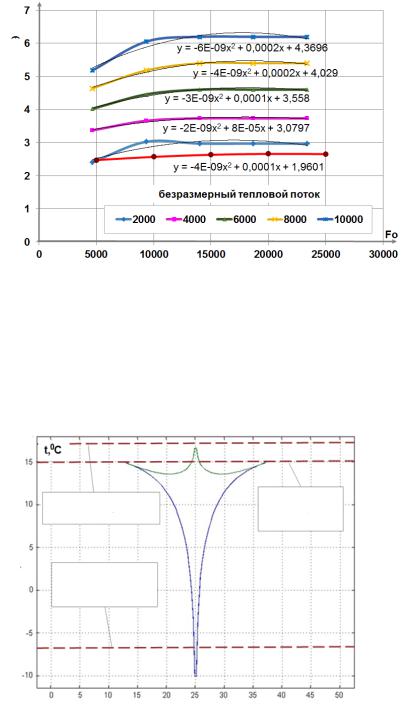
As a result of processing the obtained results in a dimensionless shape the following generalizing criteria equations are obtained:
–– one-flow:
5 10 9 Q Fo2 2 10 8 Fo Q 0.0003 Q 5.1; |
(6) |
–– sign-changing: |
|
5 10 9 Q Fo2 2 10 8 Fo Q 0.0003 Q 5.1(0.0002 kр 1.98). |
(7) |
Dimensionless temperature Θ
|
Fig. 5. Dependence |
|
|
of the dimensionless temperature Θ |
|
|
on the criterion Fo at the values |
|
|
of the dimensionless active (heat) |
|
|
flow Q |
|
Dimensionless heat flow |
||
|
||
|
|
Criterion Fo
5. Comparison of the calculation results with the current setup. The model was checked by comparing the calculation values with the results of the measurements of the parameters of the current complex setup NIBE F 1145-12 operating at a dairy processing enterprise in Astrakhan region (Fig. 6).
|
|
|
|
|
|
|
|
Background |
|
Measured temperature |
|
|
||
(summer) |
|
|
temperature |
|
|
|
|
of the layer |
|
|
|
|
|
|
|
|
|
|
|
Measured temperature (winter)
Fig. 6. Comparison of the results of calculations with the current setup
Distance, m
45
Russian Journal of Building Construction and Architecture
The data on the temperature distribution in the layer presented in the graph were obtained using a calculation method. The dotted lines correspond with the measure temperatures at the bottom of the well. The tops of the curved lines are the measured temperatures at the bottom of the well. The comparison of the calculation results and measurements show that in the summer season at the time the values were being recorded, the results were about 17 0С, the measured one was 18 0С. In winter the calculation one was −10 0С, and in fact −7 0С. The deviations in the measured and calculation values during the operation of the setup in the heatsaving mode were 1—2 0С, in the air conditioning mode — 3 0С. Based on the results, we conclude that the results obtained in the natural experiments are in good agreement with those of numerical modeling.
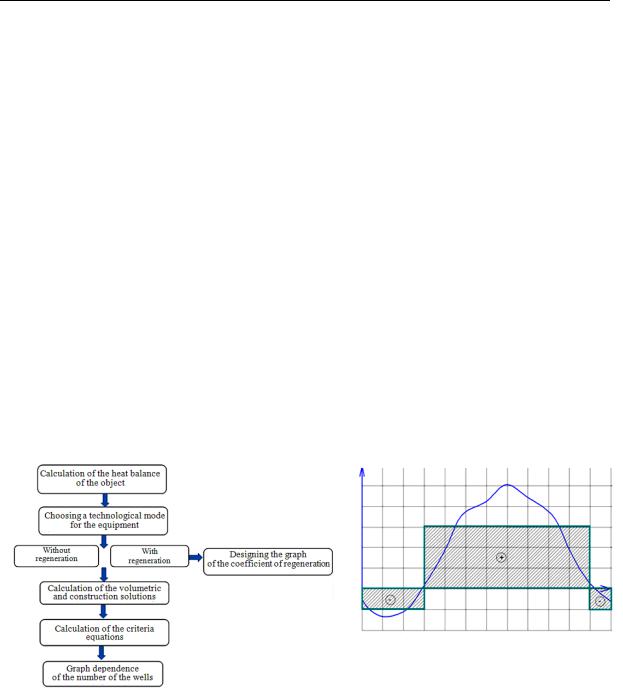
6. Меthods of calculating changes in the temperature of the soil massif. The method of designing the heat supply and air conditioning systems is suggested considering long-term operation of the geothermal well and the technical and economic conditions of the major construction and technological solutions are analyzed. The order of the calculations of the method is presented in Fig. 7.
Jan Feb Mar Apr May June July Aug Sept Осt Nov Dec
Averaged annual active load on the object
Fig. 7. Order of the calculations
The graphs of the data for calculating the number of the wells considering the natural and climatic conditions of the design area and the results of the studies of the soils are designed (Fig. 8).
The calculation method allows the energy-efficient calculation to be identified at the designing stage and a long-term operation of the heat pump to be predicted over time. The designing task can be depicted as a block scheme (Fig. 9).
46
Issue № 1 (41), 2019 |
ISSN 2542-0526 |
k Temperature
Q, Watt
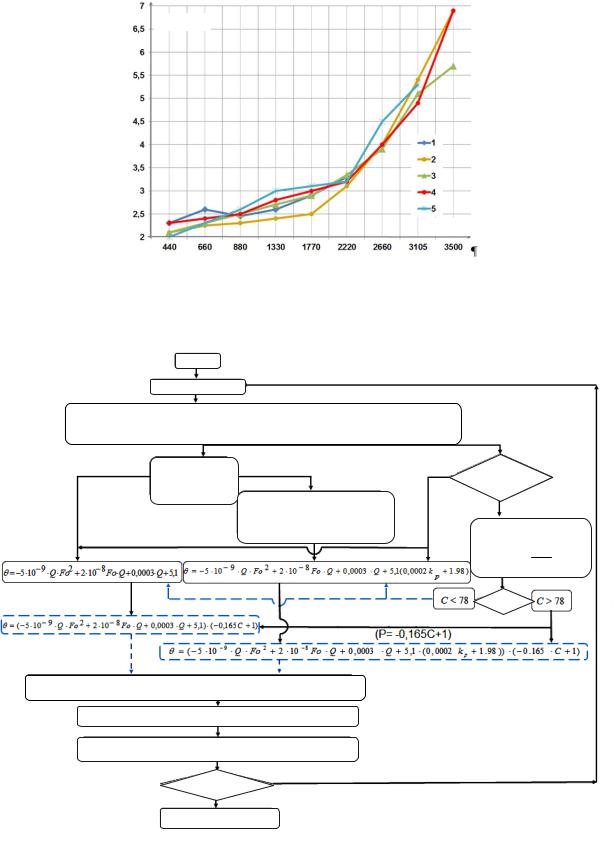
Fig. 8. Dependence of the number of the wells on the consumed energy of the heat pump with the transformation coefficient of no less than 2
Start
Initial data
Conversion into dimensionless values |
Q |
qHeating |
; |
tResidualSoil |
|
tос |
|
|
; Fo |
a |
|
|||
qEarth |
tBSackgroundoil |
|
|
|
|
|
rc 2 |
|
||||||
tос |
|
|||||||||||||
|
|
|
|
|
|
|
|
|||||||
Without regeneration |
Determining the |
With regeneration |
|
|
|
|
|
|
|
No |
Underground |
|||
|
|
|
|
|
|
|
|
|
|
|
|
|
||
|
operating mode |
|
|
|
|
|
|
|
|
|
|
|
|
water |
|
|
|
Calculating the coefficient |
|
|
|
|
|
|
|
Yes |
|||
|
|
|
|
|
|
QSupply |
|
|
|
|
|
|
|
|
|
|
of regeneration kp = |
|
|
|
|
|
|
|
Calculating the criterion |
||||
|
|
QDeflection |
|
|
|
|
|
|
|
|||||
|
|
|
|
|
|
|
|
|
|
|
|
|
of water exchange |
|
C d
If
Corrections for the filtration flow
Conversion into the real temperature tocSoil ((tBackgroundSoil toc ) ) toc
Clarification of the heat coefficient of the heat pump setup
Technical and economic analysis of the above scheme
Profitability
Choosing the equipment
Correcting the number of the wells
Fig. 9. Block scheme of the technical and economic parameters of the optimization of the composite systems of heat supply and air conditioning using a low-potential geothermal energy
47

Russian Journal of Building Construction and Architecture
Conclusions
1.A reduction in the temperature pump in the part of the layer adjacent to the bottom of the well used as a non-traditional source of heat in heat supply and air conditioning systems caused by non-stationary heat loads determined by climate conditions.
The temperature of the soil layer of the well during the one-flow mode after the heat pump is switched on increases and in the third year of operation it stabilizes. In the downtime period a reduction in the temperature is compensated for by the background heat flow and strives for the background temperature but increases by an average of 2—3 0С. In the following year of the operation the temperature increases and remains stable throughout the entire period. A switch to a quasi-stationary state is due to the fact that the operating well is only a source of excitation in the background temperature field of the Earth. During supply the heat flow gives the heat to the well. Following a break the heat pump restarts with the parameters of the previous stage, i.e. with an increased temperature of the layer, which has a positive effect on the operation of the thermal energy setup. During the sign-changing mode it is obvious that as the heat is deflected, the layer cools down and it heats up during supply but sequential reversing of the heat pump causes a system of thermal waves that lead to changes in the temperature of the well and have an effect on the technical and economic parameters of the equipment.
The results of the study enabled us to conclude that an annual drop in the temperature of the soil gradually reduces during regeneration. Regeneration allows the heat load to be compensated for. The volume of the soil massif that experiences changes of the temperature mode annually expands. The positive aspect is that in the mode with regeneration stabilization happens earlier than in the one-flow mode.
2.The obtained results of the study of heat-exchange between a heat carrier and soil in a geothermal well considering its long-term operation, heat supply and air conditioning systems in cyclic modes and the criteria dependencies for calculating the temperature ranges allowing for climatic cycles of heat loads were obtained.
3.The method of designing systems of heat supply and air conditioning employing a nontraditional heat source using geothermal wells was developed. The method allows for a long-term operation of wells in the seasonal cyclic mode of systems of heat supply and air conditioning with changes in the temperature ranges identified as a result of studies that determine a dynamic change in the coefficient of the transformation of heat of the current heat pumps.
48
Issue № 1 (41), 2019 |
ISSN 2542-0526 |
References
1.Vasil'ev V. G. Geotermal'nye teplonasosnye sistemy teplosnabzheniya i effektivnost' ikh primeneniya v klimaticheskikh usloviyakh Rossii [Geothermal heat pump systems of heat supply and efficiency of their application in climatic conditions of Russia]. AVOK. Teplosnabzhenie, 2007, no. 5. Available at: http://www.abok.ru/ for_spec/articles.php?nid=3685
2.Vasil'ev G. P. Teplokhladosnabzhenie zdanii i sooruzhenii s ispol'zovaniem nizkopotentsial'noi teplovoi energii poverkhnostnykh sloev zemli. Diss. d-ra tekh. nauk [Heat supply of buildings and structures using lowpotential heat energy of the surface layers of the earth. Dr. eng. sci. diss]. Moscow, 2006. 423 p.
3.Denisova A. E., Marmusevich A. V. Modelirovanie teplovykh protsessov v gruntovoi teplovoi trube teplonasosnoi sistemy teplo- i khladosnabzheniya [Modeling of thermal processes in the ground heat pipe of the heat pump system of heat and cooling]. Trudy Odesskogo politekhnicheskogo universiteta, 2006, no. 1 (25), pp. 65—69.
4.Ibragimov E. V., Kronik Ya. A., Pustovoit G. P. Opyt ispol'zovaniya teplovykh nasosov v kachestve sistem termostabilizatsii grunta v kriolitozone [Experience in the use of heat pumps as ground thermal stabilization systems in the cryolithozone]. OFMG, 2015, no. 5, pp. 23—26.
5.Kidruk M. I. Modelirovanie raboty gruntovogo kollektora teplovogo nasosa [Simulation of the work of the ground collector of the heat pump]. Available at: http://progress21.com.ua/ru/news/poleznaya-informatsiya/ item/35-modelirovanie-i-optimizatsiya-sistem-teplosnabzheniya-zdanij-s-ispolzovaniem-vozobnovlyaemykh-istoch- nikov-tepla-teplovoj-nasos-i-solnechnyj-kollektor
6.Kostikov A. O., Kharlampidi D. Kh. Vliyanie teplovogo sostoyaniya grunta na effektivnost' teplonanosnoi ustanovki s gruntovym teploobmennikom [The influence of the thermal state of the soil on the efficiency of the heat pump installation with a ground heat exchanger]. Energetika: Ekonomika, tekhnologiya, ekologiya, 2009, no. 1, pp. 32— 40.
7.Lykov A. V. Teoriya teploprovodnosti [Heat conduction theory]. Moscow, Vysshaya shkola Publ., 1967. 600 p.
8.Malykh V. V., Udalov S. N., Zakharov A. A. [The method of calculation of a soil battery]. Trudy nauchnoprakticheskoi konferentsii “Energo- i resursoeffektivnost' maloetazhnykh zdanii” [Proc. of the scientificpractical conference “Energy and resource efficiency of low-rise buildings”]. Novosibirsk, 2013, pp. 317—318.
9.Matsevityi Yu. M., Tarasova V. A., Kharlampidi D. Kh. [Restoration of the thermal potential of the soil due to
the choice of rational modes of operation of the heat pump system]. Tezisy dokladov i |
soobshchenii |
XIV Minskogo mezhdunarodnogo foruma po teplo- i massoobmenu [Abstracts of reports and |
reports of the |
XIV Minsk international forum on heat and mass transfer]. Minsk, 2012, vol. 1, pp. 736—739. |
|
10.Rukovodstvo po primeneniyu teplovykh nasosov s ispol'zovaniem vtorichnykh energeticheskikh resursov i netraditsionnykh vozobnovlyaemykh istochnikov energii [Guidance on the use of heat pumps using secondary energy resources and non-traditional renewable energy sources]. Moscow, GUP “NIATs”, 2001, 32 p.
11.Saprykina N. Yu. Issledovanie faktorov, vliyayushchikh na rabotu gruntovykh teplovykh nasosov pri dlitel'nykh srokakh ekspluatatsii [Study of factors affecting the operation of ground heat pumps for long service life]. Izvestiya KGASU, 2018, no. 2 (44), pp. 177—183.
12.Saprykina N. Yu., Yakovlev P. V. Issledovanie formirovaniya temperaturnogo polya grunta pri ekspluatatsii geotermal'nykh teplovykh nasosov v usloviyakh vliyaniya gruntovykh vod [Investigation of the formation of the
49