Материал: Russian Journal of Building Construction and Architecture
Issue № 1 (41), 2019 |
ISSN 2542-0526 |
The software will also come with a restriction as it is not designed for identifying large-scale gas consumption.
The software will be operating managed by the operating system with a graphic interface or another compatible operating system. A processor run PC, memory capacity of no less than 64 МB, hard drive capacity of no less than 10 GB. A graphic printer is necessary for printing out the results.
The developed software can be set up and used on mobile diagnostic and research setups. The software requires no extra software packages as well as special training. One has to be a confident Windows user. Pilot use of the new software will enable them to work with the interface in the period of 5 to 10 minutes.
One of the advantages of the software product is that it can be developed and modified further for the calculation of extra parameters and compatibility with pulse wave record software. This software is used to obtain original scientific results to enhance the involvement of educational institutions into the implementation of the national technological initiative № 13.11847.2018/11.12 “Developing Models for High-Speed Management of Urban Gas Supply Systems Using the Principle of Perturbation Record”.
Conclusions
1.The article looks at the major parameters of the developed software for measuring small-scale natural gas consumption. The software will enable the development and visualization of incoming data in order to identify the linear velocity of gas particles in the swirl nuclear as well as to evaluate the effect of the weighed phase on changes of the static and dynamic pressure.
2.The feature of the developed product is that it requires no special training and software packages. Pilot testing of the new software would enable independent operation of the interface within 5 to 10 minutes. Moreover, if necessary, the software can be further developed and modified for calculating extra parameters and compatibility with pulse wave record software.
3.The obtained results of the research and the software can be applied in energy supply and energy saving systems in gas industry and communal household services. Unlike similar mainstream products, visualization of changes in the pressure of gas movement in the device would allow one to get extra information on small-scale consumption of the gas environment and an increase in the sensitivity of the device.
References
1. Gnezdilova O. A., Kobelev N. S. Matematicheskaya model' sistemy gazosnabzheniya nizkogo davleniya kak energosberegayushchey skhemy operativnogo upravleniya [Mathematical model of low-pressure gas supply sys-
35

Russian Journal of Building Construction and Architecture
tem as energy-saving operational control scheme]. Nauchnyi vestnik Voronezhskogo GASU. Stroitel'stvo i arkhitektura, 2009, no. 3 (15), pp. 32––28.
2.Gnezdilova O. A., Kobelev N. S., Stepanov V. F. Nekotorye polozheniya vikhrevykh protsessov kak osnova dlya rascheta parametrov struezakruchivayushchikh apparatov teplovykh punktov [Some of the provisions of eddies as the basis for calculating the parameters of the jet twisting apparatus for thermal stations]. Izvestiya Kurskogo gosudarstvennogo tekhnicheskogo universiteta, 2007, no. 2 (19), pp. 42––44.
3.Gnezdilova O. A. [The main provisions of the calculation of thermal parameters of the jet twisting devices]. Sbornik materialov XIV rossiiskoi nauchno-tekhnicheskoi konferentsii “Materialy i uprochnyayushchie tekhnologii — 2007” [Proc. of the XIV Russian scientific and technical conference “Materials and strengthening technologies-2007”]. Kursk, 2007, pp. 219––224.
4.Gnezdilova O. A., Kobelev N. S. Osnovy modelirovaniya protsessa upravleniya gorodskimi sistemami gazosnabzheniya srednego i vysokogo davleniya [Basics of modeling the process of management of urban gas supply systems of medium and high pressure]. Nauchnyi vestnik Voronezhskogo GASU. Stroitel'stvo i arkhitektura, 2009, no. 3 (15), pp. 39––46.
5.Gnezdilova O. A. [Improving the accuracy of measurements in the production technology of building materials]. Trudy nauchno-prakticheskoi konferentsii “Sovremennye problemy tekhnicheskogo, estestvennonauchnogo i gumanitarnogo znaniya” [Proc. of the scientific-practical conference “Modern problems of technical, natural science and humanitarian knowledge”]. Stary Oskol, 2005, pp. 260––261.
6.Gnezdilova O. A., Stepanov V. F. [Energy saving management in heating, heating and hot water supply systems]. Trudy XXXIV universitetskoi nauchno-tekhnicheskoi konferentsii studentov i aspirantov v oblasti nauchnykh issledovanii “Molodezh' i XXI vek” [Proc. of the XXXIV University scientific and technical conference of students and postgraduates in the field of research “Youth and XXI century”]. Kursk, 2006, pp. 80––82.
7.Gnezdilova O. A. [Stratification devices as devices that increase the efficiency of coolant control and management]. Sbornik materialov XIV rossiiskoi nauchno-tekhnicheskoi konferentsii “Materialy i uprochnyayushchie tekhnologii — 2007” [Proc. of the XIV Russian scientific and technical conference “Materials and strengthening technologies-2007”]. Kursk, 2007, pp. 225––231.
8.Kobelev N. S., Gnezdilova O. A., Semicheva N. E., Lapin V. A. [The dynamics of the formation of vortex suction compressor, mining machines for quarries]. Sbornik trudov “Vibratsionnye mashiny i tekhnologii” [Proc. of the “Vibrating machines and technologies”]. Kursk, 2008, pp. 689––694.
9.Kobelev N. S., Gnezdilova O. A. [The value of devices for measuring the flow rate, as well as to improve the energy efficiency of coolant transportation]. Trudy mezhdunarodnykh akademicheskikh chtenii “Bezopasnost' stroitel'nogo fonda Rossii. Problemy i resheniya” [Proc. of international academic readings “Safety of the construction Fund of Russia. Problems and solutions”]. Kursk, 2006, pp. 39—42.
10.Ponomarev V. M., Litvinov A. P., eds. Osnovy avtomaticheskogo regulirovaniya i upravleniya [Basics of automatic control]. Moscow, Vysshaya shkola Publ., 1974. 439 p.
11.Panov M. Ya., Kvasov I. S. [Flow distribution models in hydraulic networks based on the variational approach]. Sbornik trudov “Teploobmen v energeticheskikh ustanovkakh i povyshenie effektivnosti ikh raboty”
[Collection of works “Heat Exchange in power plants and improving the efficiency of their work”]. Voronezh, Politekhnicheskii institut Publ., 1991, pp. 101––108.
36
Issue № 1 (41), 2019 |
ISSN 2542-0526 |
12.Panov M. Ya., Kvasov I. S., Kurganov A. M. Universal'naya matematicheskaya model' potokoraspredeleniya gidravlicheskikh setei i usloviya ee sovmestimosti s optimizatsionnymi zadachami [Universal mathematical model of flow distribution of hydraulic networks and conditions of its compatibility with optimization problems]. Izvestiya vuzov. Stroitel'stvo, 1992, no. 11––12, pp. 91––95.
13.Kobelev N. S., Gnezdilova O. A., Zakharov I. S. Schetchik-raskhodomer [Flowmeter]. Patent RF, no. 2003112072/28, 2005.
14.Kobelev N. S., Gnezdilova O. A., Krasnykh P. A., Evdokimov V. D. Izmeritel' raznosti davlenii [Measuring the pressure difference]. Patent RF, no. 2003122444, 2003.
15.Kobelev N. S., Gnezdilova O. A., Shchedrina G. G., Kobelev V. N., Loktionova O. S. Ustroistvo dlya drosselirovaniya gaza [Gas throttling device]. Patent RF, no. 2007102345/22, 2007.
16.Clavelloux N., Mathey R. Analyse mathematique de quelques problemes poses par le gyroscope electrostatique. Doc-Air-Espace, 1966, no. 100, pp. 3––12.
17.Aboubacar M., Phillips T. N., Snigerev B. A. e. a. High-order finite volume methods for viscoelastic flow problems. Physics. V., 2004, no. 199, pp. 16––40.
18.Aboubacar M., Aguayo J. P., Phillips P. M. e. a. Modelling pom-pom type models with high-order finite volume schemes. J. Non-Newtonian Fluid Mech, 2005, vol. 126, pp. 207––220.
19.Atkinson J. L. US pat. No. 3.642.334, cl. 308-10, 15.2. Electrostatic support system, 1972.
37

Russian Journal of Building Construction and Architecture
DOI 10.25987/VSTU.2018.41.1.004
UDC 536.491
N. Yu. Saprykina1, М. Ya. Panov2
INVESTIGATION OF THE INFLUENCE OF THE MODES OF THE OPERATION OF A GEOTHERMAL WELL WITH THE SYSTEMS OF HEAT SUPPLY AND AIR CONDITIONING IN COMBINATION WITH A THERMAL PUMP
ON THE TEMPERATURE OF A SOIL LAYER
Astrakhan State University of Architecture and Civil Engineering Russia, Astrakhan, tel.: +7-927-661-48-60, e-mail: nadin_id@ mail.ru 1Senior lecturer of the Dept. of Engineering Systems and Ecology Voronezh State Technical University
Russia, Voronezh, tel.: (473)271-53-21
2D. Sc. in Engineering, Prof. of the Dept. of Heat and Gas Supply and Oil and Gas Business
Statement of the problem. We discuss the problem of the influence of the operation modes of the heat supply and conditioning systems in combination with the heat pump on the temperature of the soil massif and the development of a methodology for improving the design of these systems taking into account the long-term operation of the heat pump system from a low-potential heat source in a cyclic mode using criteria dependencies for the calculation of well operation parameters.
Results. A description is given of the change in the temperature of the reservoir of the soil massif under the operating conditions of the heat pump in two modes: only for heat supply and alternating heat supply / cooling (air conditioning) for 5 years.
Conclusions. A decrease in the temperature head in the bottomhole part of the geothermal well is revealed, which is used as an unconventional heat source in heat supply and conditioning systems caused by non-stationary thermal loads determined by climatic conditions.
Keywords: heat pump, temperature field, design method, criteria equations.
Introduction. Geothermal heat cannot be commonly used in most settled areas due to small background densities of heat flows. The use of heat pumps for selecting heat of geothermal wells is the solution, but previous experience of operating existing wells shows that technical and economic characteristics of well degrade during operation. Despite that there are still no comprehensible methods in place that would consider these changes [1, 3—5, 8, 10]. Therefore there have been some studies to address long-term prediction of changes in the parameters of geothermal wells operating in heat supply and air conditioning systems and those relying on cyclic changes in these systems.
© Saprykina N. Yu., Panov М. Ya., 2019
38
Issue № 1 (41), 2019 |
ISSN 2542-0526 |
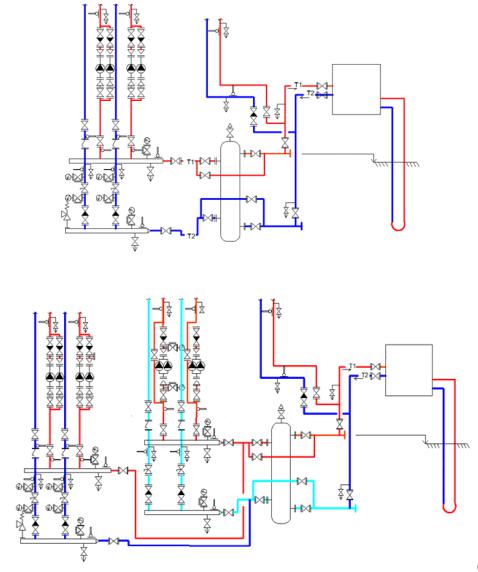
1. Modeling a temperature field of soil. A model is suggested for thermal and mass exchange processes in a layer in the influence area of the well including non-stationary heat conductivity [7, 11] and heat transfer with a filtration flow of underground water [13]. Unlike [9, 15], in this paper the problems of calculation modes of a heat-pumping device (HPD) for heat-supply and conditioning systems as well as determining initial and boundary conditions for chosen modes are addressed. For designing a calculation model the following modes (Fig.1) are chosen: a one-flow (only for heat supply or conditioning) and sign-changing (seasonal changes of load accompanied with changes of a flow direction due to switching of a heat pump from the heat supply to conditioning and back).
а)
|
|
|
Heating system (branch № 2) |
|
Heating system (branch № 1) |
|
|
|
|
|
|
HWS system
Heat pump
Ground level marks
Vertical contour (bore)
b)
Heating system (branch № 2)
|
|
|
system |
|
system |
|
|
||||
|
system |
|
№2) |
|
№1) |
|
Heating |
|
rconditioning-Ai |
|
rconditioning-Ai |
|
1) № |
|
(branch |
|
(branch |
|
(branch |
|
|
||
|
|
|
|
|
|
HWS
system
Heat pump
Ground level marks
Vertical contour (bore)
Fig. 1. Principal scheme:
а) heat supply; b) heat supply – conditioning
39