Материал: Scientific Herald of the Voronezh State University of Architecture and Civil Engineering
Issue № 1(29), 2016 |
ISSN 2075-0811 |
Table 3
Major physical and mechanical properties of bitumen SRC 60/70 with and without the additive Wetfix BE
|
|
Test results |
|
According |
Study variables |
|
|
|
|
0 % |
0,2 % |
0,3 % |
to [9] |
|
|
Wetfix WE |
Wetfix BE |
Wetfix BE |
|
|
|
|||
|
|
|
|
|
Marshall stability at 60оC (absorption level), kN |
14,27 |
14,98 |
15,37 |
> 8 |
Marshall stability at 60оC |
12,12 |
12,86 |
13,50 |
|
after 24 hours (consumption level), kN |
|
|||
|
|
|
|
|
|
|
|
|
|
Marshall stability at 60оC |
|
|
|
|
after 24 hours compared to the original one (ab- |
84,98 |
85,83 |
87,81 |
> 80 |
sorption level/consumption level), % |
|
|
|
|
|
|
|
|
|
Plasticity, mm |
3,57 |
3,40 |
3,67 |
1.5 ÷ 4 |
|
|
|
|
|
Residual porosity, % |
4,32 |
4,40 |
4,47 |
4 ÷ 6 |
|
|
|
|
|
Porosity of the mineral part, % |
15,03 |
15,25 |
15,26 |
> 14,5 |
|
|
|
|
|
Rut depth, mm |
8,86 |
5,60 |
6,00 |
< 12,5 |
|
|
|
|
|
Hence the introduction of the adhesive additive Wetfix BE into asphalt concrete BTN C12,5 in bitumen SRC increases its Marshall stability and decreases the rut depth, which causes its deformation stability to improve at high temperatures.
Conclusions
1.Increasing adhesion of road bitumen with aggregates is one of the major ways to improve the physical and mechanical properties of road asphalt concrete.
2.The introduction of 0,2 and 0,3 % adhesive additive Wetfix BE of the bitimen mass was found to improve its adhesion with aggregates, increases the Marshall stability and decreases the rut depth, which causes higher deformation resistance of asphalt concrete pavements at high temperatures.
3.The analysis of the obtained data allows us to recommend the introduction of 0,2 % of the bitumen mass of the adhesive addtive Wetfix BE for enhancing the performance of asphalt concrete surfaces.
However it should be noted that the introduction of the adhesive additive Wetfix BE in Vietnam is hampered by no regulations in place that have to be designed and endorsed.
References
1. Nguen Van Long. Predlozheniya po raschetu konstrukcij dorozhnyx odezhd s uchetom koleeustojchivosti pri povyshennyx temperaturax v usloviyax V'etnama / N. V. Long // Nauchnyj vestnik Voronezhskogo GASU. Stroitel'stvo i arxitektura. — 2013. — № 2 (30). — S. 74—82.
81

Scientific Herald of the Voronezh State University of Architecture and Civil Engineering. Construction and Architecture
2.Nguen Van Long. Razrabotka texnologii povysheniya deformativnoj ustojchivosti asfal'tobetonnyx pokrytij avtomobil'nyx dorog v usloviyax Yuzhnogo V'etnama: dis. … kand. tex. nauk / Nguen Van Long. — Voronezh, 2013. — 146 s.
3.Podol'skij, Vl. P. Issledovanie temperaturnogo rezhima asfal'tobetonnyx pokrytij avtomobil'nyx dorog vo V'etname / Vl. P. Podol'skij, Nguen Van Long, Nguen Dyk Shi // Nauchnyj vestnik Voronezhskogo GASU. Stroitel'stvo i arxitektura. — 2012. — № 4. — S. 78—84.
4.Podol'skij, Vl. P. O neobxodimosti vklyucheniya ispytanij asfal'tobetona pri temperature 60 °С v normativnye dokumenty / Vl. P. Podol'skij, V. L. Nguen, D. Sh. Nguen // Nauka i texnika v dorozhnoj otrasli. — 2013. — № 4. — S. 22—25.
5.Podol'skij, Vl. P. Prichiny koleeobrazovaniya na asfal'tobetonnyx pokrytiyax i metody povysheniya ix deformativnoj ustojchivosti v usloviyax Yuzhnogo V'etnama / Vl. P. Podol'skij, N. V. Long, D. I. Chernousov // Nauchnyj vestnik Voronezhskogo GASU. Stroitel'stvo i arxitektura. — 2013. — № 1 (29). — S. 57—65.
6.Strokin, A. S. Povyshenie sdvigoustojchivosti i sroka sluzhby dorozhnyx pokrytij putem primeneniya asfal'tobetona karkasnoj struktury na modificirovannom bitume: dis. … kand. tex. nauk / A. S. Strokin. — Voronezh: VGASA, 2009. — 178 s.
7.Kashkarov, V. M. Khimicheskaya modifikatsiya poverkhnosti poristogo i profilirovannogo kremniya v rastvore akrilovoy kisloty / V.M. Kashkarov, A.S. Len'shin, P.V. Seredin, B.L. Agapov, V.N. Tsipenyuk // Poverkhnost'. Rentgenovskie, sinkhrotronnye i neytronnye issledovaniya. –– 2012. –– № 9. –– S. 80.
8.22 TCN 211-06. Áo đường mềm — Các yêu cầu và chỉ dẫn thiết kế / Bộ Giao thông vận tải. — Hà Nội, 2006.
9.27/2014/TT-BGTVT. Thông tư quy định về quản lý chất lượng nhựa đường sử dụng trong xây dựng công trình giao thông / Bộ Giao thông vận tải. — Hà Nội, 2014.
10.858/QĐ-BGTVT. Quyết định về việc ban hành hướng dẫn áp dụng hệ thống các tiêu chuẩn kỹ thuật hiện hành nhằm tăng cường quản lý chất lượng thiết kế và thi công mặt đường bê tông nhựa nóng đối với các tuyến đường ô tô có quy mô giao thông lớn / Bộ Giao thông vận tải. — Hà Nội, 2014.
11.TCVN 7504-2005. Bitum — Phương pháp xác định độ đính bám với đá / Bộ Giao thông vận tải. — Hà Nội, 2005.
12.TCVN 8820-2011. Hỗn hợp bê tông nhựa nóng — thiết kế theo phương pháp Marshall / Bộ khoa học và Công nghệ. — Hà Nội, 2011.
13.Nguyễn Văn Long. Nguyên nhân và giải pháp hạn chế lún vệt bánh xe trên mặt đường bê tông nhựa / Nguyễn Văn Long, Nguyễn Đức Sỹ // Tạp chí Khoa học Công nghệ Giao thông vận tải. — 2015. — № 14. — Trang 63—66.
14.Phương pháp thiết kế bê tông nhựa superpave [E'lektronnyj resurs] / kompaniya BMT. –– Rezhim dostupa: http://bmt-institute. vn/thong-tin-cong-nghe/phuong-phap-thiet-ke-be-tong-nhua-superpave.
15.Goloshchapov, D. L. Synthesis of nanocrystalline hydroxyapatite by precipitation using hen's eggshell / D. L. Goloshchapov, V. M. Kashkarov, N. A. Rumyantseva, P. V. Seredin, A. S. Lenshin, B. L. Agapov, E. P. Domashevskaya // Ceramics International. 2013. Т. 39. № 4. С. 4539-4549.
16.Seredin, P. V. Strukturnye i opticheskie svojstva nizkotemperaturnyh mos-gidridnyh geterostruktur ALGAAS/GAAS (100) na osnove tverdyh rastvorov vychitanija / P. V. Seredin, A. V. Glotov, Je. P. Domashevskja, I. N. Arsent'ev, D. A. Vinokurov, A. L. Stankevich, I. S. Tarasov // Fizika i tehnika poluprovodnikov. 2009. T. 43. № 12. S. 1654-1661.
82
Issue № 1(29), 2016 |
ISSN 2075-0811 |
17. Seredin, P. V. The substructure and luminescence of low-temperature ALGAAS/GAAS(100) heterostructures / P. V. Seredin, A. V. Glotov, E. P. Domashevskaya, I. N. Arsentyev, D. A. Vinokurov, I. S. Tarasov, I. A. Zhurbina // Semiconductors. 2010. Т. 44. № 2. С. 184-188.
18.Seredin, P. V. Structural and spectral features of MOCVD ALX GAY IN1-X-Y ASZ P1-Z/GAAS (100) alloys / P. V. Seredin, A. V. Glotov, E. P. Domashevskaya, A. S. Lenshin, M. S. Smirnov, I. N. Arsentyev, D. A. Vinokurov, A. L. Stankevich, I. S. Tarasov // Semiconductors. 2012. Т. 46. № 6. С. 719-729.
19.Enin, A. E. Problemy gradostroitel'nogo razvitija malyh istoricheskih gorodov voronezhskoj oblasti: retrospektivnyj analiz i prognozirovanie / A. E. Enin, I. S. Surovcev, T. A. Litvinova // Nauchnyj vestnik Voro-
nezhskogo gosudarstvennogo arhitekturno-stroitel'nogo universiteta. Stroitel'stvo i arhitektura. 2011. № 4. S. 188-195.
83

Scientific Herald of the Voronezh State University of Architecture and Civil Engineering. Construction and Architecture
BUILDING MECHANICS
UDC 624.04
M. N. Kirsanov1
ANALYTICAL CALCULATION, MARGINAL
AND COMPARATIVE ANALYSIS OF A FLAT GIRDER
National Research University «MPEI»
Russia, Moscow, tel.: (495)362-73-14, e-mail: c216@Ya.ru
1D. Sc. in Physics and Mathematics, Prof. of Dept. of Theoretical Mechanics and Mechatronics
Statement of the problem. Girder design of statically determinate truss with diagonal lattice unusual species is examined. Using induction, a consistent calculation of truss s with different number of panels displayed the ultimate formula for the deflection of the truss . The result is compared with the analytical expression of the deflection for two standard schemes girder for which expressions of the troughs are also obtained.
Results. Analytical expressions for the deflection of the investigated truss s and two truss s in comparison based on the number of panels, size and load are obtained. Asymptotic and limiting properties of the truss are identified.
Conclusions. It is shown that for a certain number of panels and dimensions of the proposed scheme truss more stringent than the truss with standard bars. Analyzing the stability of compressed rods and not imposing a limit on the strength of the tie bars considering the formula trough, the conclusion is made about the influence of redistribution of the material between the belts on the overall stiffness of the truss .
Keywords: truss , deflection, ultimate properties, analytical solution.
Introduction
A numerical calculation of any structures with numerous members normally comes down to solving a system of linear large dimensional equations. That means an inevitable loss of accuracy which is sometimes unacceptable. Alternatively an analytical calculation is used as modern systems of symbolic mathematics (Maple, Mathematica, Maxima, etc.) are very common to use. However, all of these seems rather time-consuming which means there are solutions (even though absolutely accurate for a particular task) obtained only for systems with just a few members.
© Kirsanov М. N., 2016
84
Issue № 1(29), 2016 |
|
ISSN 2075-0811 |
In [1] the induction method o f obtaining solutions for a flat r egularly structured truss is described. In [2—4] it is tested for differen t flat and spatial rod structures. T he results obtained
using th e inductio method h ave no limitations for a number of members and allow for com- |
|
prehensive formul as for efforts in rods, |
deflections and frequencies of nodes a truss [5]. The |
effect of errors in the assemblage on the |
rigidity a d strength of a flat truss in an analytical |
form is studied in [6], the for ula for a deflection of an arched truss is obt ained in [7] and that |
|
of a flat girder truss with a tri ngulated la ttice in [8]. Analytical approaches are also employed for optimization of the shape of belts of trusses with the help of genetic algorithms [9] and those identical to ant (“bee-like” [10]).
In [11] using the analytical method the influence of the evenn ss of the number of panels on kinematic changes of a truss. In this pap r the induction method is used to obtain and analyze a formula for deflections with a non-stan dard scheme of a lattice.
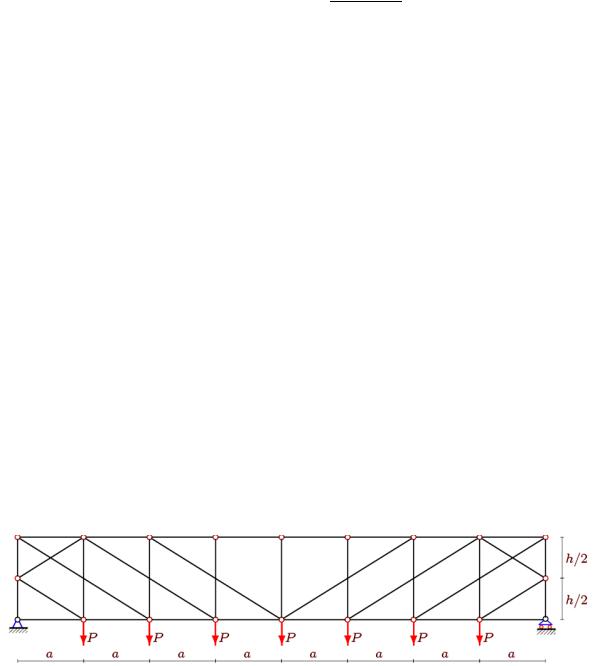
1. Scheme of a truss. A truss consists of 2n slabs and m 3 rods inclu ding 3 sup |
ort rods |
modelin g the supp ort where m 8n 5 (Fig. 1). The numbe r of nodes (number |
of joints |
(nodes) of a truss is k 4n 4, which yields 8n 8 e quations of balance. Therefore the number of rods m 3 8n 8 corresponds to the number of static equations, a tru s is statistically de-
terminate. The sch me of a truss is a peri dic statistic ally determ ined syste |
the significance of |
which i s dwelled u pon in [12]. Let us look at a load on the lower belt by ide |
tical forces P. |
Fig. 1. Truss; n = 4
2. Calculations of efforts. T e calculation was per formed according to th e algorith [13] in a syste m of compu ter mathem atics Maple. In order to specify the scheme of a structure, it is
necessary that joints and ord r of joining the node |
are introduced into the softwar . Let us |
|||||
number the joints of a truss (the lower belt is fro |
the left t o the right and then t he upper |
|||||
belt). Choosing the start of the |
coordinate s in the lef |
motionles s joint support we have |
||||
xi xi 2n 1 |
(i 1)a, |
yi 0, |
yi 2n 1 h, i 1,...,2n 1, |
|||
x4n 3 0, |
y4n 3 y4n 4 h / 2, x4n 4 x2n 1, |
y4n 3 h / 2 . |
||||
85