Материал: Scientific Herald of the Voronezh State University of Architecture and Civil Engineering

Scientific Herald of the Voronezh State University of Architecture and Civil Engineering. Construction and Architecture
Introduction
One of the major problems facing road construction is improving the performance of asphalt concrete surfacings. Asphalt concrete is known to be a thermoplastic composite. Therefore one of the most important factors adversely affecting strength and deformation properties of materials of asphalt concrete layers of roadway surfacing is temperature [1]. One of the major signs of the quality of asphalt concrete is strength. In Vietnam strength indices at 50 and 20 ºС are implicitly used to indicate deflection and crack resistance of asphalt concrete. A capacity to resist accumulation of residual deformations and not to form cracks when summer temperatures drops considerably is indicative of the longevity of roadway asphalt concrete Asphalt concrete at the temperature of 50 оС and more is a viscoelastoplastic material subjected to plastic deformations. Previous studies [2, 3] showed that in summertime in Vietnam the temperature on the surface and inside asphalt concrete roadway surfacing can get as high as 70 оС and more, which is a lot higher than specified in the guidelines. In [1—3] it was found that at high temperatures of Vietnam the computed compression strength of asphalt concrete for 50 оС is not indicative of actual operating conditions of surfacings and does not make them sufficiently deformation resistant.
Besides there are a lot of heavy duty and multiaxle vehicles with the axle load a lot higher than specified in the guidelines [7].
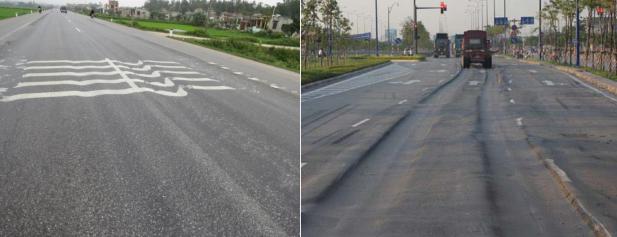
Due to the above there are not allowable deflection deformations accumulating in roadway surfacing (Fig. 1).
The formation of plastic deformations in asphalt concrete roadway surfacing compromises the travelling comfort and safety as well as damages the national economy. This is due to increasing transportation costs due to low demand as well as more frequent maintenances than specified in the guidelines. Therefore improving deformation resistance of asphalt concrete surfacing is a major concern these days [5, 12].
In [5] it was found that in order to provide the deformation resistance the construction of roadway surfacing should comply with transport and operational loads that are predicted for specific roadways considering their composition and trafficking. Materials with high strength characteristics and resistance to multiple loads should be used.
In [3, 5] the need is identified to carry out laboratory tests of physical and mechanical properties of asphalt concrete at the temperature of 60 °С to allow higher thermal resistance in the construction of roadway surfacings. Besides in [1, 4] the authors justify the need to compute the wheel resistance of the structure of a road surfacing at high summer temperatures of up to 60 оС.
76
Issue № 1(29), 2016 |
ISSN 2075-0811 |
Fig. 1. Plastic deformations on asphalt concrete surfacing of roadways of Vietnam
One of the major ways to address this is improving the structure and properties of a binder. The major characteristics of organic binders are the following [6]:
––adhesive properties providing the adhesion of binders with mineral materials;
––rheological properties determining operational and technological properties of deformation and strength of asphalt concrete;
––physical and chemical properties providing the resistance to climatic and operational conditions.
Organic binders must comply with a whole range of operational and technological requirements for the construction of asphalt concrete surfaces. Therefore adhesive additives must be introduced into organic binders to improve their adhesion with stone aggregates. As a result, there are fewer uncovered particles and the thickness of a mix is higher with less cracking caused by the operation of asphalt concrete surfacing. Hence the use of adhesive additives is cost-effective.
Presently in Vietnam different modified additives are used in organic binders, e.g., Wetfix BE, which is a liquid cation active adhesive additive specially designed for hot asphalt mixes that require high thermal stability.
The objective of the paper is to study operational properties of bitumen and asphalt concrete modified by means of Wetfix BE.
1. Experimental study to assess the effect of the adhesive additive Wetfix BE on the properties of modified asphalt concrete. In order to assess the effect of the adhesive additive Wetfix BE on the properties of modified asphalt concrete and its response to plastic deformations, an experimental study of the major properties of modified bitumen and asphalt
77
Scientific Herald of t he Voronezh State University o f Architecture and Civil Engineering. Construction and Architecture
concrete mix BTN C12,5 usin g the bind er SRC 60/70 was conducted in the Third laboratory of road ways and Laboratory C ompany B MT (Hoshi min).
The fol owing initial material were used in the tests:
––quarry limestone Socluk2 in Dong Nai Province;
––quarry sand fro m Phu Thinh in Dong Nai Provinc e;
––min ral powder from an asphalt concrete setup in km 42 of roadway 20;
––bitu men SRC 60/70;
––additive Wetfix BE by AKZO NOBE.
In orde r to investi gate the effect of the additive We fix BE a binder was m ade by int oducing
0,2 and 0,3 % of bitumen SRC |
60/70 in ass. |
Control mixes of the identical |
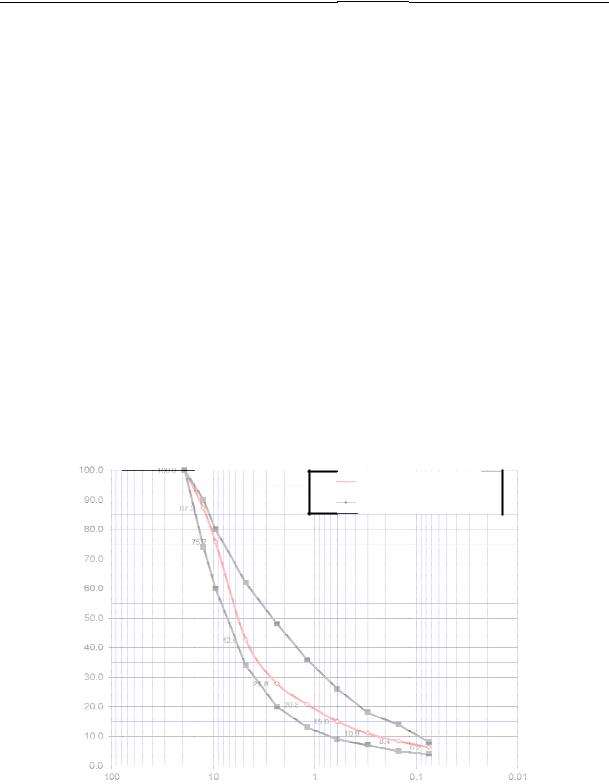
granular m etric composition (Fi . 2) were made using bitumen |
SRC 6 0/70. The ompositio s of the dense asphalt concrete BTN C12,5 were selected in complia nce with t he requirem ents TCV 8820-2011 [11]. Th binder co ntent in the investigated asphalt concrete mixes was select d according to the physical and chemical properties of the m ix SRC 60/70 and wa s 4,94 % per 100 % of a mineral skeleton.
Designed gra nular composition BTNC 12,5
Boundaries o the granular composition BTNC 1 ,5 по 858/QD-BG TVT
Fig. 2. |
ranular metric composition of a fine ag gregate asphalt concrete BT NC 12,5 |
|
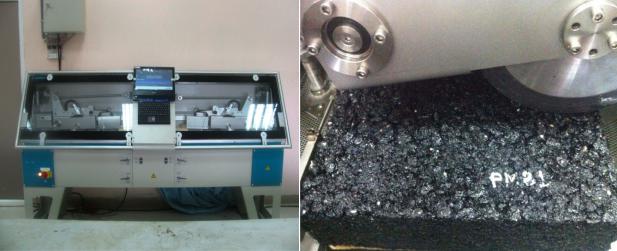
Experim ental studi es of the w heel resista ce of asph alt concrete were carried out using |
a Ham- |
|
burg wh eel trackin |
HWTD (Fig. 3). The tests were c nducted using slabs of 320×260×5 |
0 mm at |
the tem perature of |
0 оС. The rut depth in the slabs was fixed after each 1500 loading cycles. |
|
78
Issue № 1(29), 2016 |
ISSN 2075-0811 |
Fig. 3. Hamburg wheel tracking test HWTD
2. Results of the experimental study. According to TCVN 7504-2005 [10], adhesion of the road bitumen with the aggregate is evaluated on five levels that are detailed in Table 1. According to 27/2014/TT-BGTVT [8], bitumen with the adhesion level of 3 can be applied in road construction.
Table 1
|
Major physical and mechanical properties of modified bitumen SRC 60/70 |
|
|
|
|
Level |
Adhesion level of bitumen with the aggregate |
|
|
|
|
5 |
Excellent: bitumen film is all over the aggregate surface and its thickness is identical throughout |
|
the entire aggregate surface |
||
|
||
|
|
|
4 |
Good: bitumen film is all over the aggregate surface but its thickness is not identical throughout |
|
entire aggregate surface |
||
|
||
|
|
|
3 |
Adequate: in some areas of the aggregate there is no bitumen film |
|
|
|
|
2 |
Bad: in some areas of the aggregate surface there is some bitumen but the bitumen film peels off |
|
its surface |
||
|
||
|
|
|
1 |
Poor: surface of the aggregate is clean |
|
|
|
The results of the experimental study of the major physical and mechanical properties of bitumen SRC 60/70 with and without the additive Wetfix BE are identified in Table 2.
The data in Table 2 suggests that while introducing 0,2 and 0,3 % of the adhesive additive Wetfix BE in mass into the road bitumen SRC 60/70 its level of adhesion with the aggregate rises from 3 to 4, the needs penetrates from 6,48 to 10,61 % deeper respectively, the softening temperature drops from 3,45 and 5,54 % respectively and the other properties change insignificantly and comply with the requirements specified in 27/2014/TT-BGTVT [8].
79

Scientific Herald of the Voronezh State University of Architecture and Civil Engineering. Construction and Architecture
Therefore the introduction of the adhesive additive Wetfix BE into the road bitumen SRC 60/70 improves its adhesion with the aggregate to improve the operational properties of road asphalt concrete.
The results of the experimental studies of the physical and mechanical properties of asphalt concrete BTN C12,5 using bitumen SRC with and without the additive Wetfix BE are detailed in Table 3.
Table 2
Major physical and mechanical properties of bitumen SRC 60/70 with and without the additive Wetfix BE
|
|
Test results |
|
According |
|
Study variables |
|
|
|
||
0,0 % |
0,2 % |
0,3 % |
to [8] |
||
|
Wetfix BE |
Wetfix BE |
Wetfix BE |
||
|
|
||||
|
|
|
66,7 |
|
|
Depth of the needle at 25оC, 0,1 mm |
60,3 |
64,2 |
60 ÷ 70 |
||
Softening temperature along the circle and the |
48,06 |
46,40 |
45,4 |
≥ 46 |
|
ball, оС |
|||||
|
|
|
|
||
Dynamic viscosity at 600C, Pa·sec |
213 |
214 |
217 |
≥180 |
|
|
|
|
> 110 |
|
|
Flexibility at 25°С, сm |
> 110 |
> 110 |
≥ 100 |
||
|
|
|
1,88 |
|
|
Paraffin content, % |
1,86 |
1,87 |
≤ 2,2 |
||
|
|
|
318 |
|
|
Outburst temperature,оС |
320 |
320 |
≥ 232 |
||
|
|
|
99,50 |
|
|
Solubility in C2HCl3, % |
99,42 |
99,52 |
≥ 99 |
||
|
|
|
1,024 |
|
|
Specific weight at 25оC, g/сm3 |
1,025 |
1,025 |
1,0 ÷ 1,05 |
||
|
|
|
0,07 |
|
|
Weight loss, % |
0,06 |
0,07 |
≤ 0,5 |
||
|
|
|
4 |
|
|
Adhesion with the aggregate, level |
3 |
4 |
≥ 3 |
||
|
|
|
|
|
The data in Table 3 suggests that the use of 0,2 and 0,3 % of the adhesive additive Wetfix BE in mass of the bitumen into asphalt concrete BTN C12,5:
––the Marshall stability at 60оC increases by 5,34 and 8,08 % respectively;
––the Marshall stability at 60оC after 24 hours rises from 6,11 % and 11,5 % respectively;
––the Marshall stability at 60оC after 24 hours compared to the original one rises from 1,00 and 3,33 % respectively;
––the rut depth decreases by 36,79 and 32,28 % respectively;
––the other characteristics do not change considerably and meet the requirements in 858/QĐBGTVT [9] and TCVN 8820-2011 [11].
80