Материал: The international monetary system
The international monetary system
Contents
Introduction
Chapter 1. International monetary system
1.1 Currency and its types
Chapter 2. The main world currency - Euro, Dollar, Yuan
2.1 Euro
2.2 Dollar
2.3 Yuan
Chapter 3. Euro, Dollar, Yuan today and Scenarios on the Future of the International Monetary System
Conclusion
Bibliography
Introduction
The initiative on Euro, Dollar, Yuan
Uncertainties - Scenarios on the Future of the International Monetary System began
in early 2011 against a background of increasing concerns among many Forum
members and constituents about the state of the global economy. Currency
volatility and fiscal crises have consistently featured as key global risks in
the World Economic Forum’s Global Risks Report in past years. Over the course
of 2011, the escalating sovereign debt crisis in Europe, discussions around the
sustainability of US debt levels and questions around economic reforms in China
have exacerbated the challenges to global economic stability. In this context,
the Forum has mobilized key resources, including its Strategic Foresight,
Europe, Financial Services, Global Risksand Global Agenda Council teams, to
initiate a process aimed at supporting stakeholders in better understanding how
these uncertainties may play out, and how stakeholders can prepare for
plausible yet challenging alternative scenarios.report is the synthesis of the
insights generated in a process engaging over 200 policy-makers, private sector
leaders and academic experts through discussions and a series of high-level
workshops in Brussels, New York, London, Beijing, Davos-Klosters and Dalian.
This dynamic interaction complements a number of related Forum initiatives
including those of the Global Agenda Councils on the International Monetary
System, Fiscal Crises and Institutional Governance Systems, the B20 Task Force
on the Future of the International Monetary System, as well as the Remodelling
Europe Initiative which intends to deepen policy discussions on how to provide
a more stable economic environment and increase the growth outlook for Europe.
We hope that you find the insights informative and thought-provoking, and that
this report will continue to serve as the basis for productive strategic
conversations between stakeholders. The way policy-makers deal with these
internal adjustment challenges will significantly influence the context for the
future of the international monetary system. The dominant narrative of how
these adjustments will play out is that the continued growth of imbalances will
progressively undermine international faith in the US dollar, leading to a
gradual rebalancing towards the euro and eventually the yuan. The result will
be a multipolar “tripod" of reserve currencies, which under cooperative
management, creates a self-supporting system that is more resilient to the
build-up of imbalances than a system characterized by a single reserve
currency.
Chapter 1. International monetary system
At the base of the international macroeconomics is the present international monetary and financial system, which indirectly reflects the relationships between the various actors in the international economy.international monetary and financial system (international monetary system) - enshrined in international agreements form of monetary and financial relations that operate independently or serving international movement of goods and factors of production.and financial system is a necessary link that lets you develop international trade, financial instruments and movement of factors of production. It consists of two groups of elements:
. Foreign exchange elements, namely the national currency, the conditions of mutual convertibility and circulation, exchange parity exchange rate and the national and international modes of regulation.
. Financial elements, namely the international
financial markets and trading mechanisms specific financial instruments -
currency, securities, loans.element can be considered international payments,
which serve the movement of goods, services and factors of production and
financial instruments.
1.1 Currency and its types
Currency - is any product that is able to carry cash as a means of exchange in the international market. In a narrow sense - is the cash portion of money that circulates between countries. [1]types of Currencies:
. According to holder:
· National currency (legal tender of a country that used in the country)
· Foreign currency (legal tender of other countries, legally or not legally available in her country.)
· Reserve currency (include only those in which governments hold liquid international reserves (USD, Euro, Swiss Franc, Japanese Yen)
· Currency free use (include all those affected by major international agreements (Ruble, Indian rupee, Mexican peso, Brazilian real, Chinese Yuan)
3. According the stability of currency exchange rate:
· Hard currency (exchange rate stable and depends on macroeconomic fluctuations)
· Not stable currency (exchange rate changes quickly and unpredictably)
4. According the degree of convertibility
· Free convertible
· Convertible for current transactions
· Convertible capital transactions
· Internally convertible
· Externally convertible
Economic globalization is the increasing economic integration and interdependence of national, regional and local economies across the world through an intensification of cross-border movement of goods, services, technologies and capital. [1] Whereas globalization is a broad set of processes concerning multiple networks of economic, political and cultural interchange, contemporary economic globalization is propelled by the rapid growing significance of information in all types of productive activities and marketization, and by developments in science and technology. [2]globalization primarily comprises the globalization of production and finance, markets and technology, organizational regimes and institutions, corporations and labour. [3]economic globalization has been expanding since the emergence of trans-national trade, it has grown at an increased rate over the last 20-30 years under the framework of General Agreement on Tariffs and Trade and World Trade Organization, which made countries gradually cut down trade barriers and open up their current accounts and capital accounts. [2] This recent boom has been largely accounted by developed economies integrating with less developed economies, by means of foreign direct investment, the reduction of trade barriers, and in many cases cross border immigration.growth accelerated and poverty declined globally following the acceleration of globalization.capita GDP growth in the post-1980 globalizers accelerated from 1.4 percent a year in the 1960s and 2.9 percent a year in the 1970s to 3.5 percent in the 1980s and 5.0 percent in the 1990s. This acceleration in growth is even more remarkable given that the rich countries saw steady declines in growth from a high of 4.7 percent in the 1960s to 2.2 percent in the 1990s. Also, the non-globalizing developing countries did much worse than the globalizers, with the former's annual growth rates falling from highs of 3.3 percent during the 1970s to only 1.4 percent during the 1990s. This rapid growth among the globalizers is not simply due to the strong performances of China and India in the 1980s and 1990s-18 out of the 24 globalizers experienced increases in growth, many of them quite substantial." [15]to the International Monetary Fund, growth benefits of economic globalization are widely shared. While several globalizers have seen an increase in inequality, most notably China, this increase in inequality is a result of domestic liberalization, restrictions on internal migration, and agricultural policies, rather than a result of international trade. [15]has been reduced as evidenced by a 5.4 percent annual growth in income for the poorest fifth of the population of Malaysia. Even in China, where inequality continues to be a problem, the poorest fifth of the population saw a 3.8 percent annual growth in income. In several countries, those living below the dollar-per-day poverty threshold declined. In China, the rate declined from 20 to 15 percent and in Bangladesh the rate dropped from 43 to 36 percent. [15]are narrowing the per capita income gap between the rich and the globalizing nations. China, India, and Bangladesh, once among the poorest countries in the world, have greatly narrowed inequality due to their economic expansion. [15]global financial system includes three types of financial markets - stock, currency and commodity. The stock market operates securities: shares, bills, certificates of deposit, bonds, checks. A large proportion of financial transactions in commodity market comes from oil, gold, sugar, grain. In the foreign exchange market operations performed with world currencies - the US dollar (USD), euro (EUR), British pound (GBP), Swiss franc (CHF), Chinese Yuan and Japanese yenoyu (JPY) and so on.the global financial system, there are three main groups of participants:
· banks and multinational companies;
· international portfolio investors (pension, insurance, investment funds);
· international official borrowers (government and municipal authorities, international and regional organizations) [1].
currency international monetary system
Chapter 2. The main world currency - Euro, Dollar, Yuan
The rapid integration of global trade and capital flows over the past decades has made the links that connect different parts of the world economy ever more central to global prosperity. Yet the practices and institutions that regulate these links - the international monetary system - as well as the main international currencies that underpin this system are increasingly challenged.this backdrop, it is clear the current dollar-based international monetary system needs to evolve. But how it will evolve is highly uncertain. The widespread view is that the world is moving towards a multipolar currency system based on the euro, dollar and yuan. But each of these currency areas faces the need for significant internal adjustments that constrain their future international roles:Eurozone is plagued by a weak governance structure, fragmented sovereign debt markets and an uncertain growth outlook.United States must contend with a dim fiscal position, a persistently large trade deficit and a political system at risk of resorting to protectionism.the yuan is to rise to international significance, China will have to ensure continued growth, resolve systemic weaknesses in its financial system and address limitations stemming from its system of capital controls.adjustment processes play out as complex two-level games. While at the global level synchronous and coordinated adjustments between individual players may be desirable, the challenges they face at the national and regional levels may direct them to take decisions that can lead to sub-optimal global outcomes.
2.1 Euro
The euro (sign: €; code: EUR) is the currency
used by the Institutions of the European Union and is the official currency of
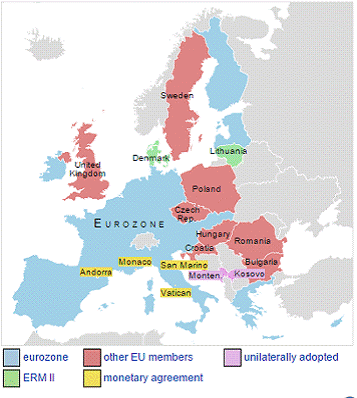
the eurozone, which consists of 18 of the 28 member states of the European
Union: Austria, Belgium, Cyprus, Estonia, Finland, France, Germany, Greece,
Ireland, Italy, Latvia, Luxembourg, Malta, the Netherlands, Portugal, Slovakia,
Slovenia, and Spain. [3] [4] Lithuania is adopting the euro as its official
currency in place of the lithuanianlitas on 1 January 2015. [5] The currency is
also officially used by a further four European countries, and unilaterally by
two others, and is consequently used daily by some 334 million Europeans as of
2013. [6] Outside of Europe, a number of overseas territories of EU members
also use the euro as their currency., 210 million people worldwide as of
2013-including 182 million people in Africa-use currencies pegged to the euro.
The euro is the second largest reserve currency as well as the second most
traded currency in the world after the United States dollar. [7] [8] [9] As of
August 2014, with more than €995 billion in circulation, the euro has the
highest combined value of banknotes and coins in circulation in the world,
having surpassed the U. S. dollar. [note 15] Based on International Monetary
Fund estimates of 2008 GDP and purchasing power parity among the various
currencies, the eurozone is the second largest economy in the world. [10]name
euro was officially adopted on 16 December 1995. [11] The euro was introduced
to world financial markets as an accounting currency on 1 January 1999,
replacing the former European Currency Unit (ECU) at a ratio of 1: 1
(US$1.1743). Physical euro coins and banknotes entered into circulation on 1
January 2002, making it the day-to-day operating currency of its original
members. [12] While the euro dropped subsequently to US$0.8252 within two years
(26 October 2000), it has traded above the U. S. dollar since the end of 2002,
peaking at US$1.6038 on 18 July 2008. [13] Since late 2009, the euro has been
immersed in the European sovereign-debt crisis which has led to the creation of
the European Financial Stability Facility as well as other reforms aimed at
stabilising the currency. In July 2012, the euro fell below US$1.21 for the
first time in two years, following concerns raised over Greek debt and Spain's
troubled banking sector. [14] As of November 2014, the euro-dollar exchange
rate stands at ~ US$1.25. [15]euro is the sole currency of 18 EU member states:
Austria, Belgium, Cyprus, Estonia, Finland, France, Germany, Greece, Ireland,
Italy, Latvia, Luxembourg, Malta, the Netherlands, Portugal, Slovakia,
Slovenia, and Spain. These countries constitute the "eurozone", some
332 million people in total as of 2013. [6]all but two of the remaining EU
members obliged to join, together with future members of the EU, the
enlargement of the eurozone is set to continue. Outside the EU, the euro is
also the sole currency of Montenegro and Kosovo and several European
microstates (Andorra, Monaco, San Marino and the Vatican City) as well as in four
overseas territories of EU members that are not themselves part of the EU
(Saint Barthélemy, Saint Pierre
and Miquelon and Akrotiri and Dhekelia). Together this direct usage of the euro
outside the EU affects nearly 3 million people.is also gaining increasing
international usage as a trading currency, in Cuba, [7] North Korea, and Syria.
[8] There are also various currencies pegged to the euro (see below). In 2009,
Zimbabwe abandoned its local currency and used major currencies instead,
including the euro and the United States dollar. [9]most obvious benefit of
adopting a single currency is to remove the cost of exchanging currency,
theoretically allowing businesses and individuals to consummate previously
unprofitable trades. For consumers, banks in the eurozone must charge the same
for intra-member cross-border transactions as purely domestic transactions for
electronic payments (e. g., credit cards, debit cards and cash machine
withdrawals).absence of distinct currencies also theoretically removes exchange
rate risks, although the imposition of transfer restrictions in 2012-13 Cypriot
financial crisis means that the situation is not quite so simple. The risk of
unanticipated exchange rate movement has always added an additional risk or
uncertainty for companies or individuals that invest or trade outside their own
currency zones.companies that hedge against this risk will no longer need to
shoulder this additional cost. This is particularly important for countries
whose currencies had traditionally fluctuated a great deal, particularly the
Mediterranean nations.markets on the continent are expected to be far more
liquid and flexible than they were in the past. The reduction in cross-border
transaction costs will allow larger banking firms to provide a wider array of
banking services that can compete across and beyond the eurozone. However,
although transaction costs were reduced, some studies have shown that risk
aversion has increased during the last 40 years in the Eurozone.
The most obvious benefit of adopting a single currency is to remove the cost of exchanging currency, theoretically allowing businesses and individuals to consummate previously unprofitable trades. For consumers, banks in the eurozone must charge the same for intra-member cross-border transactions as purely domestic transactions for electronic payments (e. g., credit cards, debit cards and cash machine withdrawals).absence of distinct currencies also theoretically removes exchange rate risks, although the imposition of transfer restrictions in 2012-13 Cypriot financial crisis means that the situation is not quite so simple. The risk of unanticipated exchange rate movement has always added an additional risk or uncertainty for companies or individuals that invest or trade outside their own currency zones.companies that hedge against this risk will no longer need to shoulder this additional cost. This is particularly important for countries whose currencies had traditionally fluctuated a great deal, particularly the Mediterranean nations.markets on the continent are expected to be far more liquid and flexible than they were in the past. The reduction in cross-border transaction costs will allow larger banking firms to provide a wider array of banking services that can compete across and beyond the eurozone. However, although transaction costs were reduced, some studies have shown that risk aversion has increased during the last 40 years in the Eurozone.
· Interest rates not suitable for whole Eurozone. A common monetary policy involves a common interest rate for the whole eurozone area. However, the interest rate set by the ECB may be inappropriate for regions which are growing much faster or much slower than the Eurozone average. For example, in 2011, the ECB increased interest rates because of fears of inflation in Germany. However, in 2011, southern Eurozone members were heading for recession due to austerity packages. The higher interest rates set by the ECB were unsuitable for countries such as Portugal, Greece and Italy.
· The Euro is not an optimal currency area. If a state in the US, such as New York,was in recession, workers in New York could move to New England and get a job. However, in the Eurozone this is much more difficult; it involves moving country and possibly learning a new language. There are more barriers to the movement of labour and capital within a diverse region like Europe. Therefore, an unemployed Greek can't easily relocate to Germany.
· Limits Fiscal Policy. With a common monetary policy it is important to have similar levels of national debt, otherwise countries may struggle to attract enough buyers of national debt. This is a growing problem for many Mediterranean countries like Italy, Greece and Spain who have large national debts and rising bond yields.
· Lack of Incentives. It is argued that being a member of the Euro protects a country from a currency crisis. Therefore, there is less incentive for countries to implement structural reform and fiscal responsibility. For example, in good years Greece was able to benefit from very low bond yields on its debt because people felt Greek debt would be secured by rest of Europe. But, this wasn't the case, and Greece were lulled into a fall sense of security.
· No scope for Devaluation. Since the start of the Euro, several countries have experienced rising labour costs. This has made their exports uncompetitive. Usually, their currency would devalue to restore competitiveness. However, in the Euro, you can't devalue and you are stuck with uncompetitive exports. This has led to record current account deficits, a fall in exports and low growth. This has particularly been a problem for countries like Portugal, Italy and Greece.
·
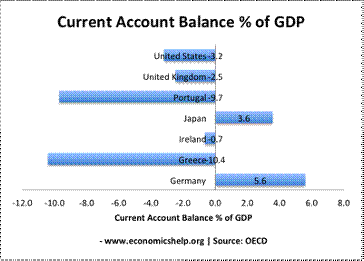
shows the effects of Eurozone members becoming uncompetitive. Very high current account deficits.
· No Lender of
Last Resort. The ECB is unwilling to buy government bonds if there is a
temporary liquidity shortage. This makes markets more nervous about holding
debt from eurozone economies and precipitates fiscal crisis. See: Problems of
Italy - why Italian bonds increased despite having a much lower budget deficit
than UK.
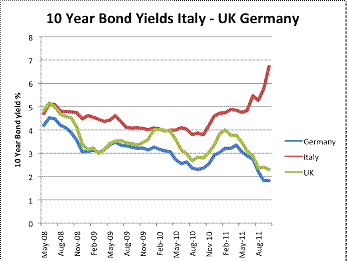
Italy bond yields rose despite a primary budget surplus
· Deflationary Bias I would
argue there is a deflationary bias in the Eurozone which increases the risk of
recession and higher unemployment
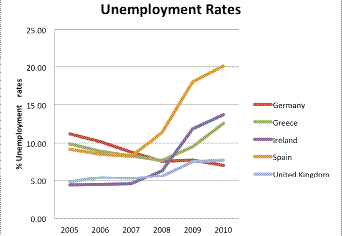
members have seen a rise in unemployment.
· Divergence in bank rates. In theory, the Eurzone creates a common interest rate. However, in the credit crisis of 2010-13, we see rising bank rates for peripheral Eurozone countries, like Italy and Spain. Small and medium sized firms faced higher borrowing costs than in 2005, even though the ECB cut the main base rate. This suggests that the ECB was unable to loosen monetary policy when needed
2.2 Dollar
The United States dollar (sign: $; code: USD; also abbreviated US$ and referred to as the U. S. dollar, American dollar or US Dollar) is the official currency of the United States and its overseas territories. It is a Federal Reserve Note and consists of 100 smaller cent units. [4]U. S. dollar is fiat money. It is the currency most used in international transactions and is the world's most dominant reserve currency. [14] Several countries use it as their official currency, and in many others it is the de facto currency. [15] Besides the United States, it is also used as the sole currency in two British Overseas Territories: the British Virgin Islands and the Turks and Caicos islands.dollar has a special place in the global economy, being essentially the first truly international currency.world monetary system spontaneously formed in the XIX century after the industrial revolution based on gold monometallism in the form of the gold standard. Legally, it was framed intergovernmental agreement at the Paris Conference in 1867 that recognized the gold the only form of world money. In this system belonged dollar in 1837 received the gold content. The currency freely convertible into gold. Gold was used as generally recognized world money. Gradually the gold standard outlived its usefulness, because did not meet the increased scale of economic relations and conditions regulated market economy. The First World War was marked by the crisis of the world monetary system. The gold standard ceased to function as money and monetary system.War II monetary system was legally intergovernmental agreement reached at the Genoa international economic conference in 1922. Its foundation was gold and foreign currencies. Conversion of currencies into gold was carried out not only directly (US, France, Britain), but also indirectly through foreign currency (Germany and another 30 countries whose monetary system based on gold exchange standard). National credit money were used as international payment and reserve funds. However, in the interwar period reserve currency status has not been officially confirmed by either in one currency and the pound sterling and the US dollar disputed leadership in this area. The Great Depression of 1929-1933. sharply devalued dollar, its gold content decreased by more than 40%.War II led to the deepening crisis Genoa monetary system. Anglo-American experts in 1941 rejecting the idea of returning to the gold standard, sought to develop principles of a new world monetary system that can ensure economic growth and limit the negative social and economic consequences of the economic crisis. The desire to secure a dominant position US dollar in the global monetary system is reflected in terms GD White and formed the basis of the so-called Bretton Woods monetary system, which has become a third world monetary system. Was introduced gold exchange standard based on gold and two reserve currencies - the US dollar and to a much lesser extent pound sterling. Gold continued to be used as an international payment and reserve means.on its increased monetary and economic potential and gold reserves, US dollar equated to gold to secure for him the main reserve currency status. For this purpose, the US Treasury has continued to negotiate a dollar for gold to foreign central banks and government agencies in the official price, established in 1934, Based on the gold content of its currency (USD 35.1 troy ounce equal to 31.1035 grams). This exchange applied only to member states of the International Monetary Fund (IMF), represented by their central banks.normal functioning gold standard required the constant increase in reserves to meet the needs of economic expansion and the corresponding payment relations in global economic growth and support optimal ratio between gold and currency (dollar) reserves, so that the price of gold was equilibrium. Failure to meet these conditions naturally had to lead to the collapse of the Bretton Woods monetary system. Lack of reserve money (dollars, pounds sterling, gold) led to inhibition of world trade and excess - to destabilize the system of fixed exchange rates. High growth rates of foreign exchange reserves, compared with growth rates of gold reserves over time component questioned the ability of the US to keep the convertibility of the dollar in reserves by central banks set official price. In the 60's Dollar virtually monopolized the sphere of international payments, which is reflected in the growth of its share in the international reserves of the state from 9% in 1950 to 75% in 1970.