Материал: UPSTREAM
People & Homes
UNIT 1 My Home is my Castle
UNIT 2 While there’s life, there’s hope

Module 1
Units 1-2
Before you start ...
How long have you been studying English? Why are you studying?
Listen, read and talk about
ñ |
dwellings |
ñ |
stages in life |
ñ |
home appliances |
ñ |
life events |
ñ |
household chores |
ñ |
types of families |
ñ |
rooms |
ñ |
facial features |
ñ |
colours |
ñ |
feelings |
ñ |
home safety |
ñ |
working lives |
Learn how to ...
ñmake houses safe for children
ñdescribe a room/a house
ñrequest services
ñexpress sympathy
ñdecide on a house
ñdescribe people
ñexpress feelings
ñexpress your opinion
ñspread the news
ñintroduce people
Practise ...
ñpresent tenses
ñadverbs of frequency
ñprepositions of place
ñlinkers
ñstate verbs
ñpast tenses
ñused to/would
Phrasal verbs
ñbreak
ñbring
ñcarry
ñcome
Write ...
ñan advertisement for a house
ñan informal letter describing a house for rent
ña description of a person
ña narrative
My Home is my Castle
Lead-in
1The title above is taken from an English proverb. What do you think it means?
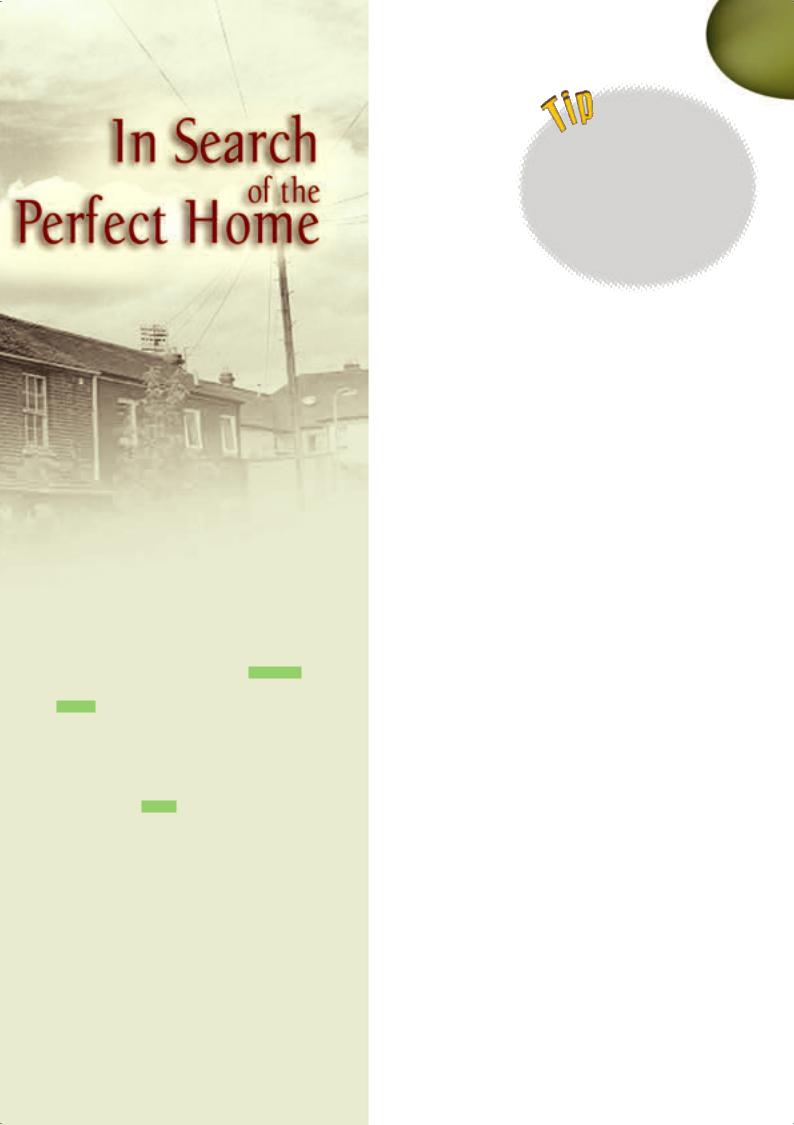
C
A
B
2a. Which of the houses in the pictures:
has: five storeys and a house on top; a fibreglass shark; brick walls; a thatched roof; a chimney; a rock on the roof; wooden stairs up to the front door; stone walls; a pitched roof; a tiled roof?
is: built underground; a castle; built on stilts?
b. Use the adjectives to describe each house. Give reasons.
ñeconomical ñimpractical ñcold |
ñspacious ñ cramped |
ñ airy ñ comfortable ñ attractive |
ñeccentric |
House A is economical to maintain because it doesn’t cost very much to heat and cool.
 c.
c. Listen and match the houses to the countries.
five-storey building |
Suffolk, England |
terraced house |
Zimbabwe |
hut on stilts |
Portugal |
rock house |
Headington, England |
d. Describe the houses A-D. Think about: |
|
ñ type of house ñ location |
ñ special features |
ñ general description |
|
The house in picture A is a hut on stilts. It is located in Zimbabwe.
It has got a thatched roof and wooden stairs up to the front door.
It’s cramped but it’s probably quite airy.
e.Which house would you/wouldn’t you like to live in? Give reasons.
I’dliketoliveinthehutonstiltsbecauseitlooksveryattractivetome.
Iwouldn’tliketoliveintherockhousebecauseitmustgetverycold.
How would you like to live in a castle, a tree house or even underground? This might not be as unusual as you think. It seems that these days more and more people want to live somewhere special and
5out of the ordinary, and if they can’t buy what they
want they are quite prepared to build it from scratch.
For John Mew and his wife Josephine their home really is their castle. They have built their own 10 English castle in the Sussex countryside. The building is brand new with all the luxuries you would expect from a house that cost more than í350,000 to build. However, when you first see it from the outside it would be easy to think that you are looking
15 at an ancient monument. The building has a lot of the features of a traditional castle, including a keep, a moat and a drawbridge. “My choice of house is somewhat eccentric and building it was very hard work, but we’ve got the perfect place to live,” Mew
20says. Although some would say that the building is impractical and may be cold in harsh British winters,
he certainly has got a unique and spacious home.
If you don’t look carefully, you might not even see the home that Jonathan Ridley-Jones and Shanon
25Ridd built at all! That’s because the house is a converted underground water tank. The only thing that can be seen from the surface is a door leading into the hillside. “We’ve never wanted to live in an
ordinary house,” Shanon says. “Living below ground
30means that our home is quiet and very cosy – none of the usual draughts. It doesn’t damage the local surroundings and has very low fuel bills. Some of our friends find it dark and feel shut in when they first visit, but they soon get used to it!”
If an underground home doesn’t appeal to you, 35 how about living in the tree tops? Dan Garner, a tree surgeon from Gloucestershire, certainly thinks that this is the way to go up in the world.
“When our family became short of space at home our solution was to build a luxury tree house in the 40 garden. The tree house is built into a spruce tree six metres above the ground. It has one main room, a bedroom and a balcony running around two sides.” Garner is so happy with this practical extension to his home that he thinks he can convince more 45 people of the benefits of living in the trees. He wants to set up his own enterprise making more of the deluxe tree dwellings, saying, “Tree houses are airy, secure and comfortable and the only disadvantage is that they might not be suitable for people who 50 suffer from hay fever or a fear of heights!”
Even people who live in more ordinary settings sometimes can’t resist doing something to make them stand out from the crowd. One extreme example of this is Bill Heines’ house in Headington, 55 Oxfordshire. Until one morning in 1986, his house looked much like all the others in his street, when suddenly overnight a 7.5 m long fibreglass shark appeared to have crashed through the roof. The shark was a sculpture by local artist John Buckley. 60 At first some people complained that it might be dangerous or that it spoilt the look of the neighbourhood, but engineers checked that the sculpture was safe and the ‘Headington shark’ has become a well-known and popular landmark. It 65 seems that no matter where you live, you can always do something to make sure your house says something about who you are.
1
Reading
3a. Look at the title of the article. What do you think it is about? Where might you read it? Say words you expect to find
Read the text quickly to get a general
idea of what it is about. Look at the first part of the question, then
find the part of the text the question refers to. Go through the choices and choose the answer that best fits. Keep in mind that the information may be rephrased. Even if you think you know the correct answer, always check that the others are not appropriate. Check your answer
against the text.
b.Read the article
and answer the questions.
c.Explain the words in bold, then suggest synonyms for the highlighted words.
1 More and more people build their own home A so that they can live underground.
B so that they can have exactly the home they want. C because it is cheaper than buying a new house.
D because they want all the modern luxuries you find in a new home.
2John and Josephine Mew
A know that their choice of home is unusual.
B found that creating their dream home was easy.
C wanted to live like people would have in traditional castles.
D converted an ancient building into a modern home.
3What do Jonathan Ridley-Jones and Shanon Ridd say about their home?
A It’s just an ordinary house.
B They always wanted to live underground.
C |
It doesn’t harm the environment. |
D |
They don’t pay anything for heating and lighting. |
4Why did Dan build a tree house in his garden? A He wants to persuade people to buy one.
B His family wanted to live in a tree house. C He builds them for a living.
D His family needed more room.
5The ‘Headington shark’
A was created by Bill Heines.
B crashed into the roof of Bill Heines’ house one night. C was immediately popular with everyone in the town. D was built without any warning.
Follow-up
4a. List the advantages and disadvantages of Mew’s, Ridd’s and Garner’s dwellings, then talk about them.
b.What would your ideal house be? Describe it giving reasons.
My ideal house would be a castle. It would be made of ...
7
Vocabulary Practice
Dwellings and Appliances
5a. Go through the table and look up the words you don’t know in your dictionary.
 b.
b. Listen and underline the words that best describe Ann’s house. Circle the ones which best describe John’s house.
|
traditional, modern, apartment/flat, (semi) |
Style: |
detached, terraced house, cottage, villa, |
1/ 2/3 storey building, castle |
|
|
village, city, centrally located, residential |
|
area, close to the shops, in the suburbs, on |
Location: |
the outskirts, isolated, in the country |
|
small, tiny, spacious, large, huge, average, |
Size: |
family-sized, 1-/2- bedroomed |
|
cheap, low-priced, overpriced, expensive, |
Cost: |
economical |
General |
cosy, comfortable, secure, luxurious, well- |
Description: |
maintained, fully furnished, airy, noisy, cold |
c.Use the words to describe Ann’s and John’s houses, then describe your house.
Annlivesinatraditionalcottageinthecountry.Thecottageis...
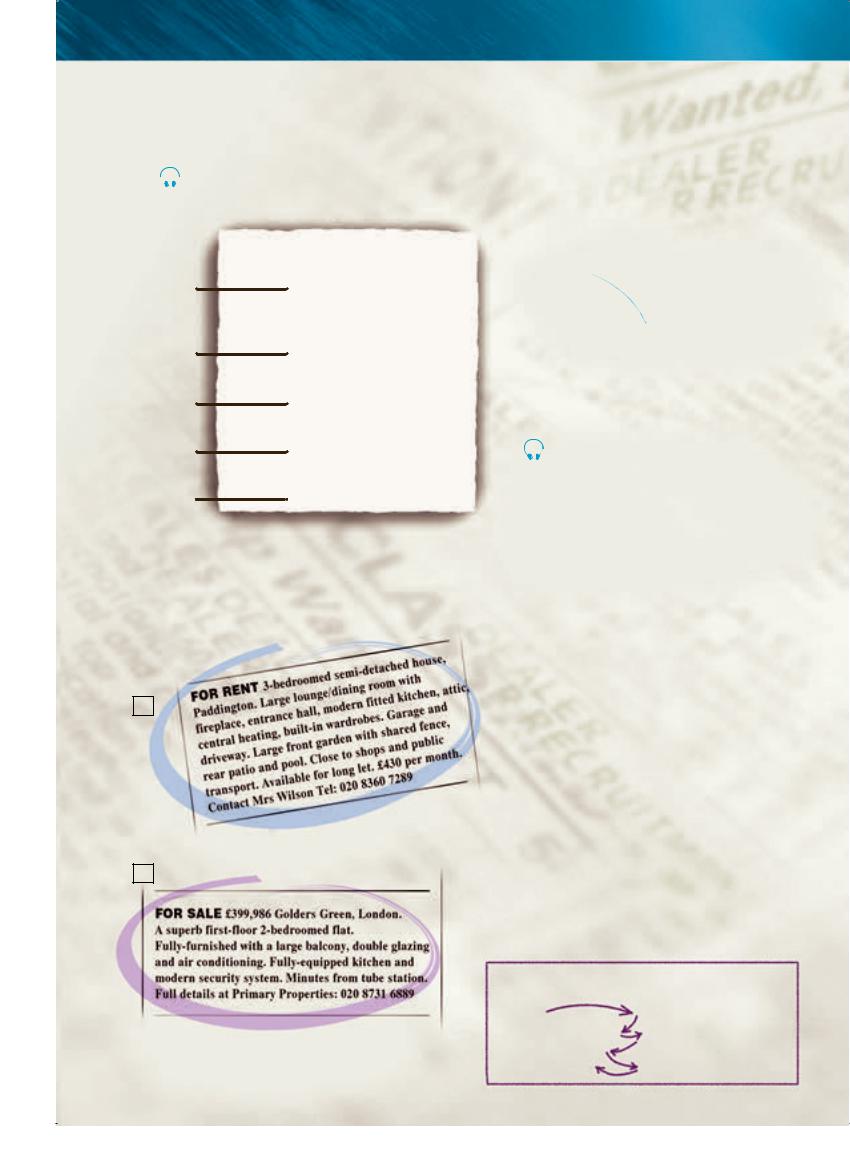
6a. Read the advertisements, then, in pairs, list the special features of each property under the headings:
Inside - Outside
A
∞: Inside: large lounge/dining room ...
Outside: garage, driveway ...
B
7a. Which of these items are in your house? In which room?
ñ refrigerator ñ vacuum cleaner ñ electric heater
ñwashing machine ñ microwave ñ humidifier
ñair conditioner ñ hairdryer ñ dishwasher ñ cooker
refrigerator – kitchen
b.Match the columns. Which of these have you/haven’t you got in your house?
built-in |
system |
central |
hall |
fitted |
glazing |
double |
wardrobes |
entrance |
kitchen |
private |
parking |
security |
heating |
There are built-in wardrobes in our house.
We haven’t got ...
8 |
a. Complete the dialogue, then listen and |
|
check. |
A:Hello!
B:Good morning. I’m calling about the house
advertised for rent in Paddington.
A:Oh yes?
B:I wonder 1) ......................................................
give me a bit more information, please.
A:Of course. 2) ....................................................
like to know?
B:First of all, 3) ....................................................
exactly where the house is situated?
A:Yes, it’s on 15, Bayswater Drive.
B:And the lounge and dining room – are they separate?
A:Yes, but they’re joined by a sliding glass door.
B:And do all the bedrooms have fitted wardrobes?
A:No, only the two largest bedrooms.
B:One last question. Is the garage large enough for two cars?
A: |
Oh, definitely. |
|
B: |
It sounds perfect. 4) |
............................................ |
|
..................................................... |
I could see it? |
A: |
5) ................................. |
6 o’clock this evening? |
B: |
That’s fine — see you then. |
|
b.In pairs, take roles and act out dialogues about each of the advertisements in Ex. 6.
|
OWNER/ESTATE AGENT |
CLIENT |
|
greeting |
greeting - ask for information |
|
agree to give information |
ask your questions (e.g. exact |
b. What features are there inside/outside your house? |
answer the questions |
location - special features) |
8 |
agree on a viewing |
arrange a viewing |
|
|