Материал: Банкова ПРАЦТИЦЕ МАКЕС ПЕРФЕЦТ ПРЕСЕНТ ФОРМС 2015
Unit 6
Present Perfect Continuous
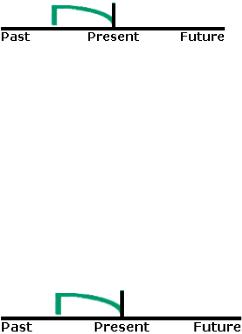
USE 1 – Duration from the Past Until Now
We use the Present Perfect Continuous to show that something started in the past and has continued up until now. «For five minutes», «for two weeks», and «since Tuesday» are all durations which can be used with the Present Perfect Continuous.
Analyze the examples:
•They have been talking for the last hour.
•She has been working at that company for three years.
•What have you been doing for the last 30 minutes?
•Johns has been teaching at the university since June.
•We have been waiting here for over two hours!
USE 2 – Recently, Lately
You can also use the Present Perfect Continuous WITHOUT a duration such as «for two weeks». Without the duration, the tense has a more general meaning of «lately». We often use the words «lately» or «recently» to emphasize this meaning.
Analyze the examples:
•Recently, I have been feeling really tired.
•She has been watching too much television lately.
•Have you been exercising lately?
•Mary has been feeling a little depressed.
•Lisa has not been practicing her English.
•What have you been doing?
56
NB! Remember that the Present Perfect Continuous has the meaning of «lately» or «recently». If you use the Present Perfect Continuous in a question such as «Have you been feeling alright?», it can suggest that the person looks sick or unhealthy. A question such as «Have you been smoking?» can suggest that you smell the smoke on the person. Using this tense in a question suggests you can see, smell, hear or feel the results of the action. It is possible to insult someone by using this tense incorrectly.
It is important to remember that Non-Continuous Verbs cannot be used in any continuous tenses. Also, certain non-continuous meanings for Mixed Verbs cannot be used in continuous tenses. Instead of using Present Perfect Continuous with these verbs, you must use the Present Perfect.
Analyze the examples:
•Sam has been having his car for two years. Not Correct
•Sam has had his car for two years. Correct
ADVERB PLACEMENT
The examples below show the placement for grammar adverbs such as: always, only, never, ever, still, just, etc.
Analyze the examples:
•You have only been waiting here for one hour.
•Have you only been waiting here for one hour?
1.Read and translate the sentences. Comment on the tenses in them.
1. – Can I let you in on a little secret? – Why not? You've been telling me your secrets since you were eight. 2. There's something I've been meaning to ask you. 3. A fine rain has been falling steadily since six o'clock and there is a dark mist on the river. 4. «Are you thinking of selling off one of the hotels?». «I have been toying with the idea», Meredith admitted. 5. She is filling the case with the papers she has been working on all day. 6. Was it gout again? Has it been bothering you lately, Bruce? 7. Blair has been working for days to make this Christmas Day a very special one. 8. Is there someone you've been seeing? 9. For generations, Transamerica has been helping people plan for a comforta-
57
ble career. 10. In my eyes you can see all the love that I've been feeling. 11. Let's talk about that fatigue, the attacks you've been having. When did the first one occur? 12. Her mind is still on her mother who has been seeing psychiatrist for the past few weeks. 13. What's been going on? Why haven't you been answering my letters? 14. Kate has been going to ballet lessons since she was a child.
2.Write a sentence for each situation. Use the Present Perfect Continuous (has/have been doing, etc.) + for or since.
1.John started his phone call twenty minutes ago, and he is still talking.
2.Sam and I arranged to meet at the cinema at 7.00 p.m. I arrived on time but I'm still waiting for Sam to arrive.
3.Harry and Sally are tired. They started walking six hours ago and they're still walking.
4.You started watching TV at 9 o'clock this morning and you're still watching it.
5.I hate this weather! It started raining last week and it's still raining.
6.Laura felt sick at lunchtime today, and she is still feeling sick.
7.Six months ago Jessica and I started building our own house. We're still doing it.
8.Fred got on the Trans-European express train on June 28th. Today is 1st July and he is still travelling.
3.Ask questions using the verb in brackets to find out the reason.
1.You look tired (to run).
2.Your face is flushed (to hurry).
3.This time she is ready for the examination (to read much).
4.He has made great progress (to practice much).
5.He is still asleep (to work all night).
6.Your eyes are red (to cry).
7.She has a wonderful tan (to sunbathe).
8.Your eyes are quite sore (to read much).
9.You look so disheveled (to sleep).
10.Your hands are dirty (to garden).
11.Why is your hair wet? (to swim)
58
4. Complete these sentences so that they are true for you.
I’ve been working for …
I’ve been living in … since
I’ve been studying English for …
I’ve been coming to this University since …
I’ve been playing … for …
I’ve been (doing my hobby) since …
5.Choose the correct alternatives.
1.I haven’t bought your present yet because I’ve worked /been working all morning.
2.How long have you known / been knowing Sally?
3.Have you finished / been finishing the report already?
4.How many matches have you played / been playing this season?
5.I’ve come / been coming to this beach since I was twelve but I’ve never seen / been seeing you here before.
6.Molly hasn’t done her homework. She’s watched / been watching TV all afternoon.
7.I’ve cleaned / been cleaning the bathroom but I haven’t cleaned / been cleaning the kitchen yet.
8.He’s had / been having this computer for three years.
6.Choose the right answer:
1. I ____ these tenses for three weeks now. Do you think I have made
any progress? |
|
a) have practiced |
b) have been practicing |
2. She _____ about me, hasn't she? I can just feel it. |
|
a) has gossiped |
b) has been gossiping |
3. Helen ______ me you are seriously ill. Why didn't you tell me yourself?
a) has told b) has been telling
4. Our company ______ its turnover over the past six months. a) has doubled b) has been doubling
59
5. ____ Your breath smells awful. |
|
a) Have you smoked? |
b) Have you been smoking? |
6.I _____ at this menu for ages now and I still _____ yet.
a)have stared / haven't been deciding
b)have stared / haven't decided
c)have been staring / haven't decided
7.Pope John Paul II _____ more than 90 countries.
a) has visited b) has been visiting
8. I _____ her to be extra careful when opening the car door. I'm not really surprised to hear that she knocked down a pedestrian.
a) have often told |
b) have often been telling |
9. With this last sentence you ______ the exercise. |
|
a) have finished |
b) have been finishing |
7.Complete the sentences using the Present Perfect or the Present Perfect Continuous.
1.Jane (write) _____ a letter to a magazine. She (not finish) ____ it yet.
2.Ben (look) _____ for his penknife, but he (not find) ____ it yet.
3.Jenny (wait) _____ for the bus for half an hour, but it (not arrive) _____ yet. 4. Nick (play) _____ a computer game for two hours and he is still playing. 5. Mike (not finished) ____ painting his car yet. He (work) _____ on it for two weeks. 6. Amanda (not come) _____
home yet. She (shop) _____ in town since 10 o'clock. 7. Mike's car (make) ______ strange noises. Nick and Jane (clean) _____ all the parts.
8.Ben (draw) _____ cartoons for two hours. He (not finish) ____ yet.
9.Greg (wait) _____ for Jenny in town. Jenny (not arrive) ____ yet.
10.Jane (knit) ______ a pullover. She (not finish) _____ it yet. 11. It
(rain) _____ all day and it (not stop) ____ yet. 12. Mr Blake (make) _____ tests all evening but he (not find) _____ a perfect one yet.
60