Материал: Практикум по переводу профессионально-ориентированных текстов. Кочнева М.Г., Ерофеева Л.А
Construction Managers: Nature of the Work

Construction managers plan, direct, coordinate, and budget a wide variety of construction projects, including the building of all types of residential, commercial, and industrial structures, roads, bridges, wastewater treatment plants, and schools and hospitals. Construction managers may supervise an entire project or just part of one. They schedule and coordinate all design and construction processes, including the selection, hiring, and oversight of specialty trade contractors, such as carpentry, plumbing, or electrical, but they usually do not do any actual construction of the structure.
Construction managers are salaried or self-employed managers who oversee construction supervisors and personnel. They are often called project managers, constructors, construction superintendents, project engineers, construction supervisors, or general contractors. Construction managers may be owners or salaried employees of a construction management or contracting firm, or they may work under contract or as a salaried employee of the property owner, developer, or contracting firm managing the construction project.
These managers coordinate and supervise the construction process from the conceptual development stage through final construction, making sure that the project gets completed on time and within budget. They often work with owners, engineers, architects, and others who are involved in the process. Given the designs for buildings, roads, bridges, or other projects, construction managers supervise the planning, scheduling, and implementation of those designs.
Large construction projects, such as an office building or an industrial complex, are often too complicated for one person to manage. Accordingly, these projects are divided into various segments: site preparation, including clearing and excavation of the land, installing sewage systems, and landscaping and road construction; building construction, including laying foundations and erecting the structural framework, floors, walls, and roofs; and building systems, including protecting against fire and installing electrical, plumbing, air-conditioning, and heating systems. Construction managers may be in charge of one or several of these activities.
Construction managers determine the best way to get materials to the building site and the most cost-effective plan and schedule for completing the project. They divide all required construction site activities into logical steps, estimating and budgeting the time required to meet established deadlines. Doing this may require sophisticated scheduling and cost-estimating techniques using computers with specialized software.
Construction managers also manage the selection of general contractors and trade contractors to complete specific phases of the project—which could include everything from structural metalworking and plumbing, to painting, to installing electricity and carpeting. Construction managers determine the labour requirements of the project and, in some cases, supervise or monitor the hiring and dismissal of workers. They oversee the performance of all trade contractors and are responsible for ensuring that all work is completed on schedule.
Construction managers direct and monitor the progress of construction activities, occasionally through construction supervisors or other construction managers. They are responsible for obtaining all necessary permits and licenses and, depending upon the contractual arrangements, for directing or monitoring compliance with building and safety codes, other regulations, and requirements set by the project's insurers. They also oversee the delivery and use of materials, tools, and equipment; worker safety and productivity; and the quality of the construction.
http://www.bls.gov/oco/ocos005.htm
The Functions of an Executive
Each company has its business structure. An organization has a number of positions and some people have more authority than others.
Top Management of a corporation consists of the board of directors and the executive officers. The board of directors determines the basic company policies and appoints the executive officers. These officers include a chairman of the board, a president and a number of vice presidents. They are responsible for carrying out the decisions of the board of directors and the stockholders. The executive officers select the managers (or the heads) of the various departments of the corporation. The Managing Director (sometimes called the Chief Executive or the President in Russia and the USA) is the head of the company.
The number of departments in a corporation depends on the size of the company and on the nature of the goods and services that it provides. A corporation with many employees may need a personnel department. A manufacturing firm may need a research department to study ways of developing new products. Most corporations have departments that handle three basic business activities - production, finance and marketing.
The Production department consists of several divisions: Production, Packaging, Distribution, Quality and Maintenance.
The Marketing department plans how to sell new products and may include Advertising division.
The Finance department connects with customer accounts, wages and salaries, financial services, taxation, investment and cash management.
W hat
Are the Duties of a Public Relations Officer?
hat
Are the Duties of a Public Relations Officer?
Public relations officers are responsible for how companies are represented in the media. Public relations officers are primarily spokespeople for the organization to the media. They are also responsible for writing and creating press kits, organizing press tours, and monitoring the media and Internet forums to learn what is communicated about the organization. Public relations officers are also responsible for creating a media strategy and ensuring that it is followed. They are responsible for both internal and external public relations – communication within the organization and to the public.
Spokesperson
A public relations officer handles media requests, answering questions that are posed by the media, including reporters who represent radio, television, Internet publications, newspapers, and magazines. Members of the media contact public relations officers to verify information or get comments for news stories about a company or an organization. The public relations officer should be the primary contact for the media. Public Relations Officers may work for nonprofit organizations or businesses.
Write
Public relations officers write press releases, newsletters, or other internal and external communication. Internal publications include newsletters, memos, and email notices for the company's staff. External communications are press releases submitted to reporters and publications that are meant for the public to read or see. The public relations officer publicizes positive news and events related to the company. He serves as the lead writer, writing the press releases and distributing them to the media.
Monitor News
Public relations officers monitor the news media for news that is related to the organization to find out how the organization is portrayed by the media. The officer should understand customer and client needs and how the media -- in print, on television, on the radio, and online -- present these needs.
Develop a Public Relations Strategy
Public relations officers must develop a plan to brand the company in the media. They must develop contacts in the media and use the company's mission statement as a guide for marketing. The plan helps the organization establish or maintain recognition in the public eye.
Organize Media Events
The public relations officer may organize press trips, press conferences, or in-house tours for the media. To do this she may contact stakeholders and venues, and make arrangements to show and present information to the media that is representative of the company's message.
http://www.ehow.com
social structure
History of the concept of social structure
The concept of social structure has a long history in the social sciences, going back for example to the functionalism of figures such as Herbert Spencer, the class structure analysis of Karl Marx, or the work of 19th century German sociologist Georg Simmel on social structure as abstract patterns underlying human interaction.
The notion of social structure has been extensively developed in the twentieth century, with key contributions from structuralist perspectives drawing on the structuralism of Levi-Strauss, Feminist or Marxist perspectives, from functionalist perspectives such as those developed by Talcott Parsons and his followers, or from a variety of analytic perspectives (see Blau 1975, Lopez and Scott 2000).
The notion of social structure is intimately related to a variety of central topics in social science, including the relation of structure and agency.
Definitions and concepts of social structure
As noted above, social structure has been identified as
(i) the relationship of definite entities or groups to each other,
(ii) as enduring patterns of behaviour by participants in a social system in relation to each other, and
(iii) as institutionalised norms or cognitive frameworks that structure the actions of actors in the social system.
Lopez and Scott (2000) distinguish between institutional structure and relational structure, where in the former:
. . . social structure is seen as comprising those cultural or normative patterns that define the expectations of agents hold about each other's behaviour and that organize their enduring relations with each other.
whereas in the latter:
. . . social structure is seen as comprising the relationships themselves, understood as patterns of causal interconnection and interdependence among agents and their actions, as well as the positions that they occupy.
Social structure can also be divided into microstructure and macrostructure. Microstructure is the pattern of relations between most basic elements of social life, that cannot be further divided and have no social structure of their own (for example, pattern of relations between individuals in a group composed of individuals – where individuals have no social structure, or a structure of organizations as a pattern of relations between social positions or social roles, where those positions and roles have no structure by themselves). Macrostructure is thus a kind of 'second level' structure, a pattern of relations between objects that have their own structure (for example, a political social structure between political parties, as political parties have their own social structure). Some special types of social structures that modern sociologist differentiate are relation structures (in family or larger family-like clan structures), communication structures (how information is passed in organizations) and sociometric structures (structures of sympathy, antipathy and indifference in organisations – this was studied by Jacob L. Moreno).
Sociologists also distinguish between:
normative structure — pattern of relations in given structure (organisation) between norms and modes of operations of people of varying social positions
ideal structure — pattern of relations between beliefs and views of people of varying social positions
interest structure — pattern of relations between goals and desires of people of varying social positions
interaction structure — forms of communications of people of varying social positions
Origins and evolution of social structure
Some believe that social structure is naturally developed. It may be caused by larger system needs, such as the need for labour, management, professional and military classes, or by conflicts between groups, such as competition among political parties or among elites and masses. Others believe that this structuring is not a result of natural processes, but is socially constructed. It may be created by the power of elites who seek to retain their power, or by economic systems that place emphasis upon competition or cooperation.
The most thorough account of the evolution of social structure is perhaps provided by structure and agency accounts that allow for a sophisticated analysis of the co-evolution of social structure and human agency, where socialised agents with a degree of autonomy take action in social systems where their action is on the one hand mediated by existing institutional structure and expectations but may, on the other hand, influence or transform that institutional structure.
The notion of social structure may mask systematic biases
Some argue that men and women who have otherwise equal qualifications receive different treatment in the workplace because of their gender. Others note that individuals are sometimes viewed as having different essential qualities based on their race and ethnicity, regardless of their individual qualities. When examined, these social distinctions are often considered stereotypes based on prejudice. However, these social distinctions often go unexamined because they appear to be the result of social structures rather than prejudice.
http://english.turkcebilgi.com/Social+system
Solar Air Heating Systems
M atrixAir™
Transpired Solar Air Collector
atrixAir™
Transpired Solar Air Collector
Designed for new construction or retrofits this patent-pending, unglazed transpired solar air heating collector resembles conventional exterior metal siding. Recommended for solar air heating systems with total fresh air flow needs of at least 3000 CFM, MatrixAir™ TR (Transpired) Solar Air Heating collectors come in a wide variety of cladding styles and colours and are practically unlimited in their size or output. MatrixAir™ “TR” series transpired solar air collectors require the use of an air outlet below the mid point of the collector.

MatrixAir™ Backpass Solar Air Collector
Ideally suited for new construction with collector heights ranging from 12 – 24 ft, this backpass solar air collector performs to within 99% of the performance of our transpired solar air heating collector thanks to our unique, modular, patent-pending design. The MatrixAir™ BP (Backpass) Solar Air Heating is characterized by its horizontal plenum located along the top of the collector or roof mounted behind the vertical cladding to facilitate integration with ceiling or roof mounted HVAC and a wide range of CFM requirements. Note: Backpass (BP) solar air heating systems are well suited to upper wall-mounted fresh air inlets prescribed by ASHRAE 62.1
M atrixAir™
Delta Roof Mounted Modular Solar Air Collector
atrixAir™
Delta Roof Mounted Modular Solar Air Collector
Our roof mounted modular solar air heating collector is the ideal solution for those circumstances where no wall area is suitable for a façade mounted collector due to obstructions, glazing, bylaws or wall orientation. Incorporating a flat, transpired absorber and built-in air plenum this solar air heating modular system optimizes the solar heated air flow through each solar collector for maximum output. The individual MatrixAir™ Delta Solar Air Heating 250 CFM modules may be connected in a combination of series and parallel configurations to address a wide variety of roof layouts or CFM requirements.
http://www.matrixenergy.ca/solar-air-heating/products.html
Cast Stone Elements - Group 1
M eltonStone™
Cast Stone Banding & Watertables
eltonStone™
Cast Stone Banding & Watertables
Enhance the beauty of your masonry facade by incorporating MeltonStone Cast Stone Banding into your design. MeltonStone Cast Stone Banding can add distinction and elegance to your buildings’ design by introducing contrast between the colour and texture of your brick, stone or other masonry. The utilization of horizontal or vertical rows of MeltonStone Banding throughout the brick veneer allows the design professional to define wall sections and spaces, and add depth, colour and distinction to the design. By combining economical MeltonStone flush and profiled banding, water table, medallions and other MeltonStone Architectural Elements, the design professional can add their own unique design imprint to their building design at amazingly affordable prices. You can select from any of our standard MeltonStone Banding profiles, or have an economically priced custom detail made from your drawings.
M eltonStone™
Custom Cast Stone Elements
eltonStone™
Custom Cast Stone Elements
Let your imagination run free. Medallions, signage, fountains, fireplaces or pilaster capitals and essentially anything you can imagine can be cast in durable MeltonStone Cast Stone. If you have seen it anywhere in architecture, we can create it for you in durable and beautiful MeltonStone Cast Stone.
M eltonStone™
Cast Stone Entry Systems
eltonStone™
Cast Stone Entry Systems
Let your entry system make a dramatic statement about the quality of your building project with MeltonStone Cast Stone Entry Features. Built with quality for lasting beauty, MeltonStone Cast Stone entry features are offered in your selection of stone colours to enhance the beauty of your building project. From a simple arch with keystone to a complete façade with MeltonStone cast stone architectural columns, Melton Classics cast stone entry features enhance the beauty and value of your building.
M eltonStone™
Cast Stone Pavers
eltonStone™
Cast Stone Pavers
MeltonStone™ cast stone paving stones add beauty and elegance to plazas, walkways, patios, porches, pool decks and walkways. Available in a wide range of sizes, colors and shapes, our cast stone paving stones can be incorporated into a wide array of patterns to create dramatic architectural designs for your project. MeltonStone paving stones can be arranged in multicoloured mosaics with bands and arches for a dramatic geometric look to add interest and flair to any courtyard. The only limit to what you can create with MeltonStone™ paving stones is your imagination.
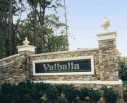 MeltonStone™
Cast Stone Pier Caps & Finials
MeltonStone™
Cast Stone Pier Caps & Finials
Melton Classics offers pier caps and finials to crown the tops of piers to enhance any design. Whether your design calls for an enhancement to an estate entry gate, an addition to an elegant balustrade pier, or a beautiful top for the piers on a masonry wall, Melton Classics can fulfil any pier cap or finial need. Whether your design calls for an urn or planter or a classic ball or simple peaked pier cap, Melton Classics has a pier cap and finial for your design needs. We also can economically create a custom pier cap or finial to your unique specifications.