Материал: 2048

6. Sometimes quantities to be measured have complex waveforms (, and whenever a quantity is non-sinusoidal, errors in instrument readings can occur if the instrument has been calibrated for sine waves only.
7. Such waveform errors can be largely eliminated by using electronic in-
struments. |
|
|
|
|
|
|
||
С |
|
|
|
|
||||
8. |
Instruments are manufactured that combine a movingcoil meter with a |
|||||||
number of shunts and series multipliers, to provide a range of readings on a |
||||||||
single scale graduated to read current and voltage. |
|
|
||||||
9. |
If a battery is incorporated then resistance can also be measured. |
|||||||
и |
|
|
|
|
||||
10. Such instruments are called multimeters or universal instruments or |
||||||||
multirange instruments. |
|
|
|
|
||||
9. |
Прочт те текст еще раз ответьте на вопросы. |
|
|
|||||
1. |
|
бА |
|
|
||||
What must one determine for the measurement of a mass? |
||||||||
2. |
What is used for measuring temperature? |
|
|
|||||
3. |
What indicating instruments are most convenient for every-day meas- |
|||||||
urement? |
|
|
|
|
|
|
||
4. |
What effect is employed for the production of such instruments? |
|||||||
5. |
What single principle is known to underlie all electromagnetic instru- |
|||||||
ments? |
|
|
|
|
|
|
||
6. |
How does the magnetic needle turn in the moving needle instrumens? |
|||||||
7. |
How does it turn in the moving coil instruments? |
|
|
|||||
8. |
|
|
|
Д |
||||
How does the iron move in the soft iron instruments? |
|
|
||||||
10. Прочтите текст и, основываясь на его содержании, заполните |
||||||||
таблицу. |
|
|
|
|
|
|
||
|
|
|
|
construction |
|
operation |
usage |
|
|
|
|
|
|
|
И |
|
|
|
|
|
|
|
|
principle |
|
|
AMMETERS AND VOLTMETERS
The action of almost all the types of measuring instruments is such that an electric current as distinct from an electric potential, is primarily responsible for the ultimate mechanical force required to produce movements of the instrument pointer. This has an exceedingly important influence on the practical forms of ammeters and voltmeters. By this is meant, that all, except the electrostatic type of instrument, are fundamentally currentmeasuring devices. They are fundamentally ammeters. Consequently, most
71
voltmeters are merely ammeters so designed as to measure small values of current directly proportional to the voltages to be measured. It is only natural, therefore, that voltmeters and ammeters should be classified together.
Ammeters, which are connected in series in the circuit carrying the current to be measured, are of low electrical resistance, this being essential Сin order that they cause only a small drop of voltage in the circuit being
tested, and accordingly absorb a minimum power from it.
Voltmeters are connected across, that is, in parallel with, the circuit points where the voltage is to be measured, and are of high resistance, in this case sufficiently high so that the current flowing in the voltmeter,
и in the delicatenessбАof their construction and the restrained motion of the ro-
and the power absorbed from the circuit, are small as possible.
The principle upon which both of these devices operate is essentially the same as that of the electric motor, differing from the motor, however,
tating armature.
A coil of fine copper wire is so mounted between the two poles of a permanent magnet that its rotation is restrained by a hair spring. The farther the coil is turned from its equilibrium or zero position, the greater is the restoring force. To this coil is fastened a long pointer at the end of which is a fixed scale reading amperes if it is an ammeter or volts if it is a voltmeter. Upon increasing the current through the moving coil of an ammeter or voltmeter the resultant magnetic field between coil and magnet
in series and the voltmeter in parallel.ДThe ammeter is so connected that all the electric current passes through it. To prevent a change in the electric current when making such an insertion, all ammeters must havea low resistance. Hence, most ammeters have a low resistance wire, called a shunt, connected across the armature coil.
is distorted more and more. The resulting increase in force therefore turns the coil through a greater and greater angle, reaching a point where it is just balanced by the restoring force of hairspring.
Whenever an ammeter or voltmeter is connected to a circuit to meas-
ure electric current or potential difference, the ammeter must be connected И
A voltmeter, on the other hand, is connected across that part of the circuit for which a measurement of the potential difference is required. In order that the connection of a voltmeter to a circuit does not change the electric current in the circuit, the voltmeter must have a high resistanse. If the armature ciol does not have a large resistance on its own, additional resistance is added in series.
72
Very delicate ammeters are often used for measuring very small currents too. A meter whose scale is calibrated to read thousandths of an ampere is called milliammeter, one whose scale is calibrated in millionths of an ampere being known as microammeter or galvanometer.
С |
|
11. Прочитайте и выучите. |
|
Distinct – отличный, непохожий; |
|
exceedingly – чрезвычайно, очень; |
|
ammeter – амперметр; |
|
напряжения |
|
consequently – следовательно; |
|
therefore – следовательно, зато; |
|
drop of voltage – спад |
; |
sufficiently – достаточно; |
|
12.ПереработайтебАтекст, заменив формы времени Present на фор-
мы времени Past.
13.Переведите предложения наДанглийский язык.
1.Амперметры, в отличие от вольтметров, соединяются последовательно. 2. В измерительных приборах именно электрический ток обусловливает, в первую очередь, возникновение механической си-
лы. Последняя, в свою очередь, вызывает движение стрелки прибора. 3. Большинство вольтметров – это по сутиИамперметры, предназначенные для измерения малых токов, прямо пропорциональных измеряемым напряжениям. Этим объясняется то, что они обычно находятся в одном классе измерительных устройств.
14.Составьте план текстов “Electrical measuring instruments” и “Ammeters and voltmeters”. Пользуясь ответами на вопросы упражнения 9 и данными таблицы упражнения 10, подготовьте рассказ об электроизмерительных приборах.
73
ТЕКСТЫ ДЛЯ ДОПОЛНИТЕЛЬНОГО ЧТЕНИЯ, ПЕРЕВОДА И РЕФЕРИРОВАНИЯ
ADJUSTABLE SPEED DRIVE SYSTEMS
СMany applications have unique demands and characteristics. Drive vendors have responded to this demand by producing a variety of
Commercial and industrial firms today use adjustable-speed drive (ASD) systems for a variety of applications. Most common of these include standard pumps, fans, and blowers. Newer applications include hoists and cranes, conveyors, machine tools, film lines, extruders, and tex-
иNew generation ASDs have evolved with advancements in solidstate electronics. ASDs can now be applied to ac motors regardless of motor horsepower or location within a facility and can be used to drive almost all types of motorized equipment, from a small fan to the largest extruder or machine tool. Commercial and industrial facilities can expect to dramatically reduce both energy consumption and operating and maintenance costs while offering improved operating conditions by using new genera-
tile-fiber spinning machines.
drives. The combination of the many types of drives available and the abundance of applications has made the selection of the optimum drive for a given application a challenge.
tion electronicбАASDs. The latest generation of ASDs allows ac induction motors to be just as controllable and efficient as their dc counterparts were. Historically a variety of terms have been used to describe a system that permits a mechanical load to be driven at user-selected speeds. These terms
include, but are not limited to: |
И |
Variable-Spee Drive Variable-Frequency Drive Adjustable- |
|
Frequency Drive Adjustable-SpeedДDrive |
|
The term variable implies a change that may or may not be under the |
|
control of the user. Adjustable is the preferred term since this refers to a |
|
change directly under control of the user. The term frequency can only be |
|
applied to drives with an ac output, while the term speed is preferred since this includes both ac and dc drives. Thus, the term most commonly accepted is Adjustable-Speed Drive (ASD).
BASIC ASD COMPONENTS
Most ASD units consist of three basic parts. A rectifier that converts the fixed frequency ac input voltage to dc. An inverter that switches the
74
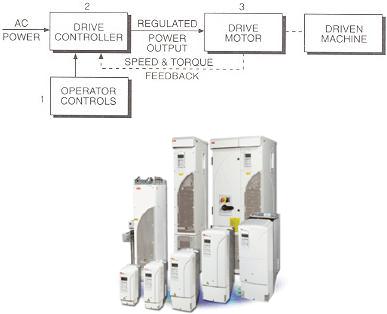
rectified dc voltage to an adjustable frequency ac output voltage. (The inverter may also control output current flow, if desired.) The dc link connects the rectifier to the inverter. A set of controls directs the rectifier and inverter to produce the desired ac frequency and voltage to meet the needs of the ASD system at any moment in time.
СThe advantages of ASDs do not stop with saving energy and improving control. ASD technology can now be applied to manufacturing equipment previously considered too expensive or uneconomical. Such applications are often unique to a particular industry and its equipment, or even to aиparticular facility. Cost benefits, such as those obtained from improved quality, may be desirable for each application.
бА
РисД. 15
TRANSFORMERSИ
It is undoubtedly true that the principle of transformer action and the practical application of this principle in connection with the construction of transformers and induction-type motors are responsible for the widespread use of alternating current as a primary source of electrical energy. The transformer is a simple, efficient, and comparatively inexpensive device used primarily in a-c circuits for the purpose of changing the voltage from one value to another. There are no moving parts in the transformer, which means that mechanical losses, always present and responsible for much of the heating of rotating and reciprocating machines, are entirely absent. Actually, a transformer is a device that transfers electrical energy from one electric circuit to anoth-
75