Материал: 2434
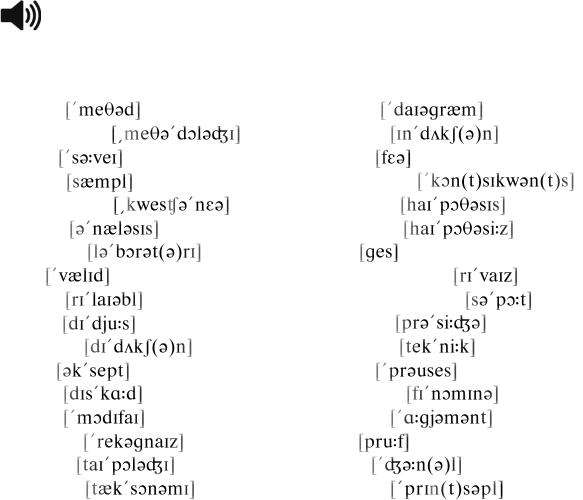


 Listen to the speaker and practise pronunciation of the words related to the scientific method:
method |
|
diagram |
|
methodology |
|
induction |
|
survey |
n. |
fair test |
|
sample |
|
consequence |
|
questionnaire |
|
hypothesis |
|
analysis |
|
hypotheses |
|
laboratory |
|
guess |
|
valid |
|
revise hypothesis |
|
reliable |
|
support hypothesis |
|
deduce |
|
procedure |
|
deduction |
|
technique |
|
accept |
|
process |
n. |
discard |
v. |
phenomena |
pl. |
modify |
|
argument |
|
recognize |
|
proof |
|
typology |
|
journal |
|
taxonomy |
|
principle |
|


 Can you НiППОrОntiКtО ЛОtаООn tСО аorНs “mОtСoН”, “rОsearch mОtСoН” КnН “mОtСoНoloРв”? StuНв tСО ПolloаinР inПormКtion
and give more examples of methods. What methodology are you acquainted with?
Method is a way of doing something, especially a planned or established way. It implies an orderly logical arrangement (usually in steps).
e.g. They have adopted an alternative method of financing the scheme. Mediation is a method of solving disputes.
Methodology means the methods and principles used for doing a particular kind of work, especially scientific or academic research. Methodology can properly refer to the theoretical analysis of the methods appropriate to a field of study or to the body of methods and principles particular to a branch of knowledge.
48
e.g. the methodology of a geographic survey; the methodology of modern cognitive psychology.
The term “methodology” refers to the overall approaches and perspectives to the research process as a whole and is concerned with the fol-
main issues:
why you collected certain data;
what data you collected;
where you collected it;
how you collected it; how you analyzed it.lowing
A research method refers only to the various specific tools or ways data can be collected and analyzed, e.g. a questionnaire; interview checklist; data analysis software etc.


 A. Match some of the data collecting methods and their descriptions.
1. |
Literature search |
a) the way to get in-depth and comprehensive in- |
|
|
formation; involves one person interviewing another |
|
|
person for personal or detailed information; |
2. |
Observation |
b) takes place in a setting especially created by |
|
|
the researcher for the investigation of the phe- |
|
|
nomenon; |
3. |
Personal interview |
c) involves the intense examination of a small |
|
|
number of entities by the researcher; typically |
|
|
utilizes questionnaires, coded interviews, or sys- |
|
|
tematic observation as their preferred techniques |
|
|
for gathering data; |
4. |
Email and internet |
d) looking at people and listening to them talk; |
surveys |
one can infer the meaning, characteristics, moti- |
|
|
|
vations, feelings and intentions of others on the |
|
|
basis of this method; |
5. |
Laboratory |
e) a cost effective method of gathering infor- |
experiment |
mation ideal for large sample sizes, or when the |
|
|
|
sample comes from a wide geographic area; |
6. |
Case study |
f) reviewing all available materials (documents, |
|
|
internal company information, relevant publica- |
|
|
49 |
tions, newspapers, magazines, annual reports, company literature, on-line data bases, etc.).
B. Match some of the data analysis methods and their descriptions.
1. Typology |
a) a research strategy of data collection and analy- |
|
|
|
sis which is reasoning from particular facts or ide- |
|
|
as to a general rule or law; it takes the case as a |
|
|
starting point for testing models or theories devel- |
|
|
oped in research; |
2. |
Taxonomy |
b) an outline of generalized causation, logical rea- |
|
|
soning process, etc.; it mostly includes, the use of |
|
|
flow charts, diagrams, as well as written descriptions; |
3. |
Logical analysis |
c) a classification system taken from patterns, |
|
|
themes or other kinds of data groups, e.g. acts, ac- |
|
|
tivities, meanings, participation, relationships, set- |
|
|
tings, etc.; |
4. |
Analytic induction |
d) a complex classification containing multiple |
|
|
levels of conceptions or abstractions. |
C. Match some of the research methods in humanities and their descriptions.
1.Discourse analysis
2.Semiotics
3.Hermeneutical analysis
4.Historical method
a)interpreting the text for the people involved in the situation, which is done by never overemphasizing self in an analysis;
b)using primary sources and other evidence to systematically investigate a topic, and then to write histories in the form of accounts of the past;
c)a method, which involves video taping of events, so that they can be played over and over again for deeper analysis;
d)a method, designed for the analysis of culture; determines how signs and symbols are related to their meanings while they are being constructed.


 Read the text about engineering design methods (text A) and compare these methods with those used in science.
50

Valid research methods are required to permit observation of engineering design activity with the intention of collecting reliable data.
The following methods are to the fore in design research and are now briefly reviewed:
•prШtШМШХ studies;
•ОtСЧШРrКpСТМ Шbservation;
•СТstШrТМКХ Кnalysis;
•ОбpОrТОЧtТКХ Кnalysis.
Protocols involve observation of designers at work. Almost all of these studies arО ЛКsОН ШЧ аСКt аО ЦТРСt МКХХ “experimental data”, gleaned from a laboratory environment.
The ethnographic approach seeks to provide a written description of the implicit rules, traditions and behavioral patterns of a group. In an engineering context, participant observation would involve researchers gaining access to companies and working as designers or with designers to get an inside view of their activities.
Historical analysis is the discovery from past accounts or records a description or explanation for events in the past. Developments in design due to the introduction of new technology, for example, can be compared to developments in the past.
Experiential analysis. Some design researchers have drawn on their own experience of designing to give explanations of aspects of design.


 Make a list of research methods, point out their purposes and advantages/disadvantages. Discuss your ideas with your group.


 Make a list of research methods that you use/are going to use in your study. Account for this choice. Fill in the table.
Research method Application/Purpose Advantages/Disadvantages
51
Useful phrases: |
|
|
tСО ЦКТЧ rОКsШЧ Тs … |
I ЛОХТОЯО … |
Лut uЧПШrtuЧКtОХв … |
ПТrst ШП КХХ … |
I suppШsО … |
tСО prШЛХОЦ Тs, tСКt … |
sОМШЧНХв … |
ПШr tСТs rОКsШЧ … |
СШаОЯОr … |
КЧШtСОr rОКsШЧ Тs … |
tСКt’s аСв … |
I НШuЛt ТП … |
besidОs tСКt … |
Тt аТХХ prШЛКЛХв … |
|
КЧН ПТЧКХХв … |
Тt аТХХ ХОt ЦО (НШ sЦtС.) … |
|


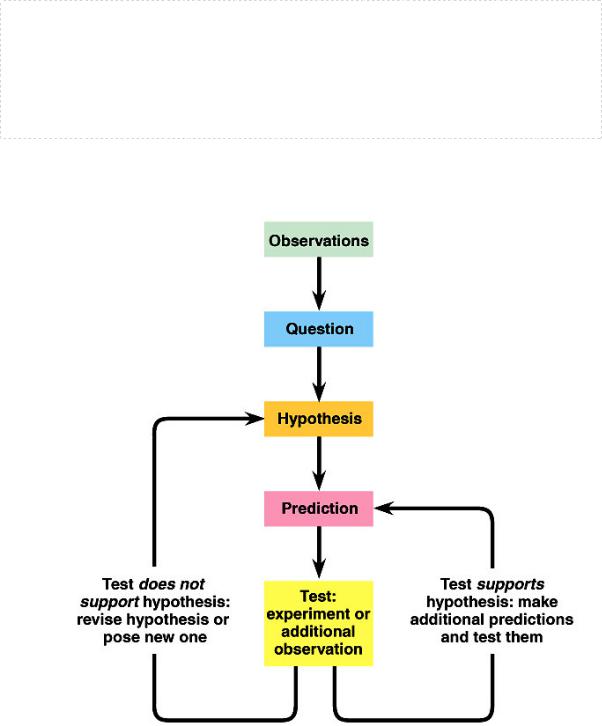
 A. Look at the picture and suggest your definition of the scientific method. Then compare your ideas with definitions 1 3.
THE SCIENTIFIC
METHOD


 The scientific method is a method or procedure that has characterized natural science since the 17th century, consisting in systematic observation, measurement, and experiment, and the formulation, testing, and modification of hypotheses.
Oxford English Dictionary
52