Материал: 2434

Useful phrases:
ОППОМts ШП … ШЧ …; ОППОМts ШП tОЦpОrКturО ШЧ …; ТЧПХuОЧМО ШП … ШЧ …; ТЦpКМt ШП … ШЧ …; ОМШХШРТМКХ КspОМts; psвМСШХШРТМКХ КspОМts ШП …; ОМo-
nomical factors; local peculiarities of …; МШЧНТtТШЧs ТЧ/ШП …
A. Guess what job is compared with the work of scientists.
In some ways, scientists are like …, piecing together clues to learn about how things work in the natural world. Scientists gather information in a certain way. They ask questions, make observations and predictions, test ideas, change variables, analyze data, and share results.
B. Work in pairs. Put the following expressions in the correct order and tell each other what scientists do.
change variables |
|
|
make observations |
|
|
|
ask questions |
|||||
|
|
|
|
|
|
|
|
|
|
|
|
|
|
|
|
|
|
|
|
|
|
|
|
|
|
analyze data |
|
|
gather information |
|
|
|
test ideas |
|
||||
|
|
|
|
|
|
|
|
|
|
|
|
|
|
|
|
|
|
|
|
|
|||||
|
make predictions |
|
share results |
|
||||||||
|
|
|
|
|
|
|
|
|
|
|
|
|
Useful phrases:
to begin with, first of all, then, next, after that, so, so then, finally, at the end
C. Explain in your own words what these expressions mean.

 A. Read the passage about scientists and write out phrases synonymous with those in task 3.7 B.
In general, scientists are people who try to figure out how the many different things in our world and our universe work. This includes scien-
tists who study the biggest galaxies to those who study the tiniest atoms.
SМТОЧtТsts usО spОМТКХ ЦОtСШНs tШ ОбКЦТЧО аСКt tСОв’rО stuНвТЧg by proposing an explanation to a question or problem, collecting evidence and running tests, and then forming a conclusion based on the results.
A scientist might work in a laboratory, out in nature, at a special office, as a professor, as a writer or journalist, and more. To answer puzzling
38
questions, scientists might do everything from performing tests and collecting surveys to brainstorming and daydreaming.
B. Tell your group about your investigation: what you have done, what you are doing at the moment, and what you are going to do next. You should use vocabulary of tasks 3.7 and 3.8.
Practise activities which help scientists to learn information about the world. First, study the definitions below.
Scientists learn about the world around them by:
•observing, i.e. using the five senses to gather information;
•inferring, i.e. making guesses about or interpreting the observations made with the use of five senses;
•predicting, i.e. making an inference about a future event based on current evidence.
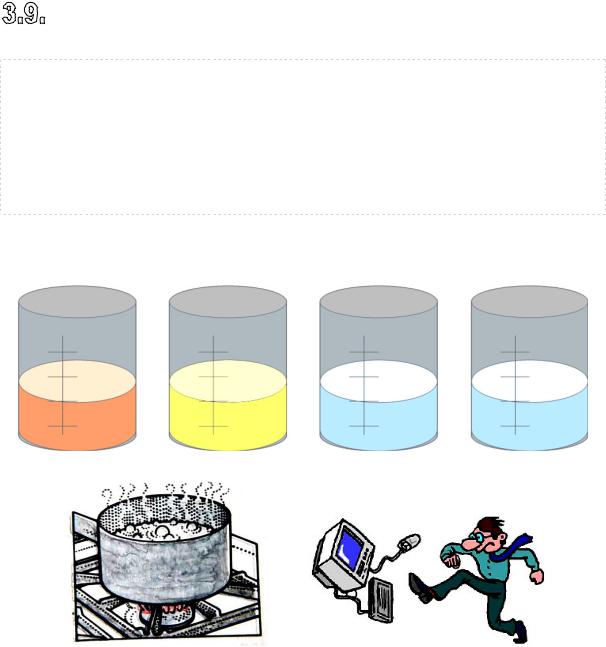
Observing. Say, what you SEE and what you DO NOT SEE in the pictures (pic. 6, a, b, c).
a
b |
c |
Pic. 6
Inferring. Say, what do you THINK is shown in the pictures above (pic. 6, a, b, c). How did you guess it? Make other suggestions.
39
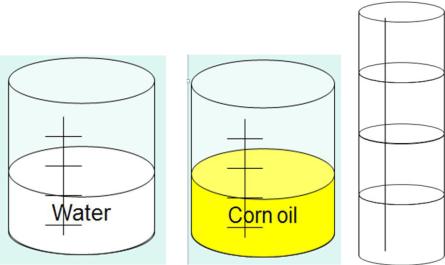
Predicting. What do you think WILL HAPPEN: a) if we pour each liquid in a graduated cylinder (pic. 7); b) in one second/in one hour (pic. 6, b, c)?
Pic. 7


 Identify each of the following statements as observation, inference or prediction.
•The three liquids that were in the beaker floated on top of each other.
•I think that the white liquid in the jar is soap.
•The milk floats on the Kool-Aid.
•The green liquid will most likely float on the white liquid.
•The colorless liquid in the beaker might be water.
•If milk is added to the beaker it will float on the syrup.


 Practise observing, inferring and predicting based on: a) what you can hear, b) what you can smell, c) what you can sense with your eyes closed at the moment. Tell your group about it.


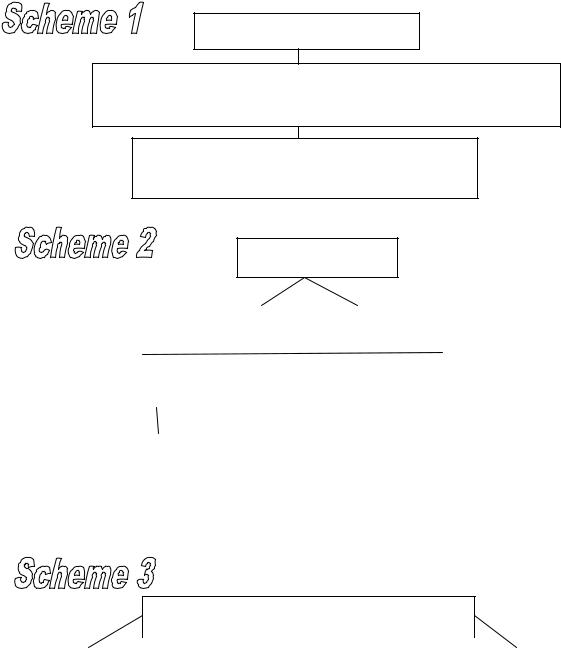
 First, study schemes 1 3 and write out things that scientists do
while conducting their research. Then describe the work of sci-
Оntists Лв tОllinР аСКt вou’vО lОКrnt Пrom tСО sМСОmОs.
40
Background/Observation
How has the work been done previously?
What similar work has been leading up to this point?
Study state-of-the-art (literature review, projects, informal discussions, etc.)
Publish findings
Write scientific papers |
|
Make presentations |
||
|
|
|
|
|
|
|
|
|
|
|
|
|
|
|
|
|
|
|
|
|
|
|
Intermediate results |
|
|
Consolidated results |
|||||||
|
|
|
|
|
|
|
|
|
|
|
|
|
|
|
|
|
|
|
|
|
|
|
|
|
|
|
|
|
|
|
|
|
Journals |
|
|
|
|
Conferences |
|
|
|
|
|
||||
|
|
|
|
|
|
|
|
|
|||
|
|
|
|
|
|
|
|
|
|
|
|
|
|
|
|
|
|
|
|
|
|
|
|
|
|
|
|
|
|
|
|
|
|||
|
Collect feedback |
|
|
|
|
|
|
||||
|
|
|
|
|
|
|
|
|
|
|
|
Understand and share what you learn
|
|
|
|
|
|
|
|
|
|
|
|
|
|
|
Classifying |
|
Making/building models |
|
|
Communicating |
|||||||
|
|
|
|
|
|
|
|
|
|
|
|
|
|
|
|
|
|
|
|
|
|
|
|
|
|
|
|
|
Size, shape |
|
|
Picture |
|
|
|
Writing |
|
||||
|
|
|
|
|
|
|
|
|
|
|
|
|
|
|
|
|
|
|
|
|
|
|
|
|
|
|
|
|
|
|
|
|
|
Diagram |
|
|
|
|
|
|
|
|
Use |
|
|
|
|
|
Speaking |
|
|||||
|
|
|
|
|
|
|
|
|
|||||
|
|
|
|
|
|
|
|
|
|
|
|
|
|
|
|
|
|
|
|
|
|
|
|
|
|
|
|
|
Composition |
|
|
Computer image |
|
|
|
|
|
|
|||
|
|
|
|
|
|
Reading |
|
||||||
|
|
|
|
|
|
|
|
|
|
|
|
||
|
|
|
|
|
|
|
|
|
|
|
|
|
|
|
|
… |
|
|
… |
|
|
|
|
|
|
||
|
|
|
|
|
|
Listening |
|
||||||
|
|
|
|
41 |
|
|
|
|
|
|
|
||
|
|
|
|
|
|
|
|
|
|
|
|||



 Practise your classification skills (tasks A, B). First, read the definition below.
Classification – the process of putting things into particular groups according to the features that they have. When you classify, you show relations between a general class (of a thing or idea) and its members or types.
A. Create classification hierarchies on reading text B.
CONCEPT
Science begins by developing concepts to describe the empirical world. A concept is an abstraction representing an object, a property of an object, or a certain phenomenon. Concepts do not actually exist as empirical phenomena: a concept is rather a symbol of the phenomenon. As a symbol of a phenomenon the concept functions as a means of communication.
Concepts also introduce a perspective: a way of looking at empirical phenomena. Through scientific concepts the perceptual world is given an order and coherence that could not be perceived before conceptualization.
Another function of concepts is as a means of classification and generalization. Scientists categorize, structure, order, and generalize their experiences and observations in terms of concepts. Concepts serve as components of theories and thus of explanations, predictions, and understanding.
There are different types of concepts: concepts of class, relation, and variable. If phenomena that resemble each other in some respect are assembled in one group, we have created a concept of class. For instance all people with blue eyes fall under the concept of blue-eyed people.
Objects, individuals, or concepts of class may have a specific relation
to each other. For instance, Stockholm and Dar–es–Salaam are geographically related tШ ОКМС ШtСОr. StШМФСШХЦ Тs ЧШrtС ШП DКr. “NШrtС ШП” Тs К МШn-
cept of relation.
B. Here is an example of Internet hyperlink navigation systems. The web page presents information on soils. General blocks are omitted. You should generalize by filling in the gaps (a, b).
42