Материал: 5119
40
Management Today magazine, which conducted the research, said that after years of having to adopt a masculine identity and hide their emotions and natural behaviour in the workplace, women become role models for managers.
The findings tally with a survey of female bosses carried out in the US. A five-year study of 2,500 managers from 450 firms found that many male bosses were rated by their staff of both sexes to be self-obsessed and autocratic. Women on the other hand leave men in the starting blocks when it comes to teamwork and communicating with staff.
Female managers use time more effectively, with many of those surveyed commenting that juggling commitments is a familiar practice for women with a home and a family.
Female managers also appear to make good financial sense for penny-pinching companies: most people, of either sex, would rather ask for a rise from a man.
“If men want to be successful at work they must behave more like women” said the magazine’s editor, Rufus Olins. “Businesses need to wake up to the fact that socalled feminine skills are vital for attracting and keeping the right people. In the past women who aspired to management were encourage to be more manly. It looks now as if the boot is on the other foot.”
From The Guardian
B. Which ideas expressed in the article do you agree with? Do you find any of the ideas surprising? Have your opinion on male and female boss changed?
Ex. 15. Write an essay “An ideal manager”. You have to express your idea about skills and qualities, management styles and personal characteristics a manager should possess to become successful.
Ex.16. Role play. Organize a conference “International problems of management”. Divide your group into two subgroups A and B.
Group A consists of management experts from well-known successful companies such as “Nokia”, “Toyota” and others. You have to use all your knowledge on management to explain how you have achieved success.
Group B presents management learners, who want to find out the key to success. You have to ask as many questions and commentaries to the information as you can.
Vocabulary |
|
approach |
подход |
to appreciate |
высоко ценить |
to assert |
утверждать |
to encourage |
поощрять |
to accomplish |
достигать, завершать |
to achieve |
добиваться, достигать |
to possess |
обладать |
|
41 |
self-awareness |
самосознание |
self-regulation |
самоограничение |
flexibility |
гибкость, уступчивость |
hierarchy |
иерархия |
subordinates |
подчинённые |
authority |
власть |
to delegate |
передавать обязанности |
to praise |
хвалить |
to interfere |
вмешиваться |
autocratic |
властный, деспотичный |
laissez-faire |
невмешательство |
empowering |
дающий возможность действий |
hands on |
активно участвующий |
to imply |
подразумевать, предполагать |
to be aware of the pressures |
осознавать сложности |
emphatic |
выразительный, настойчивый |
juggling commitments |
совмещать разную работу |
male |
мужской пол |
female |
женский пол |
feminine |
женский пол |
masculine |
мужской пол |
inspiring |
вдохновляющий |
to be self-obsessed |
поглощённый своими идеями |
42
UNIT V. COMPANY STRUCTURE.
Topics for discussion:
1.Company structure.
2.Company profile.
3.Way to success.
Ex. 1. Read the information and explain the meaning of the words in bold.
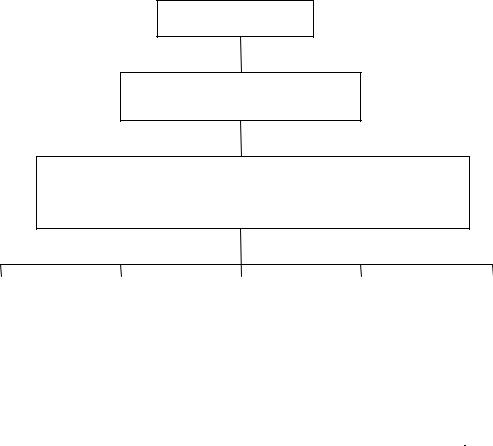
Moat companies are made up of three groups of people: the shareholders (who provide the capital), the management and the workforce. The management structure of a typical company is shown in this organization chart.
Board of Directors
Managing Director
Senior management
Middle management
At the top of the company hierarchy is the Board of Directors, headed by the Chairperson or President. The Board is responsible for policy decisions and strategy. It will usually appoint a Managing Director or Chief Executive Officer (CEO), who has overall responsibility for the running of the business. Senior managers or company officers head the various departments or functions within the company, which may include the following: Marketing, Finance, Production and others.
43
Ex. 2. Study the information about one of the most successful company “Philips”.
It is a major multinational company, which has almost 30,000 trademarks registered worldwide.
A. Look at the organization chart below and describe the structure of this company.
PHILIPS
Let’s make things better.
PRESIDENT
BOARD OF MANAGEMENT
(In charge of management)
SUPERVISORY BOARD GROUP MANAGEMENT COMMITTEE
(Responsible for the general course of business. Makes sure policy is implemented and advises the board of
management)
Finance dep.: |
|
Information |
|
Human |
|
Legal Affairs |
|
Communication |
Accounting |
|
Technology |
|
Resource |
|
department |
|
and Public |
& Control |
|
department |
|
Management |
|
|
|
Relations |
|
|
|
|
|
|
|
|
|
B. Match these products to the sectors below which they come from.
|
|
Faxes mobile computing products |
X-ray equipment |
|
|||||||||||
|
|
|
|
|
|
hairdryers |
lamp |
|
|
|
|
|
|
|
|
Sectors |
|
|
|
|
|
|
|
|
|
|
|
|
|||
|
|
|
|
|
|
|
|
|
|
|
|
|
|
||
|
Philips Business |
|
Philips |
|
Philips |
|
|
|
|
|
Philips Domestic |
||||
|
Electronics |
|
Components |
|
Consumer |
|
|
Appliances and |
|||||||
|
Products include: |
|
Products include: |
|
electronics |
|
|
Personal Care |
|||||||
|
digital video- |
|
display |
|
Products include: |
|
|
Products include: |
|||||||
|
communication |
|
|
components |
|
video: TV,VCR |
|
vacuum cleaner, |
|||||||
|
systems |
|
general systems |
|
digital video |
|
|
food processors, |
|||||||
|
1____________ |
|
|
components |
|
DVD, internet, |
|
|
blenders, coffee |
||||||
|
speech |
|
|
|
|
|
digital TV |
|
|
makers |
|||||
|
processing |
|
|
|
|
|
mobile phones |
|
|
shavers, 3_____ |
|||||
|
|
|
|
|
|
|
|
2___________ |
|
|
|
|
|||
|
|
|
|
|
|
|
|
|
|||||||
|
Philips Lighting |
|
|
Philips Medical Systems |
|
|
|
Philips Semiconductors |
|||||||
|
Products include: |
|
|
Products include: |
|
|
|
|
Products include: |
||||||
|
4____________ |
|
|
5________________ |
|
|
|
telecom terminals |
|||||||
|
lighting electronics |
|
|
ultrasound |
|
|
|
|
emerging business |
||||||
|
and gear |
|
|
|
|
|
|
|
|
|
e.g. Trimedia |
||||
|
|
|
|
|
|
|
|
|
|
|
|
|
|
|
|
44
C. Looking at the chart and sectors of production, describe the company in details. Follow the plan:
1.Company name.
2.Company creed.
3.Company structure: who is in charge of…? who reports to…?
4.Production sectors and products.
Ex. 3. A. Before reading the text about Philips below, decide whether you think these statements are true (T) or false (F).
1. |
It is the world’s second biggest electronic company. |
( |
) |
2. |
It has produced over 100 million TV sets. |
( |
) |
3. |
Its headquarters are in Amsterdam. |
( |
) |
4. |
It was the first company to produce compact discs. |
( |
) |
5. |
It is active in a small number of specialized businesses. |
( |
) |
6. |
It provides the lights for famous landmarks such as London’s Tower Bridge. |
( |
) |
B. Read the text and check your answers.
The Philips Story
The foundations of the world’s biggest electronics company were laid in 1891 when Gerard Philips established a company in Eindhoven, the Netherlands, to manufacture light bulbs and other electrical products. In the beginning it concentrated on making carbon-filament lamps and by the turn of the century was one of the largest producers in Europe. Development in new lighting technologies fueled a steady programme of expansion and, in 1914, it established a research laboratory to stimulate product innovation.
In the 1920s, Philips decided to protect its innovations in X-ray radiation and radio reception with patents. This marked the beginning of the diversification of its product range. Since then, Philips has continued to develop new and exiting product ideas like the compact disc, which is launched in 1983. Other interesting landmarks include the production of Philips’ 100-millionth TV set in 1984 and 250-millionth Philishave electric shaver in 1989.
The Philips Company
Philips’ headquarters are still in Eindhoven. It employs 256,400 people all over the world, and has sales and services outlets in 150 countries. Research laboratories are located in six countries, staffed by some 3,000 scientists. It also has an impressive global network of some 400 designers spread over twenty-five locations. Its shares are listed on sixteen stock exchanges in nine countries and it is active in about 100 businesses, including lighting, monitors, shavers and colour picture tubes; each day its factories turn out a total of 50 million integrated circuits.
The Philips’ people
Royal Philips Electronics is managed by the Board of Management, which looks after the general direction and long-term strategy of the Philips group as a whole. The