Материал: 62. Bara, B.G. Cognitive pragmatics the mental processes of communication 2011
AUTHOR’S COPY | AUTORENEXEMPLAR
448 Bruno G. Bara
(3)Since inA’s opinion, she and B share the belief that p, this implies that: Abelieves that p.
Abelieves that B believes that p.
Abelieves that B believes thatAbelieves that p.
. . . and so on, potentially ad infinitum.
One important difference between mutual belief and shared belief (1) is that the former is objectively common to both interlocutors.This means that bothA and B really do believe that p, and both should therefore possess the same mental state corresponding to the belief that p.
Shared belief, on the contrary, assumes a subjective viewpoint, since no agent can ever be sure that all the other participants possess the same beliefs she holds. Hence, shared belief always expresses the standpoint of one of the interlocutors.AmaytakeacertainfactassharedbybothBandherself,butthis assumption is subjective, one that does not necessarily correspond to the real mentalstatespossessedbyB.Noonecanopenanotherperson’sbrainandlook inside in order to check out what beliefs the other person actually does hold. And as we shall see in section 5.2, subjective assumptions regarding sharedness play an important part in nonstandard communication, especially in cases of irony and deceit.
2.2. Communicative intention
Let us now examine what happens when instead of speaking of action in general we focus our attention on communication acts. One fundamental difference between actions pure and simple and communication acts is that the latter are always carried out together with someone: Communication does not come about in isolation or in complete autonomy. Thus, though we may speak of a single agent when we refer to actions in general, when we enter the domain of communicative interaction we must always have at least one actor (A) and one partner (B) to whom the act is directed. Other agents (C, D, etc.) may participateasaudiencetothecommunicativeevent.Idefinecommunicativeintention as the intention to communicate something, plus the intention that that intention to communicate that particular something be recognized as such. To be more precise, A possesses a communicative intention that p, with regard to B — that is to say:Aintends to communicate that p to B — whenAintends the following two facts to be shared by bothAand B:
1. that p
2. thatAintends to communicate that p to B
However, making information achieve the status of sharedness does not mean one has communicated it. The necessary condition for real communica-
AUTHOR’S COPY | AUTORENEXEMPLAR
AUTHOR’S COPY | AUTORENEXEMPLAR
Cognitive pragmatics: The mental processes of communication 449
tion to take place is that such information be intentionally and explicitly proposed to the interlocutor. Grice (1975) points out that communicating includes not only the speaker’s first-order intention I1, that of achieving a certain effect ontheinterlocutor,butalsothesecond-orderintentionI2,namely,thatthefirst- order intention I1 be recognized as such by the interlocutor.
Forexample,bywearingmyKing’sCollegetie,ImakethefactthatIbelong to the teaching staff of that institution shared, but it cannot be asserted that I communicated this particular fact. The first-order intention I1, namely, that of letting others know where I teach, has been satisfied, but the second-order intentionI2,namely,thatotherpeoplerecognizethatIdesiretocommunicatethis fact, has not been satisfied. It would have been satisfied had I openly declared:
(4) I teach at King’s College, Cambridge.
In this case, listeners would gain awareness not only of the specific fact, but also of my open desire that they become aware of that fact.
Formally, communicative intention may thus be defined as follows:
(5) CINTAB p ≡ INTA SHBA ( p CINTAB p)
What formula (5) means is that A has the communicative intention that p toward B (in symbols, CINTAB p) when A intends (INTA) that the following two facts be shared by B and herself (SHBA): that p, and that she intended to communicate to B that p (CINTAB p).
All of this may be translated into more acceptable English as follows.Aintends to communicate a certain thing to B. A concurrently desires that B take as shared between the two not only the specific content she wishes to convey, but also the fact that she actually did wish to convey that content to him.
Similartosharedbelief,communicativeintentionisalsoaprimitiveinpragmatics.This means that it implies, but is not reducible to, an infinite number of finite embeddings of intentions and shared beliefs. The following logical implications may be derived from formula (5):
(6)CINTAB p INTA SHBA p
CINTAB p INTA SHBA INTA SHBA p
CINTAB p INTA SHBA INTA SHBA INTA SHBA p CINTAB p . . .
Formula (6) means that given the fact thatAintends to communicate a certain thing to B, we may infer that A also intends that her original intention to communicate that particular thing be recognized. If need be, this includes the further inference thatAwishes B to recognize her intention of letting B know thatshereallydidintendhimtobecomeawareofherintentiontocommunicate to him that particular message. And so on, until the cognitive resources possessed by both manage to make sense of the sequence of embeddings.
AUTHOR’S COPY | AUTORENEXEMPLAR
AUTHOR’S COPY | AUTORENEXEMPLAR
450 Bruno G. Bara
2.3. Brain imaging evidence for communicative intention
The brain-imaging studies I shall summarize offer converging evidence in favor of two basic tenets of cognitive pragmatics theory: that communicative intention has a special status in our brain/mind, and that communicative competence is modality-independent. In empirical science final validations do not exist (Popper 1934), but convincing experiments help.
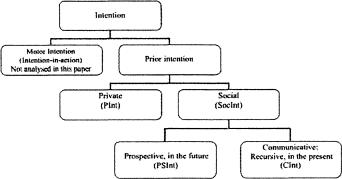
2.3.1. A dynamic intentionality network. In order to understand what a communicative intention is, we have to classify the different types of intentions. The first distinction we need is provided by Searle (1983), and is that between prior intention and intention-in-action. Searle regards the intention- in-action (or motor intention) as the direct cause of an agent’s movement: the mental and causal component of the bodily movement of an action. To cover the overall conditions of an action, one has to analyze also the prior intention, which orients the action as a whole. Prior intention is formed in advance, to represent goal states that may be quite distant from the chain of actions that lead to their fulfillment: prior intention represents the goal of the action before it is undertaken.
Figure 1 shows the three kind of prior intentions we have tested through fMRI.
Private intentions (PInt) require only theActor to perform actions adequate to reach her goal (e.g.,Aintends to drink a glass of water). On the contrary, a social intention requires at least a Partner, who is necessary for the Actor to reach her goal (e.g.,Aintends to play tennis with B). In my approach, the prototypical case of a social intention shared in the present is Communicative intention (CInt).
Figure 1. Classification of the different types of prior intention.
AUTHOR’S COPY | AUTORENEXEMPLAR
AUTHOR’S COPY | AUTORENEXEMPLAR
Cognitive pragmatics: The mental processes of communication 451
However, there are special intentions whose social goal lies in the future. For instance, Alice may intend to visit her father next Sunday. This kind of social intention involves the representation of a social goal when A and B are not actually interacting but B is part of A’s goal. We define this kind of intention Prospective social intention (PSInt). In the case of PSInt, the desired social interaction is not present at the moment, but if the PSInt will become shared in the future, then it will cause the social interaction to occur.
According to Bratman’s (1987) account, the main characteristic of futuredirected intention (as he prefers to call prior intention) is that the Actor does not only want to accomplish that intention, but she is also committed to do it. IfAliceformsthepriorintentiontovisitherfathernextSunday,sheiscommitting herself now to visit him on Sunday. Pacherie and Haggard (2010) call all kinds of prior intentions prospective intentions, because they have to be realized in a future moment. For the sake of simplicity, in this paper I reserve the term “prospective intention” only to social ones (PSInt), even though in principle also private intentions may be future-directed, e.g.,Alice may now form the prospective private intention to give up smoking on her next birthday.
In performing our fMRI experiments our main predictions were threefold:
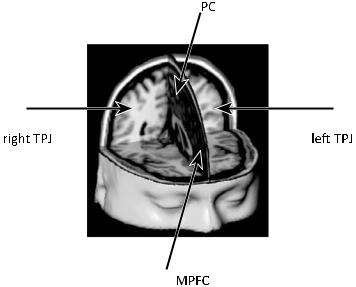
(1) the Medial PreFrontal Cortex (MPFC) areas involved in intention recognitionareactivatedonlyinresponsetosocialstimulirequiringcomprehensionof social interaction, both present and future; (2) the posterior areas underlying intention recognition (right Temporo-Parietal Junctions (TPJ) and precuneus) might suffice for representing the mental states of agents, as long as those agents are acting outside social interaction; (3) the existence of a dynamic brainnetworkencompassingtheregionsusuallyinvolvedinmindreading,i.e., the right and left TPJ, the precuneus and the MPFC, each of which with a specific function depending on what type of prior intention is represented starting from an observed action.
A first series of experiments (Walter et al. 2004) allowed us to propose a dynamicintentionalitynetwork;adeeperlevelofanalysisbasedonsignaltime courses for the four regions of interest extended and confirmed our earlier results (Ciaramidaro et al. 2007). In sum, our results show that whereas the right TPJ and the precuneus are necessary for processing all types of prior intentions,the leftTPJandthe MPFCarespecificallyinvolved intheunderstanding of social prior intention. More specifically, the left TPJ is activated only when social prior intentions occur in the present: this is the case of communicative intention (Bara et al. 2011).
Asubsequentstephasbeenthetestingoftheintentionalnetworknotonlyon healthyindividuals,butalsoonpeoplewithschizophreniaandwithautism.We hypothesized that paranoid schizophrenics could show hyper-intentionality, i.e., the tendency to over-attribute intention not only to persons but also to objects. The thesis has been confirmed in a group of 12 patients with paranoid
AUTHOR’S COPY | AUTORENEXEMPLAR
AUTHOR’S COPY | AUTORENEXEMPLAR
452 Bruno G. Bara
Figure 2. The intentionality network including the right and the left temporo-parietal junctions ( TPJ), the precuneus (PC), and the anterior paracingulate cortex (aPCC), located in the medial prefrontal cortex (MPFC).
schizophrenia: their intention detector became hyperactive in the paranoid interpretation of the physical world (Walter et al. 2009).
Adopting a line of reasoning similar to Crespi and Badcock (2008), we claim that the impairment in understanding others’ intentions exhibited by paranoidpatientsandautisticpatientscanbeconsideredasthetwoextremesof a continuum. People with autism are hypo-intentional, as they tend not to attribute the features of sociality to actors neither interacting between them (CInt), nor preparing a social interaction (PSInt). The autistic comprehension of the social interaction is quite similar to their interpretation of the physical world (Bara et al. 2011).
2.4.Brain imaging explorations of linguistic and extralinguistic modalities of communication
As explained in section 1.1, I assume that a common communicative competence — independentofthelinguisticorextralinguisticgesturalmeans — is instantiated at the level in which a communicative intention is inferred and comprehended within a specific social context, that is, at the pragmatic level. Consequently, I hypothesize that there is no difference in brain activity be-
AUTHOR’S COPY | AUTORENEXEMPLAR