Материал: 62. Bara, B.G. Cognitive pragmatics the mental processes of communication 2011
AUTHOR’S COPY | AUTORENEXEMPLAR
Cognitive pragmatics: The mental processes of communication 473
to predict errors that occur during a process is to be praised over theories that can predict only correct responses.
Noneoftheexistingpragmatictheoriesoffersaglobalaccountofsuccessful and failed communication.Anoteworthy exception is relevance theory, which establishes a continuum between the idealizations of success and failure; Sperber andWilson (1995 [1986]) measure the efficacy of communication in terms of attempted relevance, as compared with achieved relevance. The introduction of strong and weak implicatures emphasizes the idea that each communicative instance conveys core meaning and perpetual implications. The notion of failure is spread over a wide set of implicatures, both those attempted and thosethatcanbepossiblyachieved.Still,relevancetheoryhasnevergenerated systematic hypotheses for explaining communicative failures.
Bosco, Bucciarelli, and Bara (2006) proposed a taxonomy of different sorts of failure, which is grounded on the mental representations and cognitive processes involved: failure of the expression act, failure of the speaker meaning, and failure of the communicative effect. When failure of the expression act occurs, the partner fails to comprehend the literal value of the utterance; when failure of the speaker’s meaning occurs, the partners fails to comprehend the speaker’s communicative intention; and finally, when failure of the communicative effect occurs, the partner does not modify his mental states in the way the speaker desires, that is, he refuses to adhere to the speaker’s goal. Depending on the sort of failure occurred, the speaker might enact a different kind of repair. The taxonomy allows us to generate hypotheses about the relative difficulty in recognizing and repairing different kinds of failure.
Our account follows a developmental perspective. This means studying mental processes not only as fixed states — an approach that takes into consideration exclusively the final stage — but rather concentrating on how a given function develops in the infant to the child and the adult. In particular, we studied children aged 3 to 8 years.
Globally considered, the results of the experiment support our taxonomy and its underlying assumptions.Afirst result concerns the distinction between the recognition of successful communication acts and the recognition (and subsequent repair) of the respective failures. It is simpler to recognize the successofacommunicationactthantherespectivefailure.Thus,childrenperform better at recognizing that the speaker has succeeded in modifying the partner’s mentalstateinthedesiredway,thanatrecognizingwhenthespeakerhasfailed in her attempt. The hypothesis holds for all kinds of failure and supports the assumption that inconsistencies between A’s private goal and its felicitous realization are hard to detect.
Asfarasrecognitionoffailuresisconcerned,noncomprehensioniseasierto recognize than misunderstanding, and failure of the expression act is easier to recognize than failure of the speaker meaning. Failure of the communicative
AUTHOR’S COPY | AUTORENEXEMPLAR
AUTHOR’S COPY | AUTORENEXEMPLAR
474 Bruno G. Bara
effect is quite easy to recognize, and as predicted it posits at the same level of difficulty as failure of the expression act.Also, as we obviously could expect, it is simpler to recognize the failure of a communication act than to recover such a failure. One does not repair something if she does not think it failed.
6. Communicative competence
Bypassingthecontroversialissueoftheevolutionofcommunicationinthelast 4 million years (from Australopithecus on), I will focus to its development from childhood in anatomically modern Homo sapiens (last 200,000 years). The phase we are living in now began only 35,000 years ago, when the union of the potential for language and for external cognition gave rise to permanent linguistic structures, generating writing, which is in its turn allowed history.
6.1. Linguistic and extralinguistic writing
Humanity’s most brilliant invention consists in using our capacity to draw symbols to ensure the preservation of knowledge at the group level, that is, beyondthelifeofthesingleindividual.Theinventionofwritingenablesexternal cognition to become permanent, thus making transgenerational evolution possible. Stated differently, the conditions necessary for the existence of culture, intended as the possibility to transmit knowledge acquired individually to other members of the group, are external cognition and its consolidation, that is, its relative permanence.
A full reconstruction of the evolution of writing is in Bara 2003, which I here summarize. The first step toward writing is the moment when the first human artists begin to paint and sculpt cave walls. In a continuous evolution lastingatleast40,000years,aesthetic,magic,andsacredfunctionsarecomplemented by those conveying cognitive content. We may state that the earliest traces of graphological symbols go back 35,000 years, and consist of small, equidistantengravingswhosesignificanceisstillincomprehensible,butwhose function may be stated as being that of acting as an external support for an individual’s memory, or perhaps for that of a group.
Returningtothedistinctionbetweenlinguisticandextralinguisticcommunication, and given the fact that the feature of permanence may be attributed to both modes, we should be able to recognize an extralinguistic mode of writing as well as the linguistic mode that we are used to.Alexander Marshack (1991) has documented what is still today the first instantiation of protowriting. This goes back to the Paleolithic age, around 10,000 B.C.E. A bone fragment was discovered in Tai, France, bearing mathematical notation as well as writing.
AUTHOR’S COPY | AUTORENEXEMPLAR
AUTHOR’S COPY | AUTORENEXEMPLAR
Cognitive pragmatics: The mental processes of communication 475
Presumably this was allotted to marking the passage of time — a sort of elementary calendar.
We may distinguish between the various forms of writing by using the number of signs employed as our classificatory criterion: thus pictograms employ over a 1,000 signs, logograms employ between 1,000 and 40 signs, and an alphabet uses fewer than 40 signs.
The most ancient example of pictogram is the calcareous slab found in the Sumerian city of Kish in Mesopotamia. The drawing of a foot, a hand, and a sleigh, beside which are symbols that are presumably numbers, appears for the first time around 3,500 B.C.E. The clay tablets found inside the temple in the city of Uruk in Mesopotamia exhibit 1,500 different symbols. Each of these pictograms refers to an object: The head of a bull represents a bull, the outline of a mountain a mountain.
The efficacy of the pictogram simultaneously constitutes its limit: Everyone can immediately grasp the meaning of the signs drawn on the tablet, seen as a sequence of images. It constitutes a kind of representation by association: Its true meaning can only be comprehended by those who are already familiar with facts represented before their eyes. Pictography leaves aside the times, modes, and logical links that connect subjects and events. This is why I classify pictography as a permanent version of extralinguistic communication: a set of symbols having associative, noncompositional structure. I will now examine the transition stage to the permanent representation of linguistic communication.
Toincreasetheeffectivenessofpictographicwriting,signsmustbestylized, which reduces the number of signs that may be used. This is what happens to logograms. The Egyptians, who needed an efficient system of writing in order to rule their large empire, solved the problem around 3,000 B.C.E. What the eye is about to perceive becomes schematized.Thus a pubic triangle is used to represent a woman, an eye to represent seeing, and so forth. But the crucial step consists in introducing a rudimentary form of syntax, which allows the communicators to move from the property of association, which characterizes extralinguistic communication, to that of compositionality, the feature that defines linguistic communication.
Two of the most important indicators of the inception of the principle of compositionality are the plural form and the combination of logograms. Two signs of the same type indicate the plural: the sign for a bird indicates a bird, two signs of a bird indicate birds in the plural. It is also possible to create new ideograms by combining two or more different signs: For in stance, mouth + bread = eat; woman + mountain = serve; woman + dress = mistress of the house. It should be noted that ideograms are a direct reflec tion of the meaning of the sign — there is no link with the way the word is pronounced.
AUTHOR’S COPY | AUTORENEXEMPLAR
AUTHOR’S COPY | AUTORENEXEMPLAR
476 Bruno G. Bara
The final crucial step toward writing as we know it today is the substitution of ideograms by phonograms, which comes about in Mesopotamia around 2,500 B.C.E. This reduces the signs employed to fewer than 100. The main mechanism that realizes this operation is a crossword-puzzle-type principle, a principle related to the idea of rebus. For instance, in order to represent the concept of a date, the writer does not use a symbolic representation of the calendar (a sun followed by a moon). Instead he draws a date (the fruit). What creates the form–meaning link is not the sign in itself, but the uttering of the sign. We have thus reached the stage of syllabic writing, such as the systems in Mesopotamia and Egypt, which are no longer simply looked at as were pictograms, and are not yet read as are alphabet systems: These are deciphered.
The final step consists in the invention of the alphabet by the Phoenicians, around 1,700 B.C.E. This time the pressure for change came from trade, not from conquest, as was the case with the Egyptians. The Phoenician alphabet had 22 signs; it used only consonants, leaving the reader with the task of addingthevowels.VowelswereintroducedintothealphabetbytheGreeksaround 1,000 B.C.E., thereby achieving total correspondence between spoken and written linguistic communication.
6.2. Developmental pragmatics
The human adaptation for symbolic communication emerges in human ontogeny quite steadily at around 1 year of age (Tomasello 1995; Liebal et al. 2009) in the context of a whole range of new social-cognitive skills, which may be referred to as skills of intention-reading (i.e., establishment of joint attentional frames, understanding communicative intentions and so on). Language production emerges gradually in children in the months following the first birthday just because they need that these fundamental skills of intentionreadingare firmly in place (Tomasello 2003). Children’s symbolic produc tions are not confined only to language, but they include various kinds of gestures, from simple ritualizations to symbolic gestures, demonstrating that words and gestures are all a part of the same developmental communicative process.
The investigation of children’s communicative acquisition has been mostly conducted on the earlier stages of development. However, children are continuously dealing with various kinds of communication acts, from simple to complex, during all childhood years, learning how to communicate more effectively in extended conversational exchanges with other people. My colleagues and I investigate the children’s linguistic and extralinguistic progress within a coherent developmental perspective. Our work has two main ambitions:
AUTHOR’S COPY | AUTORENEXEMPLAR
AUTHOR’S COPY | AUTORENEXEMPLAR
Cognitive pragmatics: The mental processes of communication 477
1. To study in parallel the emergence of linguistic and extralinguistic communication, reunified under a single theoretical paradigm.
2. To offer a baseline against which to compare atypical performances in relation to linguistic and extralinguistic conditions.
Children with atypical development may show different deficits in the comprehension and production of communication acts, depending on the type of pathology, namely head injuries, hydrocephalus, focal brain damage, and autism (Bara, Bosco, and Bucciarelli 1999). But the key point is that it is hard to understand the nature of the deficits when one does not know how normal developmenttakesplace.Ourapproachaimstoclarifythefactorsinvolvedinthe comprehension and production of the different kinds of communication acts, following their emergence during typical development in order to deeper understand their deficits in case of pathological conditions.
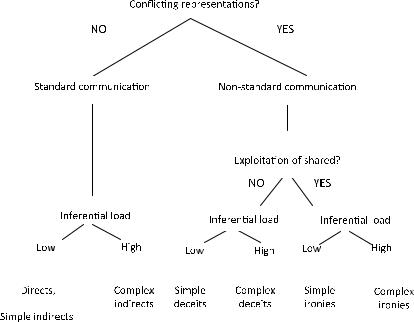
Three factors determine the complexity of the mental representation involved in the comprehension of a pragmatic phenomenon (see Figure 6). The factors involved may be referred as (1) conflicting representations, (2) ex ploitation of sharedness, and (3) inferential load (Bucciarelli, Colle, and Bara 2003).
Figure 6. Factors that determine the difficulty of comprehension of pragmatic phenomena.
AUTHOR’S COPY | AUTORENEXEMPLAR